10M16SAU169I7G Datasheet, Pinout & Specifications – Intel Altera MAX 10 FPGA Complete Guide
Overview of the 10M16SAU169I7G
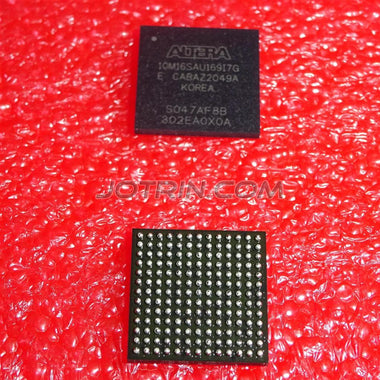
The 10M16SAU169I7G is an industrial-grade FPGA from the Intel (Altera) MAX 10 family, built on 55nm flash process technology. As a non-volatile, single-chip FPGA, it eliminates the need for an external configuration device, making it ideal for cost-sensitive and space-constrained designs. The MAX 10 family uniquely combines FPGA logic flexibility with instant-on capability, analog-to-digital converter (ADC) blocks, and dual configuration flash memory — all in a compact UBGA-169 package.
This device targets industrial automation, motor control, sensor aggregation, IoT edge computing, and communication infrastructure applications where reliable operation across the extended temperature range of -40°C to +100°C is required. The "I7G" suffix designates the industrial temperature grade with a speed grade of 7 (slowest, lowest power).
If you're looking for related Intel FPGA components, explore the wwdparts semiconductor catalog for a full range of programmable logic devices.
Key Specifications & Parameters
| Parameter | Value |
|---|---|
| Part Number | 10M16SAU169I7G |
| Family | Intel (Altera) MAX 10 |
| Logic Elements (LEs) | 16,000 |
| Logic Array Blocks (LABs) | 1,000 |
| Embedded Memory (RAM) | 562,176 bits |
| User I/O Pins | 130 |
| 18×18 Multipliers | 45 |
| PLLs | 4 |
| Internal Configuration Flash | Dual-boot capable (UFM + CFM) |
| ADC | 1× 12-bit SAR ADC (up to 1 MSPS) |
| Core Voltage | 1.2V |
| I/O Voltage | 3.0V / 3.3V (multi-voltage bank support) |
| Package | UBGA-169 (11mm × 11mm, 0.8mm pitch) |
| Temperature Range | -40°C to +100°C (Industrial) |
| Speed Grade | 7 (lowest power) |
| Process Technology | 55nm Flash |
| Configuration | Non-volatile, instant-on (no external config device needed) |
| I/O Standards | LVTTL, LVCMOS, SSTL, HSTL, LVDS, differential I/O |
For competitively priced Intel FPGA solutions, check availability and pricing of the 10M16SAU169I7G at wwdparts.com.
Block Diagram & Internal Architecture
The MAX 10 architecture integrates logic elements, embedded memory blocks, DSP blocks, PLLs, a 12-bit ADC, and dual configuration flash into a single monolithic device. Below is the functional block diagram illustrating the internal structure:

Key architectural highlights include the adaptive logic module (ALM)-based logic elements, M9K embedded memory blocks totaling 562 Kbits, and an integrated analog-to-digital converter that saves board space by eliminating external ADC ICs. The dual configuration flash enables remote field upgrades with a failsafe fallback image.
Pinout & Package Information
The 10M16SAU169I7G uses a 169-ball UBGA (Ultra-Fine-Pitch Ball Grid Array) package measuring 11mm × 11mm with 0.8mm ball pitch. This compact form factor provides 130 user I/O pins organized into multiple I/O banks supporting different voltage standards.

The UBGA-169 package features:
- 8 I/O banks with independent VCCIO supply for multi-voltage interfacing
- Dedicated configuration pins (JTAG: TCK, TDI, TDO, TMS)
- Analog input pins for the integrated 12-bit ADC
- Power pins: VCC (1.2V core), VCCIO (per-bank, 1.2V–3.3V), VCCA (analog PLL supply)
- Thermal pad on package underside for enhanced heat dissipation
Typical Applications & Circuit Design
The 10M16SAU169I7G is widely used across industrial and commercial applications. Common use cases include:
- Industrial automation: Motor drive control, PLC I/O expansion, safety logic
- Sensor hub / IoT edge: Aggregating multiple sensor inputs via the integrated ADC and processing data at the edge
- Communication interfaces: Protocol bridging (SPI, I2C, UART, PCIe), data format conversion
- Display & video: LED panel controllers, LVDS display interfaces
- Test & measurement: Custom data acquisition systems leveraging the 12-bit ADC
When designing with the 10M16SAU169I7G, ensure proper decoupling capacitors on all VCC and VCCIO banks, follow Intel's recommended power-up sequence (VCCINT → VCCIO → VCCA), and utilize the Quartus Prime Lite Edition (free) for development.
Video Tutorial: Getting Started with MAX 10 FPGA
Frequently Asked Questions
What is the difference between 10M16SAU169I7G and 10M16SAU169C8G?
The "I7G" variant is industrial-grade (-40°C to +100°C) with speed grade 7, while the "C8G" is commercial-grade (0°C to +85°C) with speed grade 8. The industrial version offers wider temperature tolerance for harsh environments but at a slightly lower maximum clock speed. Both share the same 16,000 LE architecture and UBGA-169 package.
Does the 10M16SAU169I7G require an external configuration device?
No. The MAX 10 family features integrated dual configuration flash memory (CFM), providing non-volatile, instant-on operation. The device boots from internal flash within milliseconds of power-up, eliminating the need for external EEPROM or flash configuration ICs. It also supports dual-boot images for safe remote field updates.
What development tools are needed to program the 10M16SAU169I7G?
Use Quartus Prime Lite Edition (free download from Intel/Altera) for synthesis, place-and-route, and programming. You'll need a USB Blaster or USB Blaster II JTAG programmer for device configuration. The MAX 10 is supported in both VHDL and Verilog HDL design flows, and Intel provides the Platform Designer (Qsys) tool for system integration.
How do I use the integrated ADC in the 10M16SAU169I7G?
The MAX 10 includes a 12-bit SAR ADC capable of up to 1 MSPS. Instantiate the ADC IP core through Quartus Prime's IP Catalog (search for "MAX 10 ADC"). The ADC supports up to 18 analog input channels (device/package dependent), single-ended inputs referenced to VREFP/VREFN, and can be controlled via a simple Avalon-MM register interface in your FPGA logic design.
What is the maximum operating frequency of the 10M16SAU169I7G?
With speed grade 7, the device achieves slightly lower maximum frequencies compared to faster speed grades (6 or 8). Typical internal register-to-register performance reaches up to approximately 250–300 MHz depending on design complexity and routing. The 4 integrated PLLs support output frequencies from 5 MHz to 472.5 MHz for flexible clock management.
Where can I buy the 10M16SAU169I7G at a competitive price?
The 10M16SAU169I7G is available through authorized distributors including Mouser, Digi-Key, Arrow, and Newark. For competitive pricing and stock availability, visit wwdparts.com, which aggregates pricing across multiple suppliers and offers bulk quantity discounts for production orders.