10M16SAU169I7G Datasheet: Intel Altera MAX 10 FPGA – Specifications, Pinout & Application Guide
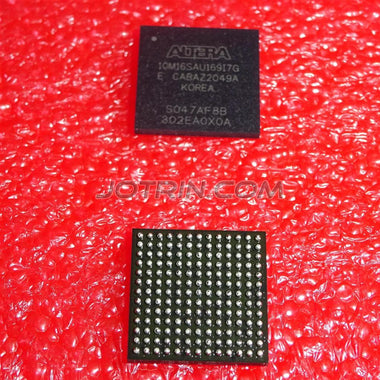
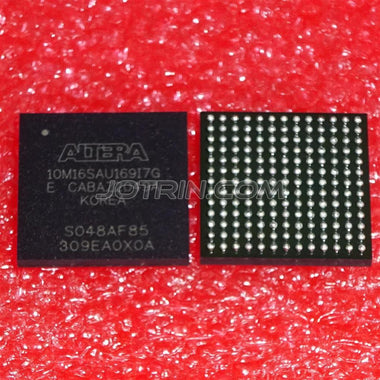
The 10M16SAU169I7G is a non-volatile FPGA from Intel (formerly Altera) belonging to the MAX 10 family. Built on a 55nm flash process, this device integrates 16,000 logic elements, embedded analog-to-digital converters, and user flash memory into a compact 169-ball UBGA package. It is designed for industrial-grade applications requiring instant-on capability, single-chip solutions, and reliable operation across a wide temperature range of -40°C to 100°C.
Table of Contents
- 1. 10M16SAU169I7G Overview
- 2. Key Specifications & Parameters
- 3. Block Diagram & Architecture
- 4. Pinout & Package Information
- 5. Application Circuit & Design Guide
- 6. Frequently Asked Questions
1. 10M16SAU169I7G Overview
The 10M16SAU169I7G is part of Intel's MAX 10 FPGA product line, which is the industry's first single-chip, non-volatile FPGA family. Unlike SRAM-based FPGAs that require an external configuration device, the MAX 10 stores its configuration in on-chip flash memory, enabling instant-on functionality with power-up times as fast as 10 milliseconds. This makes it ideal for applications in industrial automation, motor control, communications, and IoT edge computing.
The "I7G" suffix denotes the industrial temperature range (-40°C to 100°C) with speed grade 7 and lead-free (Green/RoHS) packaging. The device is supported by the Quartus Prime Lite Edition (free), making it accessible for prototyping and production alike.
If you're sourcing similar components, explore our guides on HMA42GR7AFR4N-TF DDR4 Memory and H5TC4G63EFR-RDA DRAM Specifications.
2. Key Specifications & Parameters
| Parameter | Value |
|---|---|
| Part Number | 10M16SAU169I7G |
| Manufacturer | Intel (Altera) |
| Family | MAX 10 (Non-Volatile FPGA) |
| Logic Elements (LEs) | 16,000 |
| Logic Array Blocks (LABs) | 1,000 |
| Embedded Memory (M9K Blocks) | 549 Kbit |
| User Flash Memory (UFM) | Up to 736 KB (dual-image config) |
| Embedded 18×18 Multipliers | 45 |
| PLLs | 4 |
| Global Clock Networks | 20 |
| Max User I/O Pins | 130 (U169 package) |
| Max LVDS Pairs | 22 |
| ADC (Analog-to-Digital Converter) | 1 ADC block (up to 2 ADC in some variants) |
| ADC Resolution | 12-bit, 1 MSPS |
| Package | 169-ball UBGA (11mm × 11mm) |
| Process Technology | 55nm Flash |
| Core Voltage | 1.2V |
| I/O Voltage | 3.0V / 3.3V (supports 1.2V–3.3V) |
| Speed Grade | 7 (Industrial) |
| Operating Temperature | -40°C to +100°C (TJ) |
| I/O Standards | LVTTL, LVCMOS, SSTL, HSTL, HSUL, PCI |
| External Memory Interface | DDR3, DDR2, LPDDR2, SRAM |
| Configuration | Internal (dual-boot, remote update) |
| Bitstream Security | AES-128 encryption |
| RoHS Compliant | Yes (Lead-Free) |
3. Block Diagram & Architecture
The MAX 10 FPGA architecture integrates multiple functional blocks on a single chip, including logic array blocks (LABs), M9K embedded memory, 18×18 embedded multipliers, PLLs, general-purpose I/Os, LVDS channels, a 12-bit ADC, user flash memory, and internal configuration storage. The diagram below illustrates the MAX 10 development system architecture:

Each LAB contains 16 logic elements (LEs), and each LE features a 4-input look-up table (LUT), a programmable register, and carry chain logic. The device supports dual-image configuration for seamless remote firmware updates with automatic fallback.
4. Pinout & Package Information
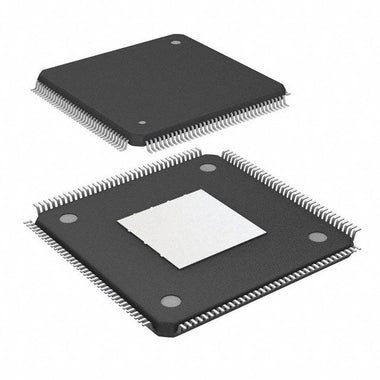
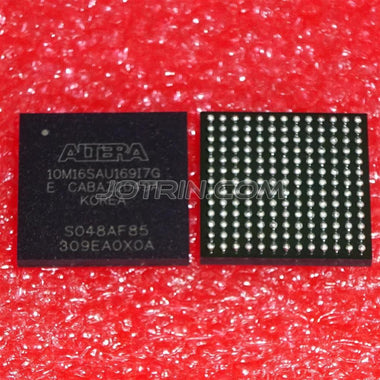
The 10M16SAU169I7G comes in a 169-ball UBGA (Ultra Ball Grid Array) package measuring approximately 11mm × 11mm with a 0.8mm ball pitch. The compact form factor makes it suitable for space-constrained designs in industrial and embedded systems.

Key pin categories include:
- User I/O Pins: 130 configurable I/Os across 8 I/O banks
- Power Pins: VCC (1.2V core), VCCIO (per-bank, 1.2V–3.3V), VCCA (analog PLL supply)
- Configuration Pins: JTAG (TCK, TDI, TDO, TMS), nCONFIG, nSTATUS, CONF_DONE
- ADC Pins: Dedicated analog input pins for the 12-bit ADC
- GND: Ground reference pins distributed across the package
For the complete pin-out table and assignment recommendations, refer to the official Intel pin-out files and the MAX 10 Device Pin Connection Guidelines.
5. Application Circuit & Design Guide
The MAX 10 FPGA is used across a wide range of applications including industrial motor control, sensor fusion, protocol bridging, display interfaces, and edge AI preprocessing. The image below shows the MAX 10 FPGA Development Kit, which can be used to prototype and validate designs using the 10M16SAU169I7G:

Design Recommendations:
- Use separate power planes for VCC (1.2V), VCCIO (per bank), and VCCA (PLL analog supply) with proper decoupling capacitors
- Place 100nF ceramic capacitors close to each power pin and bulk 10µF capacitors near the power supply entry point
- Follow Intel's PCB layout guidelines for high-speed LVDS pairs with 100Ω differential impedance
- Enable the dual-boot configuration for remote update capability with automatic fallback to factory image
- Use the on-chip 12-bit ADC for analog sensor inputs, eliminating the need for an external ADC IC
Video Tutorial: Getting Started with MAX 10 FPGA
6. Frequently Asked Questions
Q1: What is the difference between the 10M16SAU169I7G and 10M16SAU169C8G?
The "I7" variant is rated for the industrial temperature range (-40°C to 100°C) with speed grade 7, while the "C8" variant is for the commercial temperature range (0°C to 85°C) with speed grade 8. Choose the I7G version for harsh environments or extended operating conditions.
Q2: Does the 10M16SAU169I7G require an external configuration device?
No. The MAX 10 family features internal flash-based configuration storage. The device configures itself from on-chip flash memory at power-up, eliminating the need for an external EEPROM or flash configuration device. This also enables instant-on operation.
Q3: What development software is needed for the 10M16SAU169I7G?
The device is supported by Intel Quartus Prime Lite Edition, which is available as a free download. It includes the Quartus Prime design software, ModelSim simulation tool, and Nios II embedded processor support.
Q4: Can the 10M16SAU169I7G be used for analog signal processing?
Yes. The MAX 10 integrates a 12-bit SAR ADC running at up to 1 MSPS with up to 18 analog input channels (device variant dependent). This allows direct analog sensor interfacing without an external ADC IC, ideal for temperature monitoring, current sensing, and industrial measurement applications.
Q5: What is the maximum DDR3 memory speed supported?
The 10M16SAU169I7G supports DDR3 SDRAM with the hard memory controller at speeds up to 300 MHz (DDR3-600). It also supports DDR2, LPDDR2, and SRAM interfaces for flexible external memory configurations.
Q6: Is the 10M16SAU169I7G suitable for safety-critical or high-reliability applications?
The MAX 10 includes several reliability features: AES-128 bitstream encryption for IP security, dual-boot configuration with automatic fallback for remote update reliability, and SEU (Single Event Upset) detection and mitigation. The industrial-grade I7G variant with its wide temperature range makes it suitable for industrial automation, transportation, and defense applications where reliability is critical.