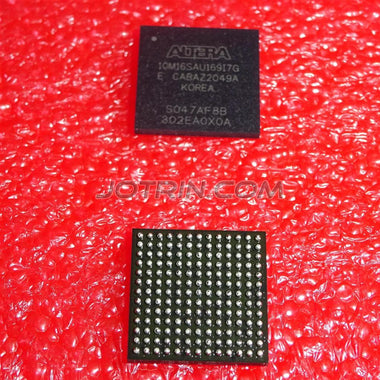
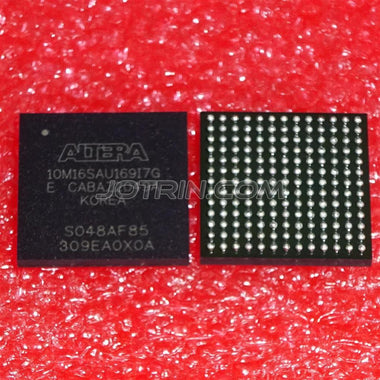
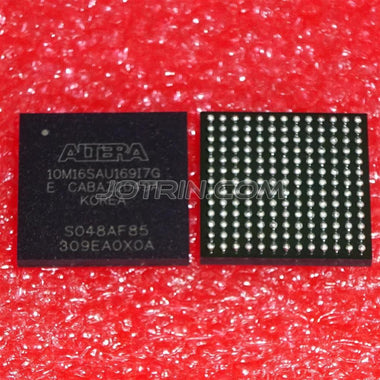
1. 10M16SAU169I7G Overview
The 10M16SAU169I7G is a non-volatile FPGA from the Intel (Altera) MAX 10 family, built on a mature 55nm process technology. Featuring 16,000 logic elements (LEs), integrated analog-to-digital converters (ADCs), and on-chip user flash memory, it delivers instant-on functionality without the need for an external configuration device. This makes it an excellent choice for industrial automation, motor control, I/O expansion, and embedded system management applications.
As part of the MAX 10 lineup, the 10M16SAU169I7G combines the flexibility of an FPGA with the simplicity and low cost traditionally associated with CPLDs. Its single-chip, single-power-supply design reduces board space and BOM cost, while the industrial-grade temperature rating (-40°C to +100°C) ensures reliable operation in harsh environments.
2. Key Specifications & Parameters
| Parameter | Value |
|---|---|
| Part Number | 10M16SAU169I7G |
| Manufacturer | Intel (Altera) |
| Family | MAX 10 (10M16) |
| Logic Elements (LEs) | 16,000 |
| Logic Array Blocks (LABs) | 1,000 |
| Embedded Memory (M9K) | 549 Kb |
| User Flash Memory (UFM) | 128 Kb |
| 18×18 Embedded Multipliers | 45 |
| PLLs | 4 |
| Max User I/O Pins | 130 |
| Max LVDS Pairs | 22 |
| ADC Blocks | 1 (dual ADC) |
| Package | UBGA-169 (11 mm × 11 mm) |
| Process Technology | 55 nm |
| Core Supply Voltage | 1.2 V |
| I/O Supply Voltage | 3.0 V / 3.3 V |
| Operating Temperature | -40°C to +100°C (Industrial) |
| Speed Grade | 7 |
| External Memory Interface | DDR3, DDR2, LPDDR2, SRAM |
| Internal Configuration | Yes (dual boot / on-chip flash) |
| Bitstream Security | AES-128 encryption |
| RoHS / Lead-Free | Yes (Green / Pb-free) |
3. Block Diagram & Architecture
The MAX 10 architecture integrates several hard IP blocks around a sea of programmable logic elements. The diagram below illustrates the schematic symbol and key functional blocks of the 10M16SAU169I7G, including I/O banks, PLLs, embedded memory, and the analog-to-digital converter subsystem.

Key architectural highlights include four PLLs for flexible clock management, 549 Kb of embedded M9K memory blocks, 45 embedded 18×18 multipliers for DSP operations, and a dual-channel ADC with up to 17 analog input channels and 12-bit resolution at 1 MSPS.
4. Pinout & Package Information
The 10M16SAU169I7G is housed in a compact UBGA-169 package measuring 11 mm × 11 mm with a 0.8 mm ball pitch. This small footprint makes it ideal for space-constrained designs while still providing up to 130 user I/O pins across multiple I/O banks supporting a wide range of voltage standards (1.2 V to 3.3 V LVCMOS, LVTTL, SSTL, HSTL, LVDS, and more).

The UBGA-169 package supports DDR3 memory interfaces at up to 300 MHz (600 Mbps) and features dedicated configuration pins for JTAG programming. The compact ball-grid-array form factor provides excellent thermal and electrical performance for industrial-grade applications. For detailed pin assignments and I/O bank mapping, refer to the official Intel MAX 10 FPGA Device Handbook.
5. Applications & Typical Circuits
Thanks to its instant-on capability, integrated ADC, and non-volatile configuration storage, the 10M16SAU169I7G is deployed across a diverse range of applications:
- Industrial Automation & Motor Control – Real-time sensor acquisition via the on-chip ADC, PWM generation, and custom protocol bridges.
- System Management & Board Management Controllers (BMC) – Power sequencing, voltage/temperature monitoring, and system health reporting using the integrated analog front-end.
- Communications & Networking – I/O expansion, protocol bridging (SPI, I²C, UART), and packet processing in telecom equipment.
- Consumer & IoT Edge Devices – Compact, low-power designs with instant boot and hardware-accelerated DSP for sensor fusion and edge inference.

Designers can take advantage of the MAX 10 development ecosystem—including Quartus Prime Lite Edition (free)—to rapidly prototype and deploy designs. The dual-image configuration flash enables safe remote firmware updates with automatic fallback.
Related Products on wwdparts.com
- 10M08SAE144C8G – MAX 10 FPGA, 8K LEs, 144-EQFP
- 5CEBA4F23C8N – Cyclone V E FPGA, 49K LEs, 484-FBGA
- EP4CE10E22C8N – Cyclone IV E FPGA, 10K LEs, 144-EQFP
Video: MAX 10 FPGA Tutorial & Overview
6. Frequently Asked Questions (FAQ)
What is the 10M16SAU169I7G?
The 10M16SAU169I7G is an Intel (Altera) MAX 10 family non-volatile FPGA with 16,000 logic elements, built on 55nm technology in a 169-pin UBGA package. It features integrated ADC, user flash memory, and instant-on capability without an external configuration device.
What is the operating temperature range of the 10M16SAU169I7G?
The 10M16SAU169I7G is rated for the industrial temperature range of -40°C to +100°C, making it suitable for demanding environments such as factory automation, outdoor equipment, and automotive sub-systems.
Does the 10M16SAU169I7G have an integrated ADC?
Yes. The 10M16SAU169I7G includes a dual-channel 12-bit ADC capable of up to 1 MSPS, with up to 17 analog input channels. This eliminates the need for an external ADC in many sensor-acquisition and power-monitoring designs.
What software is used to program the 10M16SAU169I7G?
Intel Quartus Prime Lite Edition (free download) fully supports all MAX 10 devices including the 10M16SAU169I7G. It provides synthesis, place-and-route, timing analysis, and JTAG programming capabilities for Verilog, VHDL, and schematic-based designs.
What package does the 10M16SAU169I7G use?
The 10M16SAU169I7G comes in a UBGA-169 (Ultra-thin Ball Grid Array) package measuring 11 mm × 11 mm with a 0.8 mm ball pitch. It provides up to 130 user I/O pins and supports multiple I/O voltage standards from 1.2 V to 3.3 V.
Can the 10M16SAU169I7G interface with DDR3 memory?
Yes. The MAX 10 hard memory controller IP supports DDR3, DDR2, and LPDDR2 SDRAM interfaces at up to 300 MHz (600 Mbps data rate), enabling high-bandwidth data buffering and processing applications.