10M16SAU169I7G Datasheet, Pinout, Equivalents, and Specs
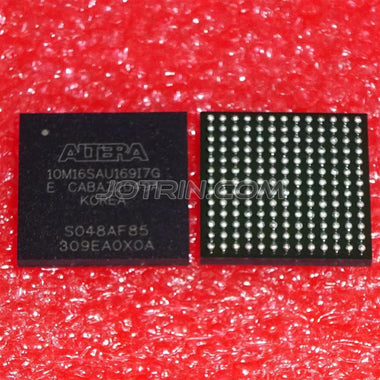
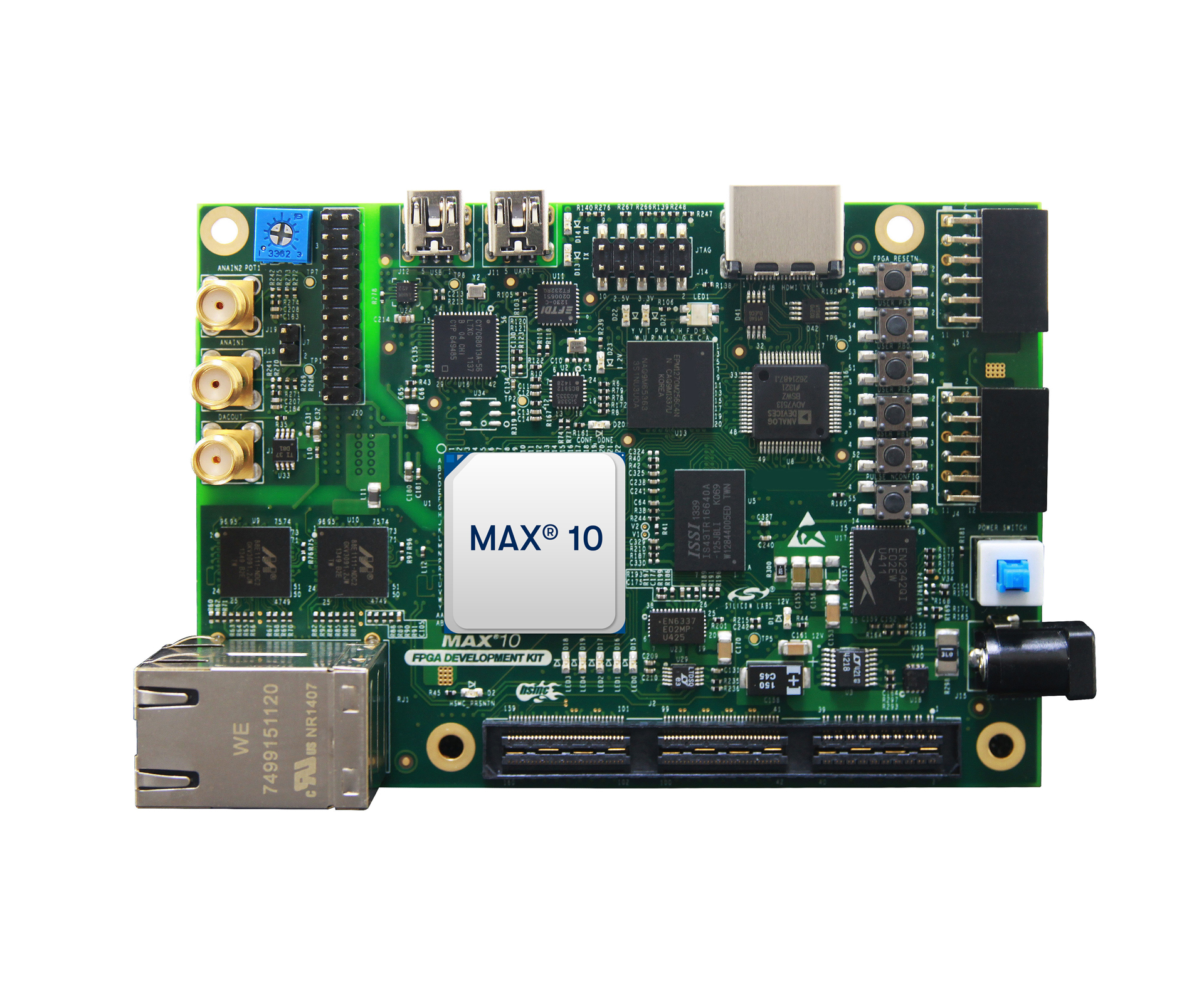
The 10M16SAU169I7G is a non-volatile FPGA from Intel's (formerly Altera) MAX 10 family, fabricated on a 55 nm flash process. It integrates 16,000 logic elements, 549 KB of embedded M9K SRAM, 549 Kbit of User Flash Memory, a 12-bit ADC, and 4 PLLs in a compact 169-ball UBGA package. With 130 user I/O pins and industrial-grade operation (-40 °C to 100 °C), the 10M16SAU169I7G targets cost-sensitive embedded, industrial, and IoT applications where instant-on capability, single-chip configuration, and extended temperature reliability are essential.
What Is the 10M16SAU169I7G?
The 10M16SAU169I7G belongs to the MAX 10 family — Intel's non-volatile FPGA line launched in 2014 that eliminates external configuration devices by integrating dual configuration flash memory on-chip. The part number decodes as follows: "10M16" indicates the 16,000-LE density variant, "SA" denotes the analog-enabled variant with dual ADC blocks, "U169" identifies the 169-ball UBGA (11×11 mm) package, "I7" signifies industrial-grade silicon (-40 °C to 100 °C) at speed grade 7, and "G" indicates RoHS-compliant lead-free terminations.
Internally, the device organizes its 16,000 logic elements into 1,000 Logic Array Blocks (LABs), each containing 16 adaptive LEs. Every LE includes a four-input look-up table (LUT), a programmable register, carry chain logic, and register packing capability — supporting efficient implementation of arithmetic, state machines, and data path logic. The MultiTrack interconnect architecture with DirectDrive technology provides deterministic signal routing with predictable timing across the die.
The embedded M9K memory blocks deliver 549 KB of dual-port SRAM, each configurable as single-port RAM, simple dual-port, true dual-port RAM, ROM, or FIFO buffers. The integrated 12-bit SAR ADC with up to 1 MSPS conversion rate enables mixed-signal designs without external analog-to-digital converters. Four general-purpose PLLs provide clock synthesis, multiplication, division, and phase shifting across up to 20 global clock networks.
Pinout Configuration and Packaging
The 10M16SAU169I7G is housed in a 169-ball UBGA (Ultra-thin Ball Grid Array) package measuring 11×11 mm with a 0.8 mm ball pitch. This compact footprint makes it well-suited for space-constrained designs in handheld, wearable, and edge computing applications. Of the 169 balls, 130 are available as user I/O, distributed across 8 independent I/O banks.
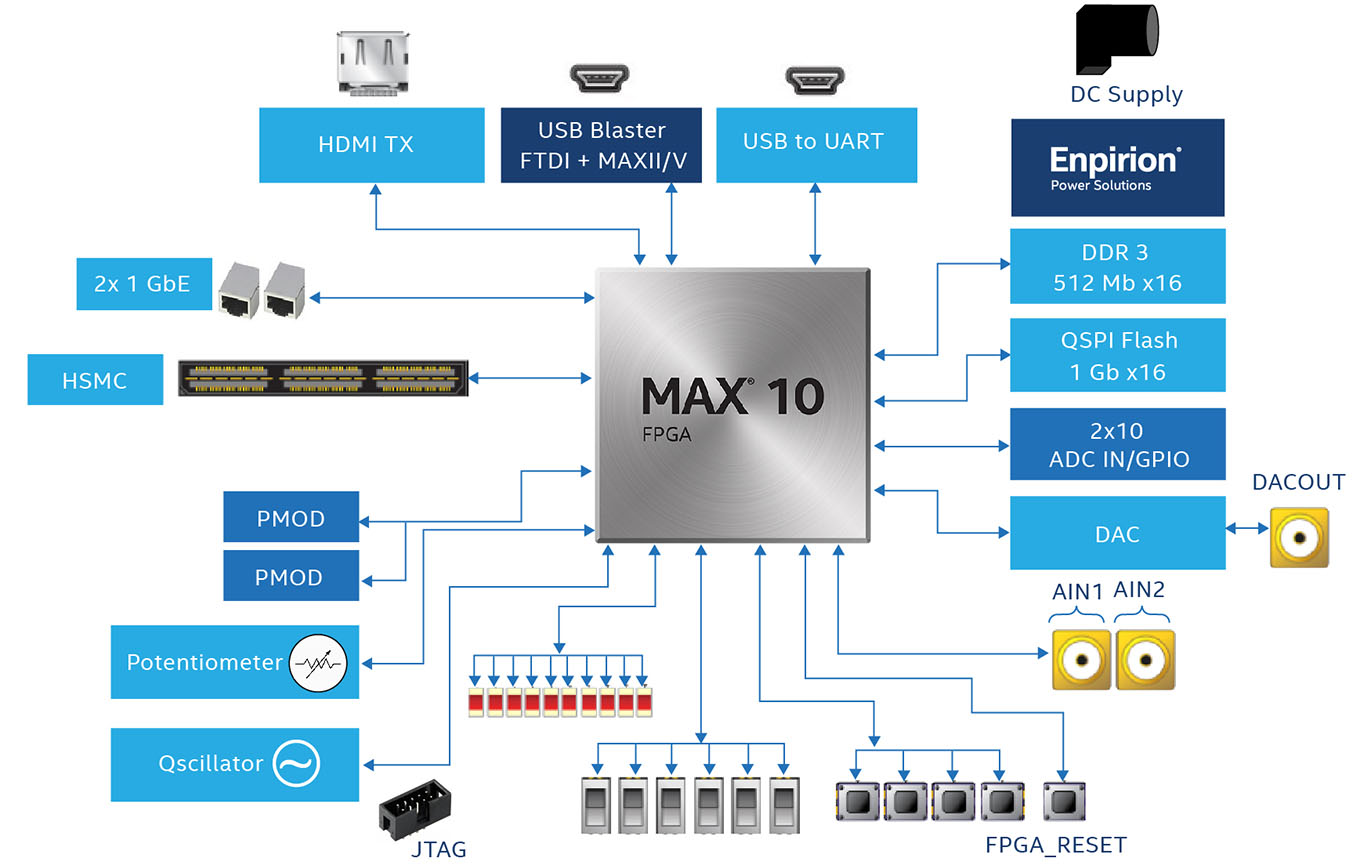
Each I/O bank supports an independent VCCIO supply rail, enabling mixed-voltage interfacing within a single device. The I/O architecture supports multiple single-ended standards — 3.0 V to 3.3 V LVTTL, 1.0 V to 3.3 V LVCMOS, PCI, SSTL, and HSTL — along with differential LVDS at up to 22 transmit/receive pairs. This I/O flexibility allows the 10M16SAU169I7G to bridge between legacy 3.3 V systems and modern 1.2 V high-speed interfaces without level-shifting ICs.
The MAX 10 eliminates external configuration devices — the on-chip flash stores up to two configuration images, enabling instant-on operation within 10 ms of power-up. Dual-image mode supports secure remote firmware updates with automatic fallback. Configuration is also supported via JTAG for development and in-system programming. The dedicated analog input pins connect directly to the internal ADC, with SMA-compatible signal conditioning recommended for precision applications.

Specifications Parameter Table
| Specification | Technical Details |
|---|---|
| Device Family | MAX 10 (Intel / Altera) |
| Process Node | 55 nm flash process |
| Logic Elements (LEs) | 16,000 |
| Logic Array Blocks (LABs) | 1,000 |
| Embedded Memory (M9K) | 549 KB (562,176 bits) |
| User Flash Memory (UFM) | Up to 8,192 Kbit (single-image mode) |
| Embedded 18×18 Multipliers | 45 |
| PLLs | 4 |
| Global Clock Networks | 20 |
| User I/O Pins | 130 |
| Maximum LVDS Pairs | 22 |
| Analog-to-Digital Converter | Dual 12-bit SAR ADC, up to 1 MSPS |
| Package | 169-UBGA (11×11 mm, 0.8 mm pitch) |
| Core Voltage (VCCINT) | 1.2 V |
| I/O Voltage (VCCIO) | 3.0 V to 3.3 V |
| Speed Grade | I7 (Industrial, -40 °C to +100 °C) |
| I/O Standards | LVTTL, LVCMOS, SSTL, HSTL, HSUL, LVDS, PCI |
| External Memory Interfaces | DDR3, DDR3L, DDR2, LPDDR2, SRAM |
| Configuration | Internal flash (single/dual-image), JTAG |
| Bitstream Security | AES-256 encryption supported |
| RoHS Compliant | Yes (lead-free, "G" suffix) |
Typical Applications and Circuit Considerations
The 10M16SAU169I7G is designed for applications requiring a reliable, instant-on FPGA with integrated analog capability and extended temperature operation. Its combination of 16,000 LEs, on-chip flash, dual ADC, and industrial-grade rating makes it suitable for demanding deployment environments:
- Industrial Automation and Motor Control: The FPGA's deterministic timing and parallel processing capability enable multi-axis servo controllers, PLC coprocessors, and safety-critical I/O modules. The integrated ADC eliminates external analog conversion for sensor inputs, simplifying BOM and reducing board area in industrial control panels.
- IoT Edge Computing and Sensor Fusion: With instant-on capability and integrated ADC, the 10M16SAU169I7G serves as an intelligent edge node — performing local signal processing, threshold detection, and protocol conversion before transmitting filtered data to cloud infrastructure. The compact UBGA package fits in constrained IoT enclosures.
- Communications Protocol Bridging: With 130 I/O pins supporting diverse voltage standards, the device acts as a flexible protocol-translation bridge between processors and peripheral subsystems — implementing SPI-to-parallel conversion, PCIe-to-custom-bus bridging, or multi-protocol serial engines for industrial fieldbus systems.
- Automotive and Transportation: The -40 °C to 100 °C industrial rating and non-volatile configuration make the 10M16SAU169I7G suitable for automotive infotainment coprocessors, ADAS preprocessing, and vehicle network gateway applications. Dual-image configuration supports secure over-the-air firmware updates.
- Test and Measurement Equipment: The 45 embedded multipliers and 12-bit ADC support portable test instruments requiring real-time signal capture and DSP — spectrum analyzers, oscilloscope front-ends, and protocol analyzers benefit from the FPGA's parallel processing and reconfigurability.
For power supply design, Intel recommends a three-rail approach: 1.2 V core (VCCINT), 2.5 V PLL analog (VCCA), and per-bank VCCIO (typically 3.3 V). Each supply pin requires 0.1 µF ceramic decoupling placed within 2 mm of the BGA pad, supplemented by 10–47 µF bulk capacitors per rail. The UBGA package requires a minimum 4-layer PCB with dedicated power and ground planes for proper signal integrity. Browse MAX 10 FPGA Series components for related power management and configuration ICs.
Video Tutorial
Equivalents, Cross-Reference, and Lifecycle
The 10M16SAU169I7G remains in active production as of 2026, with the MAX 10 family positioned as Intel's recommended non-volatile FPGA platform for new designs. For designs requiring pin-compatible variants or migration paths, consider these alternatives:
- 10M16SAU169C8G: Identical silicon in the same 169-UBGA package but rated for commercial temperature (0 °C to 85 °C) with speed grade 8. Use for cost-optimized designs that do not require extended temperature operation.
- 10M08SAU169I7G: Pin-compatible in the same 169-UBGA package with reduced resources (8,000 LEs, 378 Kbit RAM). Ideal for cost-down when logic utilization permits migration to a smaller density.
- 10M25SAU324I7G: Upward migration to a 25,000-LE MAX 10 device for designs requiring more logic headroom. Requires a larger 324-UBGA package, so a PCB redesign is necessary.
- 10CL016YU256I7G (Cyclone 10 LP): Intel's newer low-power FPGA family offering 15,408 LEs in 55 nm. Provides higher performance but lacks the integrated flash and ADC features of MAX 10.
When sourcing the 10M16SAU169I7G, verify the full ordering code — the "I7" suffix indicates industrial temperature range and speed grade 7; commercial variants use "C8" with 0 °C to 85 °C operation. The "SA" prefix confirms the dual-ADC variant; "SC" variants include the ADC but with a different flash configuration. Check 10M16SAU169I7G Inventory & Pricing for current stock and lead times. Also see our catalog of Intel FPGA and programmable logic devices for cross-compatible alternatives.
Frequently Asked Questions (10M16SAU169I7G FAQ)
Q: What is the difference between 10M16SAU169I7G and 10M16SAU169C8G?
A: Both devices are MAX 10 FPGAs with 16,000 logic elements in the same 169-UBGA package and share an identical pinout. The key difference is operating conditions: the 10M16SAU169I7G is an industrial-grade device rated for -40 °C to 100 °C junction temperature with speed grade 7, while the 10M16SAU169C8G is commercial-grade (0 °C to 85 °C) with speed grade 8. The I7G variant is preferred for automotive, military, and outdoor industrial applications requiring extended temperature reliability.
Q: What development tools are required to program the 10M16SAU169I7G?
A: The 10M16SAU169I7G is programmed using Intel Quartus Prime Lite Edition, which is a free download with no license restrictions for MAX 10 devices. Design entry supports Verilog, VHDL, and schematic capture. A USB Blaster II JTAG programmer is required for initial configuration, but the MAX 10's internal flash allows autonomous boot without an external configuration device. ModelSim-Intel FPGA Edition handles simulation, and Platform Designer (formerly Qsys) enables system-level integration with Nios II soft processors.
Q: Does the 10M16SAU169I7G have an integrated ADC?
A: Yes. The MAX 10 "SA" variant includes a dual 12-bit SAR ADC with up to 18 analog input channels, supporting up to 1 MSPS conversion rate per ADC block. This eliminates the need for an external ADC in mixed-signal designs and is accessible through the Quartus Prime Altera Modular ADC IP core. Internal temperature sensing and voltage monitoring channels are also available, enabling self-diagnostic capabilities without external sensors.
Q: What configuration modes does the 10M16SAU169I7G support?
A: The MAX 10 FPGA supports internal configuration from its on-chip flash memory — its primary advantage over traditional FPGA families that require external configuration devices. Configuration modes include single-image and dual-image internal configuration (enabling remote update with automatic fallback), JTAG configuration for development, and the Internal Configuration scheme. Dual-image mode stores two configuration images in internal flash, allowing secure field upgrades with automatic rollback to a known-good image if the new configuration fails.
Q: What is the User Flash Memory (UFM) capacity of the 10M16SAU169I7G?
A: The 10M16SAU169I7G provides User Flash Memory for non-volatile data storage separate from the configuration flash. In single-image configuration mode, approximately 8,192 Kbit of UFM is available. In dual-image mode, UFM capacity is reduced because the second configuration image occupies some of the flash space. UFM is useful for storing calibration data, serial numbers, encryption keys, or small lookup tables that must persist across power cycles without external EEPROM.
Q: Can the 10M16SAU169I7G interface with DDR3 SDRAM?
A: Yes. The MAX 10 family supports DDR3, DDR3L, DDR2, and LPDDR2 external memory interfaces. Quartus Prime includes the UniPHY-based external memory interface IP to generate calibrated DDR3 controllers with proper timing calibration. In the U169 (169-ball) package, the available DQS-capable pins support up to an 8-bit or 16-bit DDR3 data interface depending on remaining I/O allocation. For wider memory buses, consider the 10M16 in the larger U324 or F484 package options.

Alan Carter
Senior Hardware Engineer & Component Specialist
Alan has over 15 years of expertise in embedded systems design, FPGA architecture, and global semiconductor supply chains. He specializes in component cross-referencing, lifecycle management, and helping OEMs navigate supply shortages.