10M16SAU169I7G Altera MAX 10 FPGA: Datasheet, Pinout, and Application Guide
Overview of the 10M16SAU169I7G
The 10M16SAU169I7G is a non-volatile FPGA from the Altera (now Intel) MAX 10 family. Built on a 55nm flash-based process, this device integrates 16,000 logic elements, a dual 12-bit analog-to-digital converter (ADC), and internal dual-image configuration flash memory. The "SA" designation identifies the single-supply analog variant, meaning it operates from a single 3.3V power rail while providing built-in analog measurement capabilities — a major advantage for mixed-signal and sensor-interfacing designs.
The MAX 10 family bridges the gap between CPLDs and FPGAs by combining non-volatile instant-on behavior with the logic density, embedded memory, and flexible I/O of mid-range FPGAs. The 10M16SAU169I7G supports dual configuration images for remote field updates with fail-safe fallback, enabling safe over-the-air (OTA) firmware updates in deployed systems. Its industrial temperature rating (−40°C to +100°C) makes it well-suited for harsh-environment applications.
Typical applications include industrial sensor hubs, motor control with analog feedback, communications protocol bridging, automotive subsystem controllers, medical instrumentation front-ends, and IoT edge gateways. Development is fully supported by Intel Quartus Prime Lite Edition (free), providing a complete RTL-to-bitstream flow with built-in ADC IP and system integration tools.
Key Specifications and Parameters
| Parameter | Value |
|---|---|
| Manufacturer | Altera (Intel) |
| Family | MAX 10 |
| Part Number | 10M16SAU169I7G |
| Logic Elements (LEs) | 16,000 |
| Logic Array Blocks (LABs) | 1,000 |
| M9K Memory Blocks | 60 (549 Kb total) |
| 18×18 Embedded Multipliers | 45 |
| Phase-Locked Loops (PLLs) | 4 |
| Global Clock Networks | 20 |
| User I/O Pins (U169) | 130 |
| Maximum LVDS Pairs | 22 |
| User Flash Memory (UFM) | 2,304 Kb |
| Internal Configuration Flash | Yes (dual-image CFM) |
| ADC Blocks | 2 × 12-bit, up to 1 MSPS each |
| ADC Channels | Up to 18 single-ended external inputs |
| On-chip Temperature Sensor | Yes |
| Package Type | 169-UBGA (11 × 11 mm, 0.8 mm pitch) |
| Core Supply Voltage | 1.2V (internally regulated from 3.3V) |
| I/O Supply Voltage | 2.85V – 3.465V (single 3.3V supply) |
| Speed Grade | 7 (I7 = industrial, speed grade 7) |
| Operating Temperature | −40°C to +100°C (industrial) |
| Process Technology | 55 nm flash-based |
| Built-in Oscillator | 116 MHz internal oscillator |
| External Memory Support | DDR2, DDR3, LPDDR2, SRAM |
| RoHS Compliance | Yes (G = Green/Lead-Free) |
| Product Status | Active |
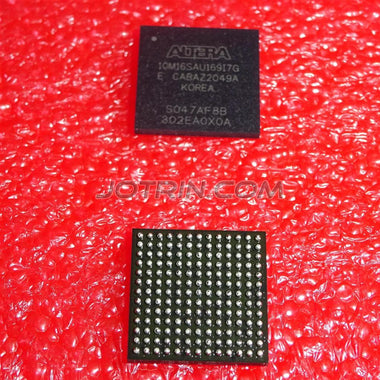
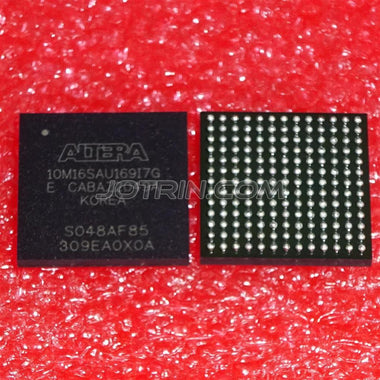
The part number decodes as: 10M16 (MAX 10 family, 16K LEs), SA (Single-supply, Analog — with integrated dual 12-bit ADC), U169 (169-ball UBGA package), I7 (industrial temperature −40°C to +100°C, speed grade 7), G (Green/RoHS-compliant). The single-supply analog variant integrates an internal 1.2V voltage regulator so the entire device can be powered from a single 3.3V rail, greatly simplifying power supply design in space-constrained applications.
Block Diagram and Architecture
The MAX 10 architecture in the 10M16SAU169I7G uses a column-based layout with logic array blocks (LABs), M9K embedded memory columns, 18×18 multiplier blocks, PLLs, a dual integrated ADC, and I/O elements arranged around the device perimeter. The internal configuration flash memory (CFM) and user flash memory (UFM) are embedded directly within the FPGA fabric.

Key architectural highlights of the 10M16SAU169I7G include:
- Logic Elements (LEs): Each of the 16,000 LEs contains a four-input look-up table (LUT), a programmable register, and carry chain logic. LEs are grouped into 1,000 LABs of 16 LEs each, providing efficient local routing and high utilization.
- M9K Memory Blocks: 60 blocks deliver 549 Kb of true dual-port SRAM, configurable as RAM, ROM, FIFO, or shift register in various width/depth combinations up to 256×36 bits.
- Dual Integrated 12-bit ADC: Two on-chip ADCs each support up to 1 MSPS sampling with up to 18 single-ended external analog inputs and an internal temperature sensor for thermal monitoring. This eliminates external ADC ICs in most mixed-signal designs.
- User Flash Memory (UFM): A generous 2,304 Kb of on-chip non-volatile storage accessible via Avalon Memory-Mapped interface for calibration data, lookup tables, or application firmware storage.
- Configuration Flash Memory (CFM): Supports dual compressed images for remote update with automatic rollback to the factory image if the application image is corrupted.
- DSP Resources: 45 embedded 18×18 multipliers support high-throughput multiply-accumulate operations for signal processing, filter implementations, and arithmetic-intensive workloads.
Pinout and Package Information
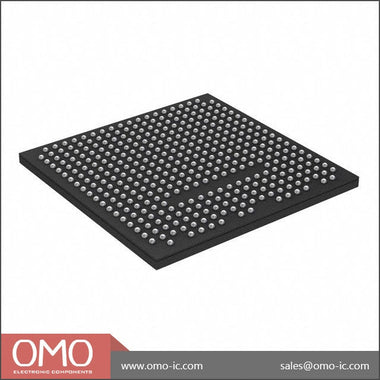
The 10M16SAU169I7G is housed in a compact 169-ball Ultra FineLine BGA (UBGA) package measuring just 11mm × 11mm with 0.8mm ball pitch — ideal for space-constrained designs. The U169 package provides 130 user-programmable I/O pins organized across multiple I/O banks supporting voltage levels from 1.0V to 3.3V.

The I/O banks support multiple single-ended standards including 3.3V/2.5V/1.8V/1.5V/1.2V LVCMOS and LVTTL, as well as differential standards such as LVDS with up to 22 differential pairs for high-speed serial interfaces. Each I/O pin features programmable drive strength, slew rate control, and optional internal pull-up resistors. Dedicated ADC input pins are available for direct connection to analog sensors without requiring additional external components.
The UBGA package includes built-in decoupling capacitance and supports 4-layer or 6-layer PCB stack-ups. For complete pin assignment tables, bank assignments, and recommended PCB footprints, refer to the official Intel MAX 10 FPGA Device Handbook and download the schematic symbol and footprint from SnapEDA.
Application Circuit and Design Guide
The 10M16SAU169I7G is widely deployed in industrial automation, communications equipment, automotive subsystems, medical instrumentation, and IoT edge processing. Its non-volatile instant-on behavior, dual ADC, generous user flash, industrial temperature rating, and compact BGA footprint make it especially suited for mixed-signal sensor hubs, motor drives with analog feedback, protocol bridges, and embedded control systems.
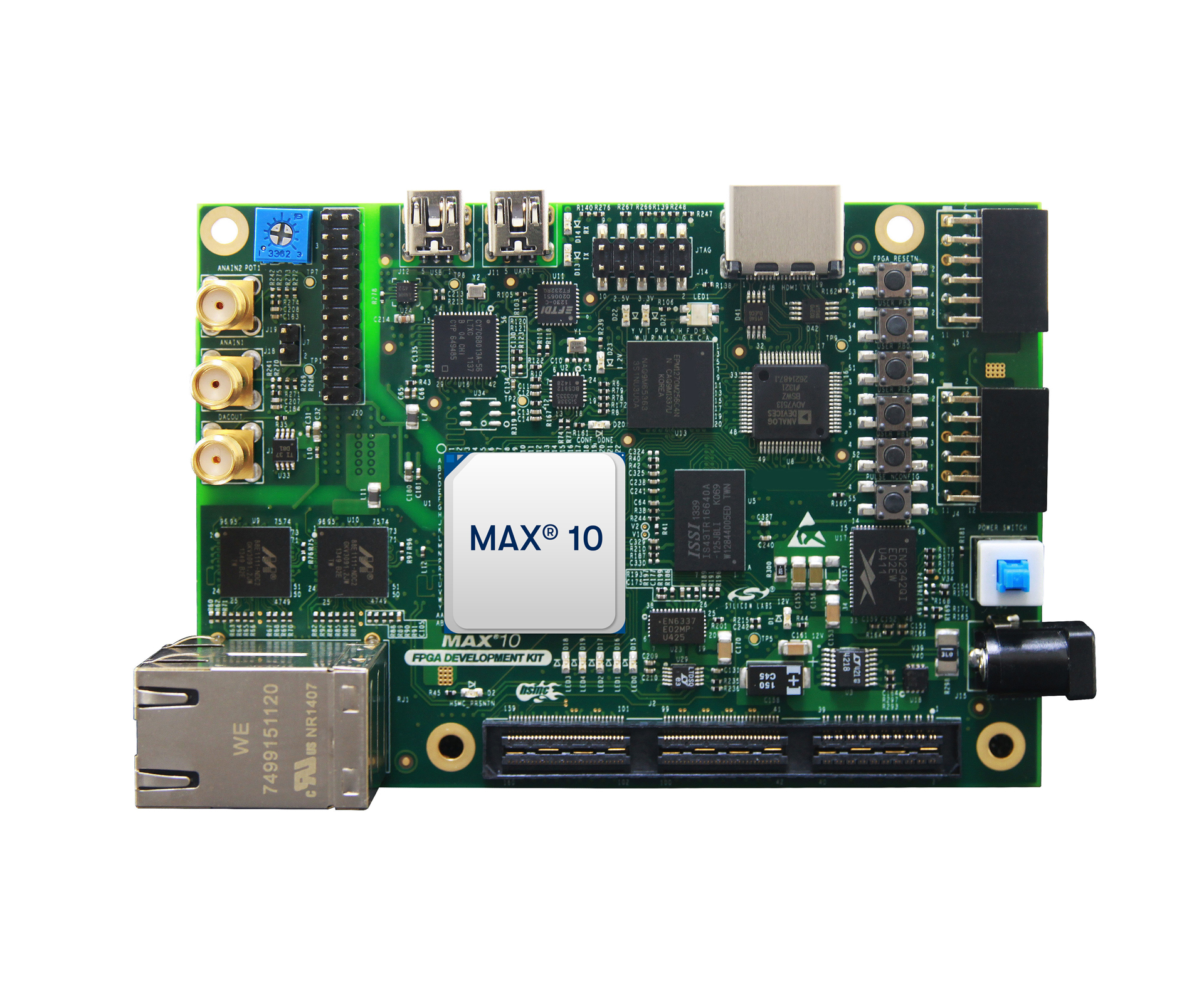
When designing with the 10M16SAU169I7G, follow these guidelines:
- Power Supply Design: The single-supply SA variant integrates an internal voltage regulator, requiring only a 3.3V ±5% input rail. Place 100nF + 10µF decoupling capacitors near each VCC pin pair. The analog supply (VCCADC) should be filtered separately with a ferrite bead and 10µF + 100nF capacitor network for optimal ADC performance.
- ADC Input Conditioning: The integrated dual ADC accepts a 0–2.5V input range. Use a simple resistive voltage divider with a 100nF anti-aliasing filter capacitor when interfacing 3.3V or 5V sensors. The on-chip temperature sensor requires no external components and can be read alongside external channels.
- Configuration and Programming: The internal CFM stores the bitstream — no external configuration memory is needed. Program via JTAG using an Intel USB Blaster or compatible programmer. Enable dual-image mode in Quartus Prime for field-updatable designs with fail-safe rollback.
- DDR Memory Interface: The device supports DDR2, DDR3, and LPDDR2 interfaces for high-bandwidth data buffering. Use the Quartus Prime DDR IP core with the recommended PCB layout guidelines for signal integrity.
- Thermal Management: The industrial-grade device operates reliably from −40°C to +100°C. The UBGA package dissipates heat through the BGA solder joints and internal ground plane; no heatsink is required at typical logic utilization levels.
Video Tutorial: Getting Started with MAX 10 FPGA Design
Frequently Asked Questions
What is the difference between 10M16SAU169I7G and 10M16SAU169C8G?
The 10M16SAU169I7G is the industrial-grade variant rated for −40°C to +100°C operation with speed grade 7, while the 10M16SAU169C8G is the commercial-grade version rated for 0°C to 85°C with speed grade 8. The industrial variant (I7) provides wider temperature tolerance for harsh environments, while the commercial variant (C8) offers a slightly different speed-power trade-off for standard operating conditions. Both share identical logic resources, pin-out, and package.
Does the 10M16SAU169I7G require an external configuration memory?
No. The MAX 10 family features integrated on-chip configuration flash memory (CFM), so the 10M16SAU169I7G stores its bitstream internally. This eliminates the need for external SPI flash or configuration EPROMs. The device supports dual configuration images for remote updates with fail-safe fallback — if the primary image is corrupted, the device automatically boots from the factory image.
How many analog input channels does the 10M16SAU169I7G support?
The 10M16SAU169I7G integrates two independent 12-bit ADC blocks, each capable of up to 1 MSPS sampling. Together they support up to 18 single-ended external analog input channels plus an internal temperature sensor. The ADC accepts a 0–2.5V input range and can be configured via the Quartus Prime ADC IP core for sequential or round-robin channel scanning.
What development tools and software are needed for the 10M16SAU169I7G?
Intel Quartus Prime Lite Edition (free, no license required) supports all MAX 10 devices including the 10M16SAU169I7G. It provides synthesis, place-and-route, timing analysis, and JTAG programming. For simulation, ModelSim-Intel Starter Edition or open-source alternatives like Icarus Verilog and GTKWave work well. Hardware programming requires an Intel USB Blaster or compatible JTAG programmer. The Quartus Platform Designer (formerly Qsys) can generate the ADC controller IP with Avalon-MM interface for easy integration.
Can the 10M16SAU169I7G interface with DDR3 memory?
Yes. The MAX 10 family supports DDR2, DDR3, and LPDDR2 external memory interfaces through hard memory controller IP. The 10M16SAU169I7G can drive DDR3 at data rates compatible with its I/O performance. Use the Quartus Prime EMIF (External Memory Interface) IP core to generate the controller, calibration logic, and PHY — the tool automatically configures timing parameters and pin assignments for the U169 package.
What is the power consumption of the 10M16SAU169I7G?
Static (standby) power for the 10M16SAU169I7G is typically around 70–90 mW depending on junction temperature. Dynamic power varies with clock frequency, toggle rate, and resource utilization — a typical mid-complexity design running at 100 MHz might consume 200–400 mW total. Use the Intel Quartus Prime PowerPlay Power Analyzer for accurate design-specific estimates. The single-supply architecture simplifies power regulation and reduces total system power compared to dual-supply variants.