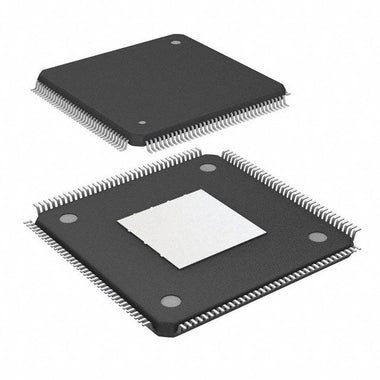
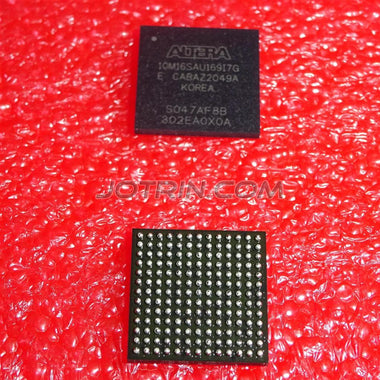
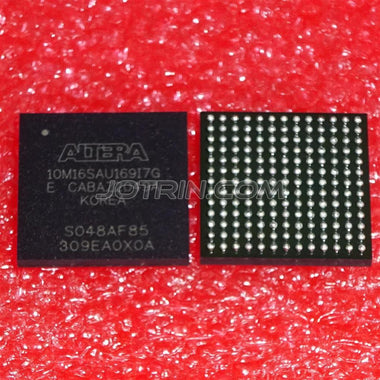
The 10M04SCE144C8G is a non-volatile, single-chip FPGA from Intel’s (formerly Altera) MAX 10 family, fabricated on TSMC’s 55 nm embedded flash process. It integrates 4,000 logic elements, 189 Kbit of M9K embedded SRAM, 16 hardware 18×18-bit multipliers, dual on-die configuration flash images, a 12-bit 1 MSPS SAR ADC, and 2 PLLs — all within a compact 144-pin EQFP package. Operating from a single 3.3 V supply with instant-on boot (under 10 ms), the 10M04SCE144C8G eliminates external configuration memory, reducing BOM cost and board area for industrial control, communications, and IoT edge applications.
Overview and Part Number Decoding
The 10M04SCE144C8G belongs to the Intel MAX 10 product line — the industry’s first single-chip, non-volatile FPGA family. Unlike SRAM-based FPGAs such as Xilinx Spartan-7 or Intel Cyclone V that require external SPI flash for configuration bitstream storage, MAX 10 devices store up to two complete configuration images in on-die flash memory. This architecture enables instant-on operation within milliseconds of power-up and supports fail-safe remote field updates via the Remote System Upgrade (RSU) IP core — without any external EPCQ or SPI NOR flash on the BOM.
The part number encodes the following attributes:
- 10M04 — MAX 10 family, 4,000 logic elements
- SC — Single-supply, Compact variant (internal 1.2 V regulator, integrated 12-bit ADC, smaller user flash)
- E144 — 144-pin Enhanced Quad Flat Package (EQFP) with exposed thermal pad
- C8 — Commercial temperature range (0 °C to +85 °C), speed grade 8
- G — Green / RoHS / Pb-free compliant
The “SC” designation indicates this is the single-supply compact variant. It includes a 12-bit, 1 MSPS SAR ADC but with a smaller user flash block than the “SA” (Analog) variants. The device is fully supported by Intel Quartus Prime Lite Edition, which is free to download and requires no license file. For current stock and pricing, check 10M04SCE144C8G availability on WWDParts.
Specifications and Parameter Table
| Parameter | Value |
|---|---|
| Manufacturer | Intel (Altera) |
| Product Family | MAX 10 |
| Part Number | 10M04SCE144C8G |
| Logic Elements (LEs) | 4,000 |
| Process Technology | 55 nm (TSMC embedded flash) |
| Embedded Memory (M9K) | 189 Kbit (21 M9K blocks) |
| 18×18 Multipliers | 16 |
| PLLs | 2 |
| ADC | 1× 12-bit SAR, up to 1 MSPS |
| User Flash Memory | Up to 16 KB (SC variant) |
| Configuration Flash | Dual-image, on-die |
| Max User I/O (E144) | 101 |
| Max LVDS Pairs | 15 |
| Global Clock Networks | 15 |
| Core Voltage | 1.2 V (internal regulator from 3.3 V supply) |
| I/O Voltage | 1.0 V to 3.3 V LVCMOS/LVTTL |
| I/O Standards | LVTTL, LVCMOS, PCI, SSTL, HSTL, LVDS, Mini-LVDS, RSDS, LVPECL, BLVDS, TMDS |
| Package | 144-EQFP (20×20 mm, 0.5 mm pitch, exposed pad) |
| Speed Grade | 8 |
| Temperature Range | 0 °C to +85 °C (Commercial) |
| RoHS / Pb-Free | Yes (Green compliant) |
| Quartus Support | Quartus Prime Lite (free, no license required) |
For a side-by-side comparison of other MAX 10 devices in the 144-EQFP package, see our guides for the 10M08SAE144C8G (8K LEs) and 10M16SAU169C8G (16K LEs).
Architecture and Block Diagram
The MAX 10 architecture integrates a configurable logic fabric with hardened analog and memory peripherals. The 10M04SCE144C8G contains 4,000 adaptive logic modules (ALMs) organized into logic array blocks (LABs), each containing 16 LEs. The M9K embedded memory blocks provide 189 Kbit of on-chip SRAM that can be configured as single-port RAM, dual-port RAM, FIFO buffers, or ROM — each block operating at up to 284 MHz.
The dual on-die flash configuration memory stores two independent FPGA bitstream images, enabling Remote System Upgrade (RSU) with automatic fallback to a known-good image if the primary configuration fails. The 12-bit SAR ADC provides a hardware analog front-end directly on-chip, eliminating external ADC components in mixed-signal applications.
Pinout, Package, and PCB Layout
The 10M04SCE144C8G is housed in a 144-pin EQFP (Enhanced Quad Flat Package) measuring 20×20 mm with a 0.5 mm lead pitch and a thermally enhanced exposed pad on the underside. The exposed pad must be soldered to a ground plane for both electrical grounding and thermal dissipation — the device’s thermal resistance (θJA) improves significantly with a properly designed ground pad and thermal via array.
PCB layout guidelines:
- Place at least 9 thermal vias (0.3 mm drill) under the exposed pad, connecting to an internal ground plane.
- Provide separate decoupling capacitors (100 nF ceramic + 10 μF tantalum) for each VCC and VCCIO bank pin, placed within 5 mm of the supply pin.
- Route JTAG signals (TCK, TDI, TDO, TMS) on an inner layer with ground shielding to minimize noise pickup during in-system programming.
- For LVDS pairs, maintain 100 Ω differential impedance and route as tightly coupled pairs with length matching within 5 mils.
The pin assignment file (.qsf) and package drawing are available in the Intel Quartus Pin Planner. Import the 10M04SCE144C8G device and use the Pin Planner tool to assign I/O locations.
Application Circuits and Design Guidelines
The 10M04SCE144C8G is well-suited for compact embedded systems where low cost, small board area, and instant-on capability are critical. Typical application areas include:
- Industrial I/O aggregation: Use the integrated ADC to sample analog sensors (temperature, current, pressure) while the FPGA fabric performs real-time filtering, threshold detection, and protocol bridging to SPI/I2C/UART host interfaces.
- Motor control pre-processing: Implement PWM generation, encoder decoding, and PID loop computation entirely within the 4,000 LE fabric, offloading the main MCU.
- Communications protocol bridging: Bridge between legacy parallel buses (8080/6800) and modern serial interfaces (SPI, I2C, UART, LVDS) with configurable data widths and clock domains.
- LED display driver: Drive large LED matrix panels with high refresh rates using the embedded multipliers for gamma correction calculations.

Minimal reference design checklist:
- Single 3.3 V supply → internal 1.2 V regulator generates core voltage automatically.
- Connect all VCC (1.2 V), VCCIO (3.3 V), and VCCA (2.5 V analog PLL supply) pins with dedicated decoupling.
- Tie unused I/O pins as ground-referenced inputs or tri-state outputs in the Quartus project settings.
- Provide 10 kΩ pull-up on nCONFIG and pull-down on nSTATUS for reliable power-up configuration.
- Use the on-die dual-image flash for fail-safe RSU: image 0 = factory default, image 1 = field-updatable application.
Video: Getting Started with Intel MAX 10 FPGA Development
Frequently Asked Questions (FAQ)
What is the difference between 10M04SCE144C8G and 10M04SAE144C8G?
Both devices share the same 4,000 LE logic fabric, 189 Kbit M9K memory, 16 multipliers, 2 PLLs, and 12-bit ADC. The key difference is the “SC” (Single-supply Compact) variant has a smaller user flash memory block compared to the “SA” (Single-supply Analog) variant. Both include the integrated ADC. Choose SC when user flash requirements are minimal and cost savings are desired; choose SA when you need larger on-chip non-volatile storage for calibration data or boot parameters.
Does the 10M04SCE144C8G require external configuration flash memory?
No. The MAX 10 family integrates dual configuration flash images directly on-die. The FPGA configures itself from internal flash within 10 ms of power-up, providing true instant-on operation without any external SPI flash, EPCQ, or EPCS device. This reduces BOM count and simplifies PCB routing.
What development software is needed for the 10M04SCE144C8G?
Use Intel Quartus Prime Lite Edition (free, no license required). It includes full synthesis, place-and-route, timing analysis, and the Pin Planner tool. For simulation, use the included ModelSim–Intel FPGA Starter Edition. Designs can be written in Verilog, VHDL, or created using the Platform Designer (Qsys) graphical system integration tool.
Can I use a Nios II soft processor inside the 10M04SCE144C8G?
Yes. The 4,000 LE fabric can accommodate a Nios II/e (economy) soft processor core, which requires approximately 600–700 LEs. This leaves sufficient resources for peripherals such as UART, SPI, GPIO, and timer controllers. For the full Nios II/f (fast) variant with hardware multiply, instruction cache, and branch prediction, consider the larger 10M08 or 10M16 devices.
What is the maximum operating frequency of the 10M04SCE144C8G?
The achievable operating frequency depends on the design complexity and routing. Typical register-to-register paths in the C8 speed grade can reach 250–300 MHz for simple logic chains. M9K memory blocks operate at up to 284 MHz. The two PLLs support output frequencies from 4.69 MHz to 472.5 MHz with jitter as low as 200 ps peak-to-peak, enabling flexible clock synthesis and domain crossing.
Is the 10M04SCE144C8G suitable for automotive or high-temperature applications?
The C8G suffix indicates a commercial temperature rating (0 °C to +85 °C), which is suitable for consumer and industrial applications but not for automotive or extended-temperature environments. For industrial temperature range (−40 °C to +100 °C), select the 10M04SCE144I7G variant. MAX 10 devices do not currently carry AEC-Q100 automotive qualification.
Ready to design with the 10M04SCE144C8G? Browse our full inventory of Intel MAX 10 and Cyclone FPGA devices with competitive pricing and fast worldwide shipping.