XC7Z030-1FBG676C Application Guide: From Datasheet to Working Circuit
When designing a high-throughput industrial machine vision system, the core challenge lies in acquiring and processing immense amounts of data from multiple high-resolution cameras in real-time. A slight delay or miscalculation can lead to incorrect product sorting, quality control failures, or production line stoppages. The Xilinx XC7Z030-1FBG676C, a member of the Zynq-7000 All Programmable SoC family, is engineered to excel in these demanding environments by tightly coupling a dual-core ARM Cortex-A9 processing system (PS) with powerful programmable logic (PL). This unique architecture allows it to handle high-bandwidth sensor interfacing and parallel pixel processing in the PL, while the PS manages complex algorithms, networking, and system control, providing a single-chip solution for sophisticated embedded vision applications.

Table of Contents
Application Context: Where XC7Z030-1FBG676C Fits in the System
In our target application—an automated optical inspection (AOI) system for electronics manufacturing—the XC7Z030-1FBG676C serves as the central processing hub. The system's goal is to inspect populated PCBs for missing components, incorrect orientation, and solder joint defects at high speed. This requires a blend of high-speed I/O, massive parallel processing, and intelligent decision-making.
A block diagram of the system places the Zynq SoC at the heart. Multiple high-resolution cameras, each outputting data over a MIPI CSI-2 interface, are connected directly to the XC7Z030. The MIPI D-PHY signals are received by the high-speed I/O banks of the Programmable Logic (PL). Within the PL, we instantiate a Xilinx IP core for MIPI CSI-2 reception, which deserializes the incoming data stream into a standard pixel bus format (e.g., AXI4-Stream). This is a critical first step where the flexibility of the PL shines, as it can be configured to support various camera resolutions, frame rates, and data formats without any hardware changes.
Once the video stream is inside the PL, it enters a custom-designed image processing pipeline. This pipeline, also implemented in the PL, performs a series of operations in a massively parallel fashion. Typical stages include:
- Color Space Conversion: Converting Bayer or YUV data from the sensor into a more usable RGB or grayscale format.
- Image Rectification: Correcting for lens distortion using pre-calculated calibration coefficients.
- Feature Extraction: Using filters like Sobel or Canny edge detectors to highlight component boundaries and solder pads. This is where the numerous DSP slices in the XC7Z030 are heavily utilized.
- Template Matching: Comparing the captured image against a "golden" reference image stored in DDR memory to identify discrepancies.
This entire pipeline operates at the pixel clock rate, processing data as it streams from the camera with minimal latency. The processed data, or metadata indicating potential defect locations, is then transferred via a high-bandwidth AXI interconnect and a Direct Memory Access (DMA) engine into the main system memory (DDR3), which is shared between the PL and the Processing System (PS). This DMA transfer is crucial as it offloads the ARM cores from the tedious task of moving large data blocks.
The dual-core ARM Cortex-A9 processors in the PS run a real-time operating system (RTOS) or a lightweight Linux distribution like PetaLinux. Their role is to analyze the metadata provided by the PL pipeline, apply more complex, non-real-time algorithms (e.g., machine learning inference for defect classification), make the final pass/fail decision, and manage system-level tasks. This includes controlling conveyor belts, actuating reject mechanisms, and communicating results over a Gigabit Ethernet connection to a central factory management server. The PS handles the TCP/IP stack, user interface logic, and overall system state, tasks for which a general-purpose processor is best suited. This PS-PL synergy is the defining feature of the Zynq architecture, enabling a level of integration and performance that would otherwise require a multi-chip solution (e.g., a separate FPGA and a microcontroller).
Core Specifications for This Application
For our AOI system design, the following specifications of the XC7Z030-1FBG676C are paramount. These values are derived from the official Xilinx Zynq-7000 SoC (DS190) datasheet.
| Parameter | Value | Application Relevance |
|---|---|---|
| Programmable Logic Cells | 125K | Provides the fundamental fabric for implementing the entire image processing pipeline, from MIPI receiver to DMA controller, with ample room for complex logic. |
| DSP Slices | 400 | Absolutely critical for accelerating the mathematical-heavy tasks in image processing, such as FIR filtering, convolutions for edge detection, and FFTs. |
| GTP Transceivers | 8 Channels (up to 6.25 Gb/s) | While MIPI can be implemented in standard I/O, these high-speed transceivers are ideal for higher-bandwidth interfaces like CoaXPress or for implementing a high-speed data link to another FPGA or storage device. |
| Processing System (PS) | Dual-Core ARM Cortex-A9 MPCore | Runs the high-level operating system, networking stacks, and decision-making algorithms. The dual-core nature allows for separating control tasks from data analysis. |
| Block RAM | 10.1 Mb | Essential for creating line buffers and FIFOs within the PL pipeline, allowing different processing stages to operate at slightly different rates and handling data buffering without accessing external DDR. |
| Max User I/O | 218 (HR Banks) | Provides the necessary connectivity for multiple camera interfaces (if using CMOS/LVDS), control signals for motors/actuators, and other general-purpose system I/O. |
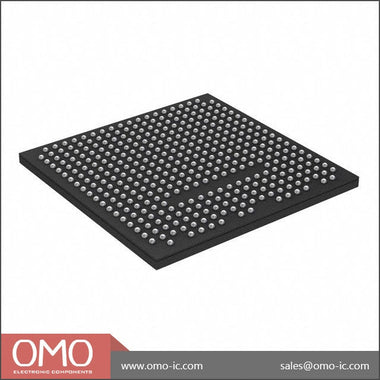
| Package | FBG676 (676-ball BGA) | A dense package that requires advanced PCB design skills. Its size dictates the minimum board area and layer count needed for proper signal and power routing. |
Reference Circuit and Component Selection
Designing a stable and reliable board around the XC7Z030-1FBG676C requires meticulous attention to detail, particularly in the power delivery network (PDN), memory interface, and configuration circuitry.
Power Delivery Network (PDN): The Zynq SoC has numerous power rails, each with specific voltage, noise, and sequencing requirements. Key rails include VCCINT (core logic), VCCBRAM (Block RAM), VCCAUX (auxiliary logic), VCCO_DDR, and multiple VCCO rails for the I/O banks. A common and robust approach is to use a dedicated Power Management IC (PMIC) designed for FPGAs, or a series of high-efficiency, low-noise point-of-load (PoL) switching regulators. For example, VCCINT requires a high-current (several amps) supply at a low voltage, demanding a regulator with excellent transient response. Each power rail must be thoroughly decoupled with a combination of bulk capacitors (e.g., 10-47µF) and a spread of smaller ceramic capacitors (e.g., 10µF, 1µF, 0.1µF, 0.01µF) placed as close as physically possible to the BGA balls. Referencing the Xilinx UG933 Power Delivery Network User Guide is non-negotiable. The Xilinx Power Estimator (XPE) spreadsheet is an indispensable tool for calculating power consumption based on your design's resource utilization, which in turn informs the selection and design of the PDN.
DDR3/LPDDR2 Memory Interface: The PS includes a hardened DDR memory controller. For our AOI application, a 32-bit DDR3 interface provides the necessary bandwidth for storing image frames. The layout of this interface is one of the most critical aspects of the PCB design. All data, address, control, and clock traces must be impedance-controlled (typically 50Ω single-ended, 100Ω differential) and length-matched within tight tolerances (e.g., +/- 5 mils for traces within a byte group). A fly-by topology is recommended for the address/command/control lines, while data lines (DQ/DQS) are routed as point-to-point byte groups. Proper termination, as specified in the memory device datasheet and Zynq technical reference manual (UG585), is also mandatory. Using a PCB layout tool with built-in length-matching and differential pair routing features is essential.
Configuration and Boot: The Zynq device must be configured at power-up. The boot source is selected via the MIO[5:2] pins, which must have appropriate pull-up or pull-down resistors. For a standalone embedded system, booting from QSPI flash is a common choice. This requires a reliable QSPI flash memory IC connected to the dedicated PS MIO pins. An SD card interface is also a popular option for development and field updates. Including a JTAG header on the board is mandatory for debugging both the PS and PL during development using the Xilinx toolchain. You can Browse Zynq-7000 Series to see the various configurations and supporting components commonly used in these designs.
Clocking: A low-jitter, high-stability oscillator is required to feed the PS_CLK input. A 33.333 MHz or 50 MHz oscillator is typical. This single clock source is used by the internal PLLs within the Zynq to generate all necessary clocks for the ARM cores, memory controller, and peripherals. Additional clock sources may be needed for specific PL functions, like the pixel clock for the camera interface.
Design Pitfalls and How to Avoid Them
Even experienced engineers can encounter issues when working with complex SoCs like the Zynq-7000. Here are some common pitfalls and how to steer clear of them.
| Common Mistake | Symptom | Fix |
|---|---|---|
| Incorrect Power-Up Sequence | Device fails to boot, draws excessive current, or is permanently damaged. The DONE pin may never go high. | Strictly follow the power-on sequence specified in the datasheet (DS190). Use a dedicated power sequencer IC or a PMIC with programmable sequencing to enforce the VCCINT -> VCCBRAM -> VCCAUX -> VCCO order. |
| Poor DDR3 Layout | Memory calibration fails in software. System experiences random crashes, data corruption, or fails to boot when running from DDR. | Use a 10+ layer PCB. Adhere to strict length matching rules (within byte lanes and relative to clock). Maintain controlled impedance. Run signal integrity simulations (e.g., with HyperLynx) before fabrication. |
| Inadequate Decoupling | System is unstable under heavy processing load. Jitter on high-speed interfaces. Unexplained logic errors. | Place decoupling capacitors directly under the BGA on the reverse side of the PCB using low-inductance vias. Use a range of capacitor values to cover a wide frequency spectrum. Follow Xilinx's recommendations in UG475. |
| Floating Unused I/O Pins | Increased power consumption, potential for I/O banks to become unstable or damaged due to ESD or noise. | Consult the Zynq-7000 SoC Technical Reference Manual (UG585). Most unused I/O pins should be tied to Ground via a weak resistor or configured as outputs and driven low in the PL design, but some have specific requirements. Never leave them floating. |
Beyond the table, a significant pitfall is underestimating the thermal design. The XC7Z030-1FBG676C can dissipate several watts of power, especially when the PL and DSP slices are heavily utilized. A simple thermal analysis should be part of the initial design phase. This involves using the Xilinx Power Estimator to get a power budget and then performing a basic thermal simulation to determine if a heatsink is necessary. A dense BGA package like the FBG676 relies on the PCB for heat spreading, so a grid of thermal vias under the device connected to ground planes is a standard and necessary practice. Ignoring thermal management leads to performance throttling at best, and a drastically reduced component lifetime at worst.
Performance Optimization Tips
Extracting maximum performance from the XC7Z030-1FBG676C involves a holistic approach covering the hardware design, PL implementation, and PS software.
Thermal Management: As mentioned, this is critical. If a heatsink is required, ensure a good thermal interface material (TIM) is used. The choice of heatsink (passive, active with a fan) depends on the power dissipation, ambient temperature, and enclosure airflow. A well-designed PCB with solid ground and power planes acts as an effective heat spreader, so don't skimp on copper. A 2-oz copper weight for power and ground planes can significantly improve thermal performance.
Signal Integrity: For high-speed interfaces like DDR3 and the GTP transceivers, signal integrity is paramount. Use the pre-emphasis and equalization features available in the Zynq's GTP transceivers to compensate for channel loss in the PCB traces. The Vivado Design Suite includes the I/O and Clock Planning tool, which helps in assigning pins to optimize signal routing and minimize crosstalk. Running post-layout simulations is the only way to be certain that your high-speed links will meet timing and have sufficient eye-opening.
EMI Reduction: A fast-switching digital system like this is a significant source of electromagnetic interference (EMI). Employ best practices like ensuring an uninterrupted ground plane beneath all high-speed signals, using spread-spectrum clocking options where available, and adding ferrite beads on power supply inputs. Proper PCB layer stack-up, with signal layers sandwiched between ground or power planes (a stripline configuration), provides excellent shielding and helps control impedance.
PL/PS Partitioning: The most important architectural optimization is deciding what runs in the PL and what runs in the PS. Any task that is massively parallel, repetitive, and operates on a stream of data (like our image filtering) is a prime candidate for the PL. Tasks that are serial, involve complex decision-making, or require standard software stacks (like networking) belong in the PS. Use the AXI interconnect efficiently; use wider data buses and burst transfers to maximize bandwidth between the two domains.
Related Components and Accessories
A successful XC7Z030-1FBG676C design relies on a well-chosen ecosystem of supporting components. For the power system, consider multi-output PMICs from manufacturers like Texas Instruments (e.g., their TPS series) or Analog Devices that are specifically marketed for FPGA/SoC applications. For the DDR3 memory, use chips from reputable suppliers like Micron or Samsung; it's often wise to choose a part that is listed on the bill of materials of an official Xilinx evaluation kit, as this ensures compatibility. For boot configuration, a high-reliability QSPI NOR Flash memory from Cypress (Infineon) or Micron is a standard choice. An Ethernet PHY, such as the DP83867 from Texas Instruments, is needed to complete the Gigabit Ethernet interface. Finally, a robust JTAG programmer/debugger, like the Xilinx Platform Cable USB II, is essential for development. When you are ready to source these components, you can Check XC7Z030-1FBG676C Inventory & Pricing to ensure availability for your production run.
Video Demonstration
Frequently Asked Questions (XC7Z030-1FBG676C FAQ)
What operating system can I run on the XC7Z030-1FBG676C's ARM cores?
The dual-core ARM Cortex-A9 processing system is highly versatile and can run a variety of operating systems. For applications requiring a rich software environment with networking and file systems, a custom-built embedded Linux distribution using Xilinx's PetaLinux tools is the most common choice. For hard real-time requirements, you can use a real-time operating system (RTOS) like FreeRTOS or VxWorks. For the simplest control tasks, you can even run a bare-metal application with no OS at all, programmed using the Vitis IDE.
How do I connect a high-speed camera to the XC7Z030?
The method depends on the camera's interface. For MIPI CSI-2 interfaces, you can use the Zynq's high-performance (HP) I/O banks, which support the D-PHY electrical standard, and instantiate a MIPI CSI-2 receiver IP core from the Vivado catalog in the programmable logic. For older parallel interfaces like CMOS or LVDS, you can connect directly to the I/O pins and use the PL to deserialize the data. For even higher bandwidth interfaces like CoaXPress, the device's multi-gigabit GTP transceivers are the appropriate choice.
What are the main power supply considerations for this device?
The three most critical power considerations are sequencing, noise, and current capacity. The Zynq-7000 has a mandatory power-on sequence (typically core, then auxiliary, then I/O rails) that must be followed to prevent damage. Each rail, especially the core voltage (VCCINT), requires very low ripple and noise, necessitating careful filtering and decoupling with capacitors placed close to the device. Finally, you must use the Xilinx Power Estimator (XPE) tool to accurately calculate the current draw for each rail based on your specific design and select regulators that can provide sufficient current with adequate margin.
Can I debug the ARM cores and FPGA fabric simultaneously?
Yes, this is a key feature of the Xilinx ecosystem. Using the Vitis Unified Software Platform and a JTAG probe (like the Platform Cable USB II), you can achieve cross-triggering and simultaneous debugging. This allows you to set a breakpoint in your C/C++ code running on the ARM processor and have it halt the execution in the programmable logic (FPGA fabric) at the exact same clock cycle. You can then inspect the state of both the software variables and the hardware signals, which is invaluable for debugging complex PS-PL interactions.
What is the fundamental difference between the Processing System (PS) and Programmable Logic (PL)?
The Processing System (PS) is a hardened, fixed-function block containing the dual-core ARM Cortex-A9 processors, memory controllers, and standard peripherals like USB, Ethernet, and UART. It behaves like a traditional microprocessor. The Programmable Logic (PL) is the FPGA fabric, a flexible sea of logic cells, DSP slices, and block RAM that can be configured to create any custom digital circuit you can design. The two are tightly connected by high-bandwidth AXI interfaces, allowing the PS to control and exchange data with custom hardware accelerators implemented in the PL.