The Xilinx XC7Z010-1CLG400I is a highly integrated System-on-Chip (SoC) from the Zynq-7000 family, designed to provide a flexible and powerful platform for a wide range of embedded systems. It uniquely combines a software-programmable ARM-based Processing System (PS) with hardware-programmable Programmable Logic (PL) on a single die. This architecture solves the challenge of balancing raw processing power with real-time, parallel task execution, enabling designers to accelerate critical functions in hardware while running complex operating systems and applications on a standard processor.

Table of Contents
What is the XC7Z010-1CLG400I?
The XC7Z010-1CLG400I is a member of the Xilinx (now AMD) Zynq-7000 All Programmable SoC family. At its core, this device is not just an FPGA, nor is it just a microprocessor. It is a tightly coupled hybrid that integrates two distinct but cooperative domains: the Processing System (PS) and the Programmable Logic (PL).
The Processing System (PS) is built around a dual-core ARM Cortex-A9 MPCore processor. This is a robust, application-class processor capable of running high-level operating systems like Linux or real-time operating systems (RTOS) such as FreeRTOS. The PS side is a hard-silicon implementation, meaning its architecture is fixed. It includes not only the CPU cores but also L1 and L2 caches, on-chip memory, memory controllers (for DDR3, DDR2, LPDDR2), and a rich set of standard peripherals. These peripherals include Gigabit Ethernet, USB 2.0 OTG, SD/SDIO, SPI, I2C, CAN, and UARTs. This allows the XC7Z010-1CLG400I to function as a standalone embedded processor system without even using the FPGA fabric.
The Programmable Logic (PL) is based on Xilinx's 28nm Artix-7 FPGA architecture. This is the reconfigurable hardware portion of the chip. For the XC7Z010, this includes 28K logic cells, a significant number of flip-flops, look-up tables (LUTs), DSP slices for signal processing, and Block RAM for high-speed data storage. The PL allows engineers to create custom hardware accelerators, specialized I/O interfaces, and parallel processing engines that can operate orders of magnitude faster than a traditional CPU for specific tasks. Anything from a custom video codec to a multi-channel data acquisition front-end can be implemented in the PL.
The true power of the Zynq-7000 architecture lies in the high-bandwidth, low-latency connection between the PS and PL. This is achieved through multiple AMBA AXI (Advanced eXtensible Interface) connections. These act as a multi-lane highway for data, allowing the ARM cores to control and be fed by the custom hardware in the PL. This tight integration enables a co-design workflow where software tasks running on the PS can offload computationally intensive functions to dedicated hardware accelerators in the PL, achieving performance that is impossible with a traditional two-chip (CPU + FPGA) solution.
Pinout Configuration and Packaging
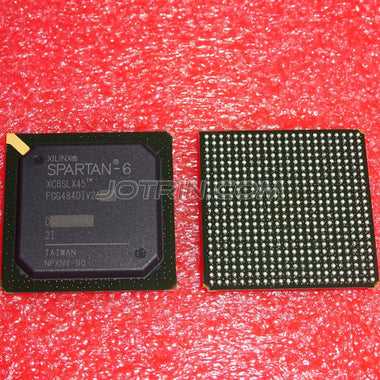
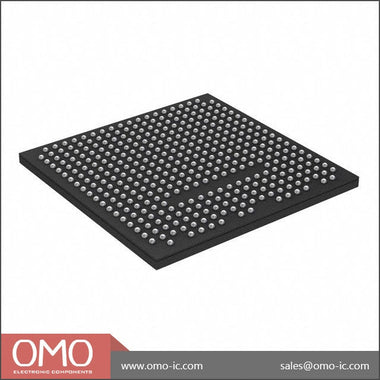
The XC7Z010-1CLG400I is offered in the CLG400 package. This is a 400-ball, 17x17mm Chip Scale Package (CSP) BGA with a 0.8mm pitch. This high-density package is necessary to accommodate the extensive I/O capabilities of the device. From a hardware design perspective, careful attention to PCB layout, including via-in-pad or microvia technology, is often required for successful routing.
The pins on the Zynq-7000 are not a monolithic block of general-purpose I/O. They are segregated by function and voltage domain, a critical aspect for board design. The main categories are:
- Processing System I/O (MIO): The PS has 54 dedicated Multiplexed I/O (MIO) pins. These pins can be configured to serve the various hard peripherals of the PS, such as UART, USB, Ethernet, or SPI. The pin mapping is flexible and is configured during the boot process based on the design created in the Xilinx tools.
- Programmable Logic I/O (HR I/O): The PL has its own set of I/O pins, which are connected to the FPGA fabric. On the XC7Z010-1CLG400I, there are 100 user I/O pins available from the PL. These are High Range (HR) I/Os, supporting various single-ended and differential signaling standards like LVCMOS, LVDS, and TMDS. These are used for implementing custom interfaces or expanding the peripheral set beyond what the PS offers.
- Extended Multiplexed I/O (EMIO): This feature allows PS peripheral signals to be routed through the PL fabric to its I/O pins instead of the dedicated MIO pins. This provides immense flexibility, for example, allowing you to have three UARTs when the MIO only has physical pins for two.
- Power, Ground, and Configuration Pins: A significant number of pins are dedicated to the multiple power supply rails (VCCINT, VCCAUX, VCCO, VCC_PS), ground, and configuration signals (e.g., JTAG, boot mode selection). A robust power distribution network (PDN) is non-negotiable for these devices.
Engineers must consult the official Xilinx Zynq-7000 Packaging and Pinouts Guide (UG865) for the definitive pin list and function for the CLG400 package. The I/O planning tools within the Vivado Design Suite are indispensable for managing the complexity of pin assignments.
Core Architectural Features
- Dual-Core ARM Cortex-A9 MPCore Processing System: Features two ARM Cortex-A9 cores that can operate at speeds up to 667 MHz for this specific part (-1 speed grade). Each core includes a NEON™ media-processing engine for SIMD operations and a floating-point unit (FPU). The system is supported by 32KB L1 instruction and data caches per core, a unified 512KB L2 cache, and a 256KB on-chip memory (OCM).
- Artix-7 Based Programmable Logic: The PL section provides 28K logic cells, 17,600 Look-Up Tables (LUTs), 35,200 flip-flops, and 80 DSP slices. This fabric is ideal for implementing parallel algorithms, custom state machines, and high-throughput data path logic that would be inefficient to run on a CPU.
- High-Bandwidth PS-PL Interconnect: The architecture is defined by its AXI interconnect fabric. It includes multiple general-purpose (AXI_GP) ports for control and status registers, and high-performance (AXI_HP) ports for high-throughput DMA between the PL and DDR memory. This enables the PL to act as a powerful co-processor with direct memory access.
- Rich Set of Hard Peripherals: The PS is equipped with a comprehensive suite of industry-standard connectivity peripherals, including one Gigabit Ethernet MAC, two USB 2.0 OTG controllers, two CAN 2.0B controllers, two SD/SDIO controllers, two SPI, two I2C, and two UARTs. This reduces the need to implement these standard functions in the PL, saving logic resources.
- Integrated Analog-to-Digital Converter (XADC): The device includes a built-in dual 12-bit, 1 Megasample-per-second (MSPS) analog-to-digital converter. The XADC can monitor up to 17 external analog inputs and also features on-chip sensors for monitoring internal die temperature and supply voltages, which is invaluable for system health monitoring and reliability.
Specifications Parameter Table
| Specification | Technical Details |
|---|---|
| Processing System (PS) | Dual-core ARM Cortex-A9 MPCore with NEON & FPU |
| Maximum CPU Frequency | 667 MHz (-1 speed grade) |
| Programmable Logic (PL) | Artix-7 based |
| Logic Cells | 28K |
| Look-Up Tables (LUTs) | 17,600 |
| DSP Slices | 80 |
| Total Block RAM | 2.1 Mb |
| Package | CLG400 (17x17mm, 400-ball BGA) |
| Temperature Grade | Industrial (Tj = -40°C to 100°C) |
| PS I/O (MIO) Pins | 54 |
| PL I/O Pins | 100 |
XC7Z010-1CLG400I Equivalents, Cross Reference & Lifecycle
Finding a direct, 100% drop-in equivalent for a complex SoC like the XC7Z010-1CLG400I is challenging. However, understanding the part number and family provides options for migration or substitution within a design cycle.
The most direct "equivalent" is another device from the Zynq-7000 family. The XC7Z020-1CLG400I is a popular upgrade path. It shares the exact same CLG400 package and pinout, making it a potential drop-in replacement on the PCB. The key difference is that the XC7Z020 offers significantly more programmable logic resources (85K logic cells, 53,200 LUTs, 220 DSP slices), providing more room for hardware acceleration. If a design's logic utilization is pushing the limits of the XC7Z010, migrating to the XC7Z020 is a common strategy. The PS side remains identical.
Variations on the XC7Z010 itself exist based on speed and temperature grade:
- Speed Grade: The "-1" in XC7Z010-1CLG400I denotes the slowest speed grade. Faster grades like "-2" and "-3" exist, offering higher maximum clock frequencies for both the PS and PL. These are pin-compatible but may have different timing characteristics and power consumption.
- Temperature Grade: The "I" denotes Industrial grade (-40°C to 100°C junction temperature). Commercial ("C") and Extended ("E") grades are also available with different temperature ranges.
The Zynq-7000 family has a long lifecycle and is considered an active product line by AMD/Xilinx, widely used in industrial, automotive, and communications markets. Always verify pin compatibility using the official documentation before committing to a substitution. For current stock levels and pricing on this specific part, you can Check XC7Z010-1CLG400I Inventory & Pricing.
Typical Applications & Circuit Considerations
The unique PS+PL architecture of the XC7Z010-1CLG400I makes it suitable for applications requiring a blend of control, connectivity, and real-time signal processing. It excels where a microcontroller alone is too slow and a pure FPGA is too difficult to manage for complex control tasks.
Common Applications:
- Industrial Automation & Motor Control: The PL can implement high-frequency, multi-phase PWM generation and precise feedback capture (e.g., from quadrature encoders) with nanosecond-level timing. The PS runs the sophisticated control loop algorithms (like field-oriented control), handles user interface, and manages network communication (e.g., EtherCAT via a PL-based MAC).
- Machine Vision: A camera sensor can be interfaced directly to the PL, which performs real-time, pixel-level pre-processing such as filtering, color space conversion, or edge detection. The processed image data is then passed to the PS, where the ARM cores run object detection or classification algorithms using libraries like OpenCV.
- Software Defined Radio (SDR): The PL is used to implement the high-speed digital front-end, including digital down-converters (DDCs), digital up-converters (DUCs), and custom filtering. The PS handles the lower-rate modem functions, networking stack, and overall system control.
- Medical and Scientific Instrumentation: Used for multi-channel data acquisition from sensors, with the PL handling parallel sampling and filtering, and the PS performing data logging, analysis, and visualization.
Circuit Considerations:
Designing a board for the XC7Z010 requires careful attention to power and signal integrity. The device has multiple power domains: VCCINT (core logic), VCCAUX (auxiliary internal logic), VCCO (I/O banks), and several PS-specific rails. These rails have specific voltage, tolerance, and power-up/power-down sequencing requirements detailed in the datasheet (DS187). Failure to follow the sequencing can damage the device. Using a dedicated power management IC (PMIC) designed for Xilinx SoCs is a common and recommended practice.
The DDR memory interface is another critical area. As it operates at high speeds, controlled impedance routing, precise length matching of traces, and a clean power supply are mandatory. The Xilinx tools provide guidelines and can help with pin planning to make routing easier. For engineers exploring this powerful family, it's beneficial to Browse Zynq-7000 Series to understand the full range of capabilities offered.
Video Demonstration
Frequently Asked Questions (XC7Z010-1CLG400I FAQ)
What is the difference between the Processing System (PS) and Programmable Logic (PL) in the XC7Z010-1CLG400I?
The Processing System (PS) is a hard, fixed-silicon block built around a dual-core ARM Cortex-A9 processor and its associated peripherals like memory controllers, USB, and Ethernet. It runs software like a traditional microprocessor. The Programmable Logic (PL) is a flexible FPGA fabric (based on Artix-7 technology) that can be configured to create custom digital hardware circuits. The key innovation of Zynq is the high-bandwidth AXI interconnect that tightly couples these two domains, allowing software on the PS to control and exchange data with custom hardware accelerators in the PL.
What software and tools are needed to develop for the Zynq-7000 series?
Development for the Zynq-7000 platform is primarily done using the AMD-Xilinx unified tool suite. The hardware design for the Programmable Logic (PL) is created using the Vivado Design Suite, where you can write HDL (Verilog/VHDL) or use graphical tools like IPI. Software development for the Processing System (PS) is done using the Vitis Unified Software Platform, which is an Eclipse-based IDE for writing, debugging, and profiling C/C++ code for the ARM cores. For embedded Linux, you would use tools like PetaLinux to build the custom Board Support Package (BSP) and root filesystem.
What does the part number suffix "-1CLG400I" mean?
The suffix provides critical information about the specific variant of the device. "-1" indicates the speed grade, which is the slowest (and lowest power) grade available. "CLG400" describes the package: a 400-ball, 17x17mm, 0.8mm pitch, lidless flip-chip BGA. The final "I" specifies the temperature grade, which is Industrial, rated for a junction temperature range of -40°C to 100°C, making it suitable for harsh environments.
Is the XC7Z010-1CLG400I suitable for beginners in FPGA/SoC design?
While the Zynq-7000 is a powerful and complex device, the XC7Z010 is the entry-point to the family and is supported by numerous affordable development boards (like the Digilent Arty Z7 or PYNQ-Z2). This makes it an accessible, albeit steep, learning platform. A beginner with a software background might find the PS side familiar, providing a bridge to learning the PL hardware design concepts. However, a solid understanding of digital logic, embedded C programming, and PCB design principles is highly recommended to fully leverage its capabilities.
What are the main power supply rails for this device?
The XC7Z010-1CLG400I requires several key power supply rails for proper operation, and their sequencing is critical. The main rails include VCCINT (for the internal PL core logic), VCCBRAM (for Block RAM), VCCAUX (for auxiliary internal logic), VCCO (for the PL I/O banks, which can vary by bank), and a set of PS-specific rails like VCCPINT, VCCPAUX, and VCCPLL. A designer must refer to the "Power-On/Off Power Supply Sequencing" section of the official datasheet (DS187) to ensure the power delivery network is designed correctly to avoid damaging the device.