XC7K420T FPGA: Datasheet, Pinout, Equivalents, and Specs
The Xilinx XC7K420T, a key member of the Kintex-7 FPGA family, represents a pivotal balance of high-end performance, power efficiency, and cost-effectiveness. Engineered on a 28nm process, it delivers substantial logic density, advanced DSP capabilities, and high-speed serial connectivity. This makes the XC7K420T an optimal solution for a wide range of demanding applications, from next-generation wireless infrastructure and medical imaging to aerospace and defense systems where computational throughput per watt is a critical design metric.
What is the XC7K420T?
The XC7K420T is a high-performance Field-Programmable Gate Array (FPGA) manufactured by Xilinx (now AMD). It is built on the proven 28nm HKMG (High-K Metal Gate) process technology, which provides a significant leap in performance and power reduction compared to previous 40nm and 65nm generations. The Kintex-7 family is strategically positioned to offer the performance of the higher-end Virtex-7 family at a price point closer to the lower-cost Artix-7 family, creating a best-in-class price/performance ratio.

Architecturally, the XC7K420T is designed for parallel processing tasks that require massive data throughput. Its fabric is composed of a vast array of configurable logic blocks (CLBs), each containing Look-Up Tables (LUTs) and flip-flops, which are the fundamental building blocks for implementing digital logic. The device's primary market includes applications that demand significant signal processing bandwidth, high-speed data aggregation, and real-time control. The architectural benefits include a unified 7-series architecture, ensuring design portability across the Artix-7, Kintex-7, and Virtex-7 families, which streamlines development and scaling of product lines.
Pinout Configuration and Packaging
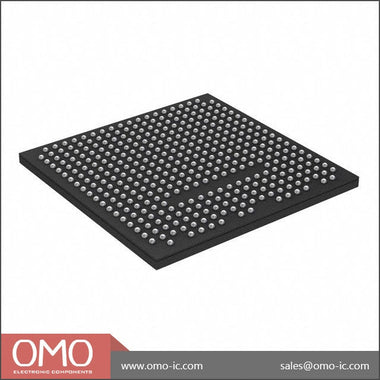
The XC7K420T is offered in several high-density, fine-pitch Ball Grid Array (BGA) packages to accommodate its large number of I/O pins and high-speed transceivers. Common packages include the FFG900 (900 balls, 31x31mm, 1.0mm pitch) and the FBG676 (676 balls, 27x27mm, 1.0mm pitch). The choice of package is a critical design decision, balancing PCB real estate, I/O requirements, and thermal performance.
The pinout is meticulously organized into I/O banks. Each bank can be powered by a different VCCO voltage (e.g., 1.8V, 2.5V, 3.3V), allowing the FPGA to interface directly with a wide variety of logic standards without external level-shifters. This simplifies PCB design and reduces bill-of-materials (BOM) cost. The pinout also dedicates specific locations for high-speed GTX transceiver differential pairs, clock inputs, and power/ground pins. Effective thermal management is crucial; these BGA packages often feature a thermally enhanced design, but designers must implement proper PCB-level solutions like thermal vias under the package and potentially a heat sink to dissipate the power generated during high-utilization operation.
Core Architectural Features
- DSP Slices: The XC7K420T is heavily optimized for digital signal processing. It contains a large number of dedicated DSP48E1 slices. Each slice includes a 25x18 bit multiplier, a 48-bit accumulator, and a pre-adder. This hardware is ideal for accelerating algorithms like Finite Impulse Response (FIR) filters, Fast Fourier Transforms (FFTs), and correlators, offloading these compute-intensive tasks from the general-purpose logic fabric and enabling extremely high throughput at lower power consumption.
- Clock Management: Sophisticated clocking is at the heart of the device's performance. The XC7K420T features multiple Clock Management Tiles (CMTs), each containing a Mixed-Mode Clock Manager (MMCM) and a Phase-Locked Loop (PLL). These blocks provide advanced clock synthesis, jitter filtering, and deskew capabilities. Engineers can use them to generate multiple clock domains from a single input reference, ensuring precise timing relationships across the entire FPGA, which is essential for high-frequency designs.
- High-Speed Transceivers: A key feature of the XC7K420T is its bank of high-speed serial transceivers (GTX). These transceivers support data rates up to 12.5 Gb/s per lane, enabling direct implementation of industry-standard protocols such as PCI Express (PCIe) Gen1/Gen2, 10 Gigabit Ethernet (XAUI/10GBASE-KR), Serial RapidIO (SRIO), and the Common Public Radio Interface (CPRI). The device also includes integrated PCIe blocks, simplifying the design of systems that connect to a host processor.
- Block RAM (BRAM): To support high-bandwidth data buffering, the device is equipped with a substantial amount of on-chip Block RAM. These are true dual-port 36Kb memory blocks that can be configured as two independent 18Kb blocks. This flexible, high-speed memory is essential for implementing FIFOs, packet buffers, video frame buffers, and processor caches directly on the FPGA fabric, eliminating the latency associated with external memory access.
- Power Efficiency: The 28nm HPL process technology is central to the Kintex-7 family's power efficiency. The XC7K420T operates with a core voltage (VCCINT) of 1.0V (or 0.9V in lower-power modes), significantly reducing static and dynamic power consumption. The Vivado design suite provides sophisticated tools for power analysis and optimization, allowing designers to implement techniques like clock gating to further minimize power draw in their applications.
Specifications Parameter Table
| Specification | Technical Details |
|---|---|
| Logic Cells | 416,900 |
| Look-Up Tables (LUTs) | 260,600 |
| DSP Slices (25x18) | 1,540 |
| Block RAM (BRAM) | 29,700 Kb (~29 Mb) |
| Maximum User I/O Pins | 500 (in FFG900 package) |
| Transceiver Speed (GTX) | Up to 12.5 Gb/s |
| PCIe Gen2 Blocks | 2 |
| Core Voltage (VCCINT) | 1.0V |
XC7K420T Equivalents and Alternatives
Choosing the right FPGA involves a careful trade-off between resources, performance, and cost. The XC7K420T sits in a powerful sweet spot, but engineers should consider these alternatives:
-
Within the Kintex-7 Family:
- XC7K325T: If a design requires the Kintex-7 architecture but does not need the full logic and DSP capacity of the 420T, the XC7K325T is an excellent lower-cost alternative. It offers fewer logic cells (~326k) and DSP slices (~840) but maintains the same high-performance transceivers and core features. Choose the XC7K325T when your design fits comfortably within its resource limits to optimize for cost.
- XC7K480T: For designs that are pushing the resource limits of the 420T, the XC7K480T is the next step up. It provides a significant increase in logic cells (~478k) and DSP slices (~1,800). An engineer should select the XC7K480T if their algorithm requires more parallel processing paths or if they need to accommodate future feature growth without changing the PCB footprint (as they share package options).
-
Competitor Alternatives:
- Intel (formerly Altera) Arria V GX: The Arria V GX family is a direct competitor to the Kintex-7. An equivalent Arria V GX device offers a similar blend of logic, memory, DSP, and transceivers on a 28nm process. An engineer might choose the Arria V GX if their design team has extensive experience with the Intel Quartus Prime design software, if their application can leverage specific Arria V architectural features like hard memory controllers, or if pricing and availability for a specific Arria V part are more favorable. However, the Kintex-7 family is often praised for its powerful DSP48E1 slices and the maturity and feature set of the Xilinx Vivado Design Suite. The choice often comes down to toolchain preference and specific resource mix requirements.
Typical Application & Block Diagram Considerations
The XC7K420T excels in applications that bridge the gap between data acquisition/transmission and high-performance processing. Common use cases include:
- Telecommunications: Implementing digital front-end (DFE) processing for 4G/5G remote radio heads, including digital up/down conversion, filtering, and crest factor reduction. The GTX transceivers are used for CPRI/JESD204B links to data converters.
- Machine Vision: High-resolution, high-frame-rate image pre-processing in industrial cameras. The FPGA can perform real-time pixel correction, color space conversion, and feature extraction before sending data to a host processor via PCIe.
- Aerospace & Defense: Building software-defined radio (SDR) platforms, radar signal processors, and secure communication systems. The combination of massive parallelism and DSP resources is ideal for these computationally intensive tasks.
From a PCB design perspective, several considerations are critical. A robust power delivery network (PDN) is non-negotiable. This requires multiple dedicated power planes and extensive use of high-quality decoupling capacitors placed as close as possible to the BGA balls for VCCINT and other power rails. Routing for the high-speed GTX transceiver differential pairs requires careful impedance control (typically 10

Alan Carter
Senior Hardware Engineer & Component Specialist
Alan has over 15 years of expertise in embedded systems design, FPGA architecture, and global semiconductor supply chains. He specializes in component cross-referencing, lifecycle management, and helping OEMs navigate supply shortages.
Frequently Asked Questions (FAQs)
What are the typical lead times for the XC7K420T-2FFG901I variant?
Lead times for the XC7K420T-2FFG901I are highly volatile and depend on factory allocation and distributor inventory. Standard factory lead times can range from 20 to 52+ weeks. For immediate needs, checking authorized and independent distributor stock is recommended, though this may come at a premium.
Are there any direct, pin-compatible replacements for the XC7K420T?
There are no direct, 100% drop-in replacements for the XC7K420T from other manufacturers. Within the Xilinx/AMD Kintex-7 family, the XC7K325T and XC7K355T in the same package (e.g., FFG901) are pin-compatible but offer fewer logic resources. Migration to a newer family like Kintex UltraScale or Versal would require a complete board redesign.
What is the maximum number of GTX transceivers on the XC7K420T and what is their maximum data rate?
The XC7K420T features up to 28 GTX transceivers. These transceivers support data rates up to 12.5 Gb/s, making them suitable for high-speed serial protocols such as 10G Ethernet (XAUI/10GBASE-KR), PCIe Gen2/Gen3, and CPRI.
What is the current lifecycle status of the XC7K420T? Is it recommended for new designs?
The XC7K420T is currently in "Active" production status. However, as part of the 28nm 7 Series family, it is considered a mature product. For new high-performance designs, AMD/Xilinx generally recommends considering newer families like Kintex UltraScale+ (16nm) or Versal AI Core Series for improved performance, power efficiency, and long-term availability.
What are the typical static and dynamic power consumption figures for an XC7K420T-2FFG901I?
Power consumption is highly design-dependent. A typical static power (Vccint) is around 1.5W. For a moderately utilized design (e.g., 60% logic, 16 GTX transceivers at 10 Gb/s), dynamic power can range from 15W to 25W. High-utilization designs can exceed 35W, requiring careful thermal management. Use the Xilinx Power Estimator (XPE) tool for accurate projections.
What are the primary package options for the XC7K420T and are they RoHS compliant?
The most common packages for the XC7K420T are the FBG900 (Flip-Chip BGA, 900-pin) and FFG901 (Flip-Chip Fine-Pitch BGA, 901-pin). All variants currently manufactured are RoHS-6 compliant (lead-free). The 'G' in the package code (e.g., FFG901) explicitly indicates a lead-free package.
Which version of the Vivado Design Suite is required to target the XC7K420T?
The XC7K420T is supported by the Vivado Design Suite. While older versions support the device, for access to the latest IP cores, bug fixes, and optimal performance, it is recommended to use Vivado 2019.1 or a more recent version. Always check the specific version's release notes for device support details.
How does the speed grade (-1, -2, -3) impact the cost and availability of the XC7K420T?
The speed grade significantly impacts both cost and availability. The -1 speed grade is the slowest and typically the most readily available and least expensive. The -2 grade offers a performance boost at a moderate price increase. The -3 grade, being the fastest, is the most expensive and often has the longest lead times and lowest stock levels, as it is binned from a smaller portion of the silicon wafer yield.
Looking for XC7K420T Inventory?
We offer competitive pricing, full traceability, and fast shipping for the XC7K420T and related components.
Check Stock & Request Quote