XC7K355T FPGA: Datasheet, Pinout, Equivalents, and Specs
The Xilinx XC7K355T is a high-performance FPGA from the Kintex-7 family, engineered to deliver an optimal balance of price, performance, and power consumption. Positioned as a mid-to-high-range solution, it provides substantial logic density, advanced DSP capabilities, and high-speed serial connectivity. This makes the XC7K355T an ideal choice for computationally intensive applications in markets such as telecommunications, medical imaging, aerospace, and industrial automation where performance-per-watt is a critical design metric.
What is the XC7K355T?
The XC7K355T is a Field-Programmable Gate Array (FPGA) built on a mature and power-efficient 28nm High-K Metal Gate (HKMG) process technology. This process node was a significant leap forward, enabling Xilinx to pack more functionality into a smaller area while drastically reducing static power consumption compared to previous 40nm or 65nm generations. The XC7K355T is part of the unified Xilinx 7-series architecture, which shares common building blocks (like logic cells, DSP slices, and clock management) across the Artix-7, Kintex-7, and Virtex-7 families. This architectural consistency allows for design scalability, enabling engineers to migrate designs up or down the family ladder with minimal effort.

The Kintex-7 family, and the XC7K355T specifically, is targeted at applications that require performance beyond the capabilities of lower-cost FPGAs but do not warrant the expense of the highest-end Virtex-7 devices. Its architecture is optimized for signal processing, featuring a high ratio of DSP slices to logic cells. This makes it exceptionally well-suited for implementing complex algorithms like Fast Fourier Transforms (FFTs), Finite Impulse Response (FIR) filters, and high-resolution video processing pipelines directly in hardware, offering deterministic, low-latency performance that is unattainable with traditional software-based processors.
Pinout Configuration and Packaging
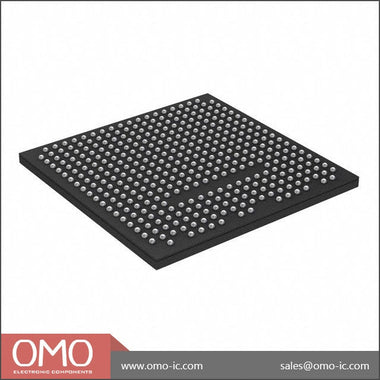
The XC7K355T is available in several high-density Fine-Pitch Ball Grid Array (FBGA) packages, designed to support the high number of I/O pins and high-speed signals the device offers. Common packages include the FBG484 (484 balls, 23x23mm), FFG676 (676 balls, 27x27mm), and FFG900 (900 balls, 31x31mm). The choice of package is a critical design decision, dictating the maximum number of available user I/O pins, thermal performance, and PCB layout complexity.
Key pinout characteristics include:
- I/O Banks: The user I/O pins are grouped into several banks. The Kintex-7 architecture features both High-Performance (HP) and High-Range (HR) I/O banks. HP banks are optimized for the highest performance single-ended and differential signaling standards (up to 1866 Mb/s), while HR banks support a wider range of I/O standards and voltages (from 1.2V to 3.3V), providing maximum flexibility for interfacing with various external components.
- Power and Ground Pins: A significant portion of the BGA footprint is dedicated to power (VCCINT, VCCAUX, VCCO, etc.) and ground (GND) balls. A robust Power Distribution Network (PDN) on the PCB is essential for stable operation, requiring careful placement of decoupling capacitors close to the BGA pins.
- High-Speed Transceiver Pins: The GTX transceiver pins are located in dedicated quads and require precise, controlled-impedance routing on the PCB to maintain signal integrity at multi-gigabit data rates.
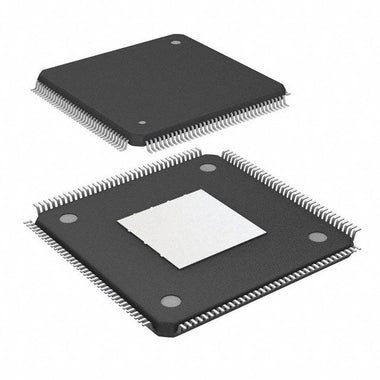
- Thermal Management: The packages often include a central ground pad or a die-attach paddle (DAP) that must be soldered to the PCB. This provides a low-impedance ground connection and, more importantly, serves as the primary path for heat dissipation from the die into the PCB. A proper thermal design, often involving thermal vias under the package, is crucial to prevent overheating and ensure reliable operation.
Core Architectural Features
- DSP Slices: The XC7K355T is equipped with a large number of dedicated DSP48E1 slices. Each slice contains a 25x18 bit two's complement multiplier, a 48-bit accumulator, and a pre-adder. This architecture is highly optimized for implementing digital signal processing algorithms with maximum efficiency and performance, offloading these tasks from the general-purpose logic fabric. They are fundamental for applications like software-defined radio (SDR), radar systems, and real-time image analysis.
- Clock Management: Sophisticated clocking is managed by Clock Management Tiles (CMTs). Each CMT contains one Mixed-Mode Clock Manager (MMCM) and one Phase-Locked Loop (PLL). These blocks provide powerful capabilities for clock synthesis, jitter filtering, frequency multiplication/division, and fine-grained phase shifting. This allows for the creation of a clean, stable, and complex clocking scheme required to support multiple high-speed interfaces and internal processing domains.
- High-Speed Transceivers: The device integrates multiple GTX serial transceivers, capable of data rates up to 12.5 Gb/s per lane. These transceivers are highly configurable and support a wide range of protocols, including PCI Express (PCIe) Gen1/Gen2, Serial RapidIO (SRIO), 10 Gigabit Ethernet (XAUI/10GBASE-KR), CPRI, and OBSAI. An integrated block for PCI Express provides a hardened, compliant endpoint, simplifying the implementation of this ubiquitous interface.
- Block RAM (BRAM): The XC7K355T contains a substantial amount of on-chip memory in the form of 36Kb Block RAMs. Each 36Kb BRAM can be configured as two independent 18Kb blocks. These are true dual-port memories, allowing simultaneous read and write access from different parts of the logic design. BRAM is essential for implementing FIFOs, data buffers, lookup tables, and processor caches, providing high-bandwidth, low-latency on-chip storage.
- Power Efficiency: Built on the 28nm HKMG process, the device is inherently power-efficient. It supports a low core voltage of 1.0V, with a 0.9V option for even lower static power consumption in certain speed grades. The Vivado design tools provide intelligent clock gating capabilities, automatically shutting down parts of the logic that are not actively switching, which significantly reduces dynamic power consumption.
Specifications Parameter Table
| Specification | Technical Details |
|---|---|
| Logic Cells | 356,960 |
| LUTs (6-input) | 223,100 |
| DSP Slices (DSP48E1) | 1,320 |
| Block RAM (BRAM) | 25,650 Kb (25.65 Mb) |
| Maximum User I/O Pins | Up to 500 (Package dependent) |
| Transceivers (GTX) | Up to 16 |
| Transceiver Speed | Up to 12.5 Gb/s (GTX) |
| PCI Express Block | Gen2 x8 Integrated Block |
| Core Voltage (VCCINT) | 1.0V (or 0.9V for low-power option) |
| Process Technology | 28nm HKMG |
XC7K355T Equivalents and Alternatives
Choosing the right FPGA involves a trade-off between resources, performance, and cost. When considering the XC7K355T, engineers should evaluate alternatives both within the Kintex-7 family and from competing manufacturers.
-
Within the Kintex-7 Family:
- XC7K160T: If a design prototyped on the XC7K355T ends up using significantly fewer resources (e.g., under 40% logic utilization and fewer than 8 transceivers), the XC7K160T is an excellent cost-down alternative. It offers roughly half the logic, DSP, and BRAM resources but shares the same architecture, making migration straightforward. This is a common strategy for creating different product tiers from a single base design.
- XC7K410T: Conversely, if a design is pushing the resource limits of the XC7K355T, the XC7K410T is the logical upgrade path. It provides approximately 25% more logic cells, BRAM, and DSP slices, offering more headroom for feature additions or algorithm complexity without requiring a major architectural change.
-
Competitor Alternatives (Intel/Altera):
- Intel Arria V GZ/GT: The Arria V family was Intel's (formerly Altera's) direct competitor to the Kintex-7 series, also built on a 28nm process. An Arria V GT device with similar logic density would be a primary alternative. An engineer might choose the Arria V if their team has extensive experience with the Quartus Prime design software, if the project requires specific Altera IP cores, or if they have existing designs on the Altera platform. The XC7K355T, however, is often lauded for the maturity of the Vivado Design Suite and its superior synthesis and place-and-route algorithms, which can lead to better timing closure and performance. The choice often comes down to toolchain preference, existing IP, and specific transceiver protocol requirements.
The decision-making process is clear: choose the XC7K160T for cost reduction, the XC7K410T for resource expansion, and consider the Arria V if the design ecosystem and legacy tools are a primary factor. For new

Alan Carter
Senior Hardware Engineer & Component Specialist
Alan has over 15 years of expertise in embedded systems design, FPGA architecture, and global semiconductor supply chains. He specializes in component cross-referencing, lifecycle management, and helping OEMs navigate supply shortages.