XC6SLX9-2TQG144I Datasheet, Pinout, Equivalents, and Specs
The XC6SLX9-2TQG144I is a Field-Programmable Gate Array (FPGA) from the Xilinx Spartan-6 family, fabricated on a mature 45nm low-power copper interconnect process. It provides a balanced architecture of logic resources, block RAM, and DSP slices, making it suitable for a wide range of cost-sensitive, high-volume applications. Housed in a 144-pin TQFP package and rated for the industrial temperature range, this device is engineered for logic integration, interface bridging, and co-processing tasks in embedded systems.
Table of Contents
What is the XC6SLX9-2TQG144I?
The XC6SLX9-2TQG144I is a specific configuration of the Spartan-6 LX series FPGA. The part number decodes as follows: XC6S for Spartan-6, LX9 indicating a logic-optimized device with approximately 9,000 logic cells, -2 for the standard speed grade, TQG144 for the 144-pin Thin Quad Flat Package, and I for the industrial operating temperature range (-40°C to 100°C). The internal architecture is built around four-input Look-Up Tables (LUTs) and flip-flops, organized into configurable logic blocks (CLBs). It also integrates dedicated resources such as 18 Kb Block RAMs, DSP48A1 slices for arithmetic operations, and Clock Management Tiles (CMTs) for precise clock synthesis and distribution.

Pinout Configuration and Packaging
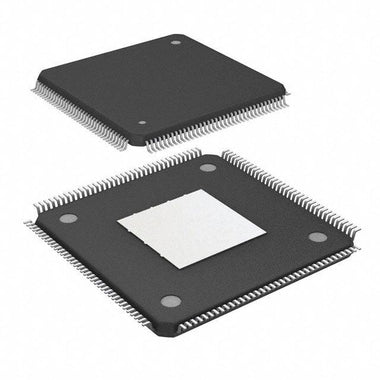
The XC6SLX9-2TQG144I is offered in the TQG144 package, a 144-pin Thin Quad Flat Pack with a 20x20 mm body and 0.5 mm lead pitch. This package provides up to 102 user I/O pins. The pins are organized into I/O banks, with each bank having a dedicated power supply pin (VCCO) that determines the voltage standard for all I/Os within that bank. Key pins include dedicated configuration pins for JTAG (TMS, TCK, TDI, TDO), mode selection (M0, M1), and the configuration clock (CCLK). Multiple VCCINT (core voltage), VCCAUX (auxiliary voltage), and GND pins are distributed throughout the package to ensure stable power delivery and signal integrity.
Core Architectural Features
- Configurable Logic Blocks (CLBs): Contains two slices, each with four 6-input LUTs (usable as two 5-input LUTs), wide-function multiplexers, and eight flip-flops/latches. This structure provides a high degree of logic implementation flexibility.
- Block RAM: Features 576 Kbits of total Block RAM, organized as 32 blocks of 18 Kb each. Each block can be configured as two independent 9 Kb RAMs, supporting true dual-port operation for efficient data buffering and storage.
- DSP48A1 Slices: Integrates 16 dedicated DSP slices, each containing an 18x18 multiplier, an accumulator, and a pre-adder. These slices enable high-performance, power-efficient implementation of signal processing algorithms like FIR filters and FFTs.
- Clock Management Tiles (CMTs): Includes two CMTs, each with two Digital Clock Managers (DCMs) and one Phase-Locked Loop (PLL). These blocks provide robust capabilities for clock de-skew, frequency synthesis, and jitter filtering.
- SelectIO Technology: The I/O blocks support over 20 different voltage and protocol standards, including LVCMOS, LVTTL, HSTL, and SSTL, on a per-bank basis, enabling direct interfacing with a wide variety of external components.
Specifications Parameter Table
| Specification | Technical Details |
|---|---|
| Logic Cells | 9,152 |
| Number of Slices | 1,430 |
| Total Block RAM | 576 Kbits |
| Number of DSP48A1 Slices | 16 |
| Maximum User I/O | 102 |
| Core Supply Voltage (VCCINT) | 1.14V to 1.26V (1.2V Nominal) |
| Operating Temperature Range | -40°C to 100°C (Junction) |
XC6SLX9-2TQG144I Equivalents, Cross Reference, and Lifecycle
The XC6SLX9-2TQG144I is a mature component but remains active in production for legacy designs and specific industrial applications. When considering alternatives, direct pin-to-pin compatibility is typically only found within the same device family and package. For instance, the XC6SLX16-2TQG144I offers more logic resources in the identical TQG144 package, providing a potential upgrade path if a design requires more logic. Conversely, the XC6SLX4-2TQG144I is a lower-density, pin-compatible option for cost reduction if the design's resource utilization is low. A functional equivalent from a different manufacturer, such as an Intel/Altera Cyclone IV series device, would require a complete redesign of the PCB and firmware. Due to its lifecycle status, verifying stock is essential for new designs. You can Check XC6SLX9-2TQG144I Inventory & Pricing to assess current availability. For a wider selection of devices in this family, you can Browse Spartan-6 Series components.
Typical Application & Circuit Considerations
The XC6SLX9-2TQG144I is well-suited for applications requiring custom logic, I/O expansion, and moderate signal processing. Common use cases include industrial motor control, machine vision pre-processing, legacy bus protocol bridging (e.g., ISA to SPI), custom glue logic in embedded systems, and data acquisition front-ends. From a circuit design perspective, robust power delivery is critical. Each VCCINT and VCCAUX pin should be decoupled with a 100nF low-ESR ceramic capacitor placed as close to the pin as possible. A bulk capacitance of 10-47uF should also be present on each power rail. Careful attention to the power-on sequence specified in the Xilinx documentation is necessary to prevent latch-up and ensure proper device initialization.
Video Demonstration
Frequently Asked Questions (XC6SLX9-2TQG144I FAQ)
Q: What is the significance of the "-2" speed grade in the XC6SLX9-2TQG144I part number?
A: The "-2" denotes the speed grade of the FPGA, which dictates its timing performance characteristics. It is the standard industrial speed grade for this device. A higher number, such as "-3", indicates a faster part with lower propagation delays and the ability to support higher clock frequencies. Conversely, a lower speed grade like "-1L" would be slower but optimized for lower power. The choice of speed grade depends on the timing constraints of the specific application; for many designs, the "-2" grade provides an adequate balance of performance and cost.
Q: How is the configuration memory stored in the XC6SLX9-2TQG144I?
A: The XC6SLX9-2TQG144I, like all Spartan-6 FPGAs, is based on SRAM technology. This means its configuration is volatile and must be loaded from an external non-volatile memory source each time the device is powered on. The configuration data, or "bitstream," is typically stored in an external SPI flash memory chip. Upon power-up, the FPGA acts as a master and clocks the data out of the SPI flash to configure its internal logic, I/O, and routing.
Q: What are the core and I/O voltage requirements for this device?
A: The device requires several distinct power rails. The core logic voltage (VCCINT) has a nominal value of 1.2V. The auxiliary voltage (VCCAUX), which powers internal resources like CMTs and JTAG circuitry, is 2.5V. The I/O voltage (VCCO) is flexible and must be supplied to each I/O bank independently. The VCCO for a given bank can range from 1.2V to 3.3V, which determines the output voltage standard (e.g., LVCMOS33) for all pins in that bank.
Q: Can the I/O pins on the XC6SLX9-2TQG144I support 3.3V LVCMOS signaling?
A: Yes, the I/O pins can support 3.3V LVCMOS signaling. This is enabled by the SelectIO technology. To implement a 3.3V interface, the VCCO supply for the specific I/O bank containing the relevant pins must be connected to a 3.3V power supply. This sets the output high voltage level to 3.3V and makes the inputs 3.3V tolerant. It is critical to ensure that all devices connected to that bank are compatible with this voltage level.
Q: What software development tools are used to program the Spartan-6 family?
A: The Spartan-6 family, including the XC6SLX9-2TQG144I, is supported by the Xilinx ISE Design Suite. The last version to provide full support for Spartan-6 is ISE 14.7. It is important to note that the newer Xilinx Vivado Design Suite does *not* support Spartan-6 or any older device families. Therefore, any development, synthesis, implementation, and bitstream generation for this FPGA must be performed using the appropriate version of the ISE software.

Alan Carter
Senior Hardware Engineer & Component Specialist
Alan has over 15 years of expertise in embedded systems design, FPGA architecture, and global semiconductor supply chains. He specializes in component cross-referencing, lifecycle management, and helping OEMs navigate supply shortages.