XC6SLX16-2CSG324C Datasheet, Pinout, Equivalents, and Specs
The XC6SLX16-2CSG324C is a Field-Programmable Gate Array (FPGA) from the Xilinx (now AMD) Spartan-6 family, engineered to provide a cost-effective solution for high-volume logic designs. It solves the problem of integrating complex digital logic, memory, and signal processing functions into a single component, reducing board space, power consumption, and bill of materials (BOM) cost. This device strikes a balance between performance, power, and price, making it a workhorse for a wide range of applications from industrial control to consumer electronics where flexibility and time-to-market are critical.

Table of Contents
What is the XC6SLX16-2CSG324C?
The XC6SLX16-2CSG324C is a member of the logic-optimized Spartan-6 LX series, built on a mature 45 nm low-power copper interconnect process technology. As an FPGA, it is a semiconductor device containing a matrix of configurable logic blocks (CLBs) and programmable interconnects. Unlike a fixed-function ASIC or microcontroller, its internal hardware can be reconfigured by the designer using a hardware description language (HDL) like VHDL or Verilog. This specific part number denotes a device with a substantial amount of logic resources, making it a mid-range option within the Spartan-6 family.
At its core, the architecture is based on 6-input Look-Up Tables (LUTs), a significant feature of the Spartan-6 family. Each Configurable Logic Block (CLB) contains two slices, and each slice is composed of four 6-input LUTs and eight flip-flops. This structure provides a high degree of logic granularity and efficiency, allowing more complex combinatorial functions to be implemented per LUT compared to older 4-input architectures. For the XC6SLX16, this translates to 14,579 logic cells organized into 2,278 slices.
Beyond general-purpose logic, the XC6SLX16 integrates specialized hardware blocks to accelerate common functions. It includes 32 DSP48A1 slices, which are dedicated hardware blocks for digital signal processing. Each DSP slice contains a high-speed 18x18 multiplier, an adder, and an accumulator, essential for implementing functions like FIR filters, FFTs, and correlators without consuming general logic resources. For on-chip data storage, the device provides 576 Kb of total Block RAM, organized as 32 blocks of 18 Kb each. These dual-port RAMs are critical for buffering data streams, implementing FIFOs, and creating local memory for embedded soft-core processors like the MicroBlaze.
Clocking is managed by two Clock Management Tiles (CMTs). Each CMT contains two Digital Clock Managers (DCMs) and one Phase-Locked Loop (PLL). These blocks are crucial for robust clock network design, providing capabilities for clock synthesis, frequency division/multiplication, phase shifting, and jitter reduction. This ensures reliable system timing across the device, even in complex, multi-clock domain designs.
Pinout Configuration and Packaging
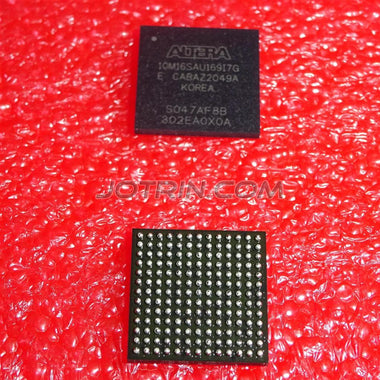
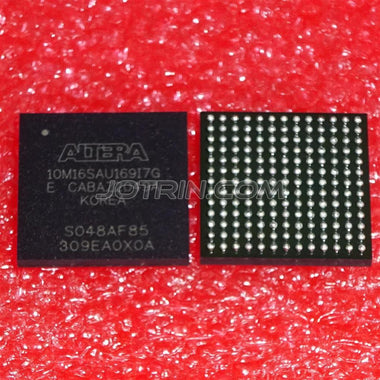
The XC6SLX16-2CSG324C is offered in the CSG324 package. This is a 324-ball Chip Scale BGA (Ball Grid Array) with a 15x15 mm body size and a 0.8 mm ball pitch. This fine-pitch package enables a high I/O count in a small footprint, but it requires precise PCB manufacturing and assembly processes. Out of the 324 balls, 232 are available as user I/O, providing ample connectivity for most target applications.
The pinout is organized into several functional categories, which are critical for a hardware designer to understand during schematic capture and PCB layout:
-
Power Pins: The device requires multiple power rails.
VCCINTsupplies the internal core logic.VCCAUXpowers auxiliary internal logic, including JTAG and configuration circuits.VCCO_0,VCCO_1,VCCO_2, andVCCO_3are the I/O bank voltages, allowing different I/O standards to be used on different banks of the FPGA. A large number ofGNDpins are provided and must be connected to a solid ground plane for signal integrity and power stability. - User I/O Pins: These are the general-purpose input/output pins that connect to the rest of the system. They are grouped into four banks, with each bank's I/O standard determined by its respective VCCO supply.
-
Configuration Pins: These pins control the loading of the configuration bitstream. Key pins include
PROGRAM_B(to initiate configuration),DONE(indicates successful configuration),INIT_B(indicates configuration errors), and the mode pins (M0,M1) which select the configuration mode (e.g., Master SPI, Slave Serial). -
JTAG Pins: The standard JTAG Test Access Port pins (
TCK,TMS,TDI,TDO) are used for boundary-scan testing, programming the bitstream, and on-chip debugging with tools like the ChipScope Pro analyzer. -
Dedicated Clock Inputs: The package includes dedicated global clock input pins (
GCLK) that are routed to the internal clock network with low skew, making them the preferred inputs for high-frequency system clocks.
Proper pin assignment and PCB layout, especially for power and high-speed signals, are paramount for a successful design using the CSG324 package. Designers should consult the Xilinx UG393, Spartan-6 FPGA PCB Design and Pin-Planning Guide, for detailed layout recommendations.
Core Architectural Features
- Advanced 6-Input LUT Logic Fabric: The fundamental building block is the 6-input Look-Up Table (LUT) with dual flip-flops. This architecture increases logic density, allowing more complex functions to be implemented in a single logic element. This leads to better device utilization, reduced routing congestion, and potentially higher performance compared to older 4-input LUT structures.
- High-Performance DSP48A1 Slices: The device integrates 32 dedicated DSP slices, each featuring an 18 x 18 two's complement multiplier, a 48-bit accumulator, and a pre-adder. These blocks can operate at high frequencies and are optimized for computationally intensive DSP algorithms, offloading the work from the general-purpose logic fabric.
- Flexible Block RAM with FIFO Support: It includes 576 Kb of true dual-port Block RAM. Each 18 Kb block can be configured as two independent 9 Kb blocks. They feature built-in logic to efficiently implement synchronous or asynchronous FIFOs, which is essential for clock domain crossing and data buffering between different system components.
- SelectIO™ Interface Technology: The I/O blocks are highly configurable, supporting over 30 different I/O standards. Each I/O bank can be powered independently (via its VCCO pin), enabling the FPGA to interface directly with multiple devices that use different voltage levels and signaling standards (e.g., 3.3V LVCMOS, 2.5V LVCMOS, 1.8V HSTL) without external level-shifting hardware.
- Integrated Memory Controller Blocks: The XC6SLX16 includes dedicated hardware blocks to create efficient and reliable memory controllers for external memory interfaces. It supports various standards including DDR, DDR2, DDR3, and LPDDR, simplifying the design of systems that require large amounts of off-chip memory.
Specifications Parameter Table
| Specification | Technical Details |
|---|---|
| Logic Cells | 14,579 |
| Number of Slices | 2,278 |
| Number of Flip-Flops | 18,224 |
| Total Block RAM | 576 Kb |
| DSP48A1 Slices | 32 |
| Maximum User I/O | 232 |
| Core Voltage (VCCINT) | 1.2V (Nominal) |
| Speed Grade | -2 (Commercial Grade, Standard Performance) |
XC6SLX16-2CSG324C Equivalents, Cross Reference & Lifecycle
The Xilinx Spartan-6 family is a mature product line. While not recommended for brand new designs where newer families like Artix-7 or Zynq-7000 offer better performance-per-watt, the Spartan-6 series remains in production and is a critical component for sustaining engineering, product maintenance, and long-life industrial and automotive applications. Its availability is managed for these existing designs.
When considering alternatives, it's important to distinguish between pin-compatible and functionally similar devices:
- Pin-Compatible Alternatives: Within the same family and package (CSG324), other variants may be used. The XC6SLX16-3CSG324C is a faster speed grade version and is typically a drop-in replacement, provided the original design's timing constraints are met. The XC6SLX16-2CSG324I is the industrial temperature grade version, offering a wider operating temperature range. For a design with lower logic requirements, the XC6SLX9-2CSG324C is a smaller, pin-compatible device in the same package, though this requires recompiling the design for the smaller target.
- Functionally Similar Alternatives: There is no direct, drop-in replacement for the XC6SLX16 from a different FPGA family (e.g., Xilinx 7-series or Intel/Altera Cyclone series). Migrating to a device like a Xilinx Artix-7 (e.g., XC7A15T) would require a complete redesign of the PCB due to different package footprints, pinouts, and power supply requirements. The design logic would also need to be re-synthesized, re-implemented, and re-verified using the Vivado Design Suite instead of the ISE Design Suite used for Spartan-6.
For ongoing production or repair, sourcing the exact part number is the most reliable path. Check XC6SLX16-2CSG324C Inventory & Pricing to ensure supply chain stability for your project.
Typical Applications & Circuit Considerations
The XC6SLX16-2CSG324C's blend of logic, DSP, and memory resources makes it suitable for a wide array of cost-sensitive applications that require more processing power and flexibility than a standard microcontroller can offer.
Typical Applications:
- Industrial Control and Automation: Used for real-time motor control loops, implementing custom PLC logic, interfacing with industrial sensors and actuators, and pre-processing data in machine vision systems.
- Automotive Systems: Found in older-generation infotainment systems for graphics acceleration and display control, in-cabin networking gateways (e.g., CAN to Ethernet), and some driver-assistance functions.
- Consumer Electronics: Deployed in set-top boxes for video stream demultiplexing, in flat-panel displays for timing control (TCON), and in home networking equipment for custom packet handling.
- Test and Measurement: Serves as the core of data acquisition systems, arbitrary waveform generators, and logic analyzers, where its reconfigurability is a key advantage.
Circuit Design Considerations:
A successful design with the XC6SLX16 requires careful attention to the PCB layout, particularly for power and configuration.
Power Distribution Network (PDN): The device has strict requirements for its power rails (VCCINT, VCCAUX, VCCOs). A low-impedance PDN is essential. This is achieved by using multiple power and ground planes in the PCB stack-up and placing high-quality, low-ESR ceramic decoupling capacitors as close as possible to every power pin of the BGA package. A common strategy is to place a combination of 0.1µF, 0.01µF, and larger bulk capacitors (e.g., 10µF) for each power rail to provide low impedance across a wide frequency range. Refer to Xilinx User Guide UG393 for specific recommendations.
Configuration Circuitry: The most common configuration method is Master SPI mode, where the FPGA reads its configuration bitstream from an external SPI flash memory upon power-up. The designer must ensure the SPI flash is compatible and that the SPI signal traces (SCK, MOSI, MISO, CS) are routed cleanly. The mode pins (M0, M1) must be pulled to the correct levels to select this mode.
Thermal Management: While the Spartan-6 is a low-power family, designs that heavily utilize the DSP slices or run high-frequency logic can generate significant heat. The CSG324 package relies on the PCB for heat dissipation. A grid of thermal vias placed directly under the package, connecting the central ground pad to internal ground planes, is a standard and effective technique for drawing heat away from the die.
Exploring the capabilities of the entire family can help in selecting the right device for your cost and performance targets. Browse Spartan-6 Series to compare different densities and features.
Video Demonstration
Frequently Asked Questions (XC6SLX16-2CSG324C FAQ)
What does the part number XC6SLX16-2CSG324C mean?
The part number is a code that describes the device's specifications. 'XC' stands for Xilinx Commercial. '6S' denotes the Spartan-6 family. 'LX16' indicates it's a logic-optimized (LX) device with approximately 16K logic cells (14,579 to be exact). The '-2' is the speed grade, where a lower number is slower. 'CSG324' specifies the package: a 324-ball Chip Scale BGA. Finally, 'C' indicates it is for commercial temperature range (0°C to 85°C junction temperature).
What software is used to program the XC6SLX16-2CSG324C?
The Spartan-6 family, including the XC6SLX16, is supported by the Xilinx ISE Design Suite. The latest version that supports Spartan-6 is ISE 14.7. It is important to note that this device is not supported by the newer Xilinx Vivado Design Suite, which is intended for the 7-series FPGAs and beyond. Therefore, all development, synthesis, implementation, and bitstream generation for this part must be done using the ISE toolchain.
Is the XC6SLX16-2CSG324C a 5V tolerant device?
No, the I/O pins on the XC6SLX16-2CSG324C are not 5V tolerant. According to the official datasheet (DS162), the absolute maximum voltage on user I/O pins (VIN) is 4.1V. The I/O standards supported, such as LVCMOS33, have a nominal voltage of 3.3V. Applying 5V directly to any I/O pin will exceed the absolute maximum ratings and will likely cause permanent damage to the device.
What is the difference between a Spartan-6 LX and LXT device?
The primary difference is the inclusion of high-speed serial transceivers. The 'LX' series, like the XC6SLX16, is optimized for logic-heavy designs and does not contain Gigabit Transceivers (GTPs). The 'LXT' series (e.g., XC6SLX45T) integrates one or more GTP transceivers, making them suitable for applications requiring high-speed serial interfaces like PCI Express, Serial ATA (SATA), or Gigabit Ethernet. Both families share the same core logic fabric, Block RAM, and DSP slices.
Can I migrate a design from a Spartan-3 to this Spartan-6 device?
Migration is possible but it is not a simple drop-in replacement. It requires a significant engineering effort. The core architectures are different (Spartan-3 uses 4-input LUTs, Spartan-6 uses 6-input LUTs), so the design must be re-synthesized and re-implemented for the new target. Pinouts and packages are different, necessitating a full PCB redesign. Power supply requirements are also different, as Spartan-6 uses a lower core voltage (1.2V) than most Spartan-3 devices. While Xilinx provides guides for migration, it should be treated as a new design project that reuses the original HDL code.