EP4SGX180HF35C2N Datasheet, Pinout, Equivalents, and Specs
The EP4SGX180HF35C2N is a high-performance FPGA in Intel's (formerly Altera) Stratix IV GX family, fabricated on TSMC's 40 nm low-power process with a 0.9 V core supply. It integrates 70,300 Adaptive Logic Modules (ALMs) equivalent to 175,750 logic elements, 13,954 Kbit of total embedded memory across 950 M9K and 20 M144K blocks, 920 embedded 18×18 multipliers, up to 24 CDR-based full-duplex transceivers operating at 8.5 Gbps, and 564 user I/O pins in a 1152-pin flip-chip FBGA package. With speed grade C2 and commercial-grade operation (0 °C to 85 °C), the EP4SGX180HF35C2N targets high-bandwidth networking equipment, telecom infrastructure, PCIe Gen2 accelerator cards, high-frequency trading systems, and advanced DSP platforms requiring integrated multi-gigabit serial connectivity.
Need EP4SGX180HF35C2N?
Check real-time stock, pricing, and volume discounts for worldwide distribution.
Request a Quote · EP4SGX180HF35C2N Check EP4SGX180HF35C2N Stock1. What Is the EP4SGX180HF35C2N?
The EP4SGX180HF35C2N belongs to the Stratix IV GX product line — Intel's 40 nm, high-performance FPGA family designed for bandwidth-intensive applications requiring integrated multi-gigabit transceivers. The “EP4SGX180” designation indicates the Stratix IV GX die with 70,300 ALMs (175,750 equivalent logic elements), “HF35” specifies the 1152-pin flip-chip FBGA package (35 × 35 mm body) with the maximum transceiver configuration, “C2” denotes the second-fastest commercial speed grade, and the trailing “N” confirms lead-free (RoHS-compliant) packaging.
Compared to smaller members of the Stratix IV GX family such as the EP4SGX110 (43,000 ALMs) or the larger EP4SGX230 (91,200 ALMs), the EP4SGX180 occupies the mid-range density sweet spot — delivering 63% more logic than the EP4SGX110 while consuming less power and costing less than the EP4SGX230. This positions the EP4SGX180 as the ideal device for designs that outgrow the EP4SGX110 but do not require the full capacity of the EP4SGX230 or EP4SGX360.
The Stratix IV GX architecture builds on the Stratix III ALM structure, with each ALM containing an 8-input fracturable look-up table (LUT), two registers, two dedicated full adders, and carry chain connections. The 950 M9K memory blocks provide 8,550 Kbit of dual-port SRAM, each configurable as single-port RAM, simple dual-port, true dual-port RAM, ROM, or FIFO buffers operating at up to 600 MHz. The 20 M144K blocks add 2,880 Kbit of high-density memory optimized for large buffers. The 920 embedded 18×18 multipliers support high-throughput DSP operations including fixed-point and floating-point arithmetic.

2. Pinout Configuration and Packaging
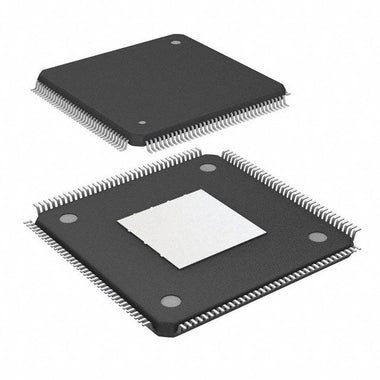
The EP4SGX180HF35C2N is housed in a 1152-pin FineLine BGA (FBGA) flip-chip package designated HF35, with a 35 × 35 mm body and 1.0 mm ball pitch. The flip-chip construction places the die face-down, providing shorter interconnect paths for superior signal integrity at multi-gigabit data rates. Of the 1152 balls, 564 are available as user I/O, distributed across multiple independent I/O banks.
The “H” in HF35 denotes the high transceiver count configuration, providing up to 24 full-duplex CDR-based transceiver channels organized in six-channel transceiver blocks. Each transceiver block includes its own transmit PLL, CDR circuitry, and signal conditioning (programmable pre-emphasis and equalization). The transceiver channels are arranged along two sides of the die, with dedicated REFCLK input pins for each transceiver block.
Each general-purpose I/O bank supports an independent VCCIO supply rail, enabling mixed-voltage interfacing. The IOE architecture supports LVTTL (3.3 V), LVCMOS (1.2 V to 3.3 V), SSTL-2, SSTL-18, HSTL-18, HSTL-15, differential LVDS at up to 1.6 Gbps, mini-LVDS, RSDS, LVPECL, and PPDS. The device supports DDR3 SDRAM at up to 533 MHz (1,066 Mbps), DDR2 SDRAM, QDR II+ SRAM, and RLDRAM II external memory interfaces with DQS/DQS# alignment calibration.
%3C/text%3E%3C/svg%3E)
3. Specifications Parameter Table
| Parameter | Value |
|---|---|
| Manufacturer | Intel (formerly Altera) |
| Family | Stratix IV GX |
| Process Node | TSMC 40 nm low-power CMOS |
| Adaptive Logic Modules (ALMs) | 70,300 |
| Equivalent Logic Elements (LEs) | 175,750 |
| Registers | 140,600 |
| M9K Memory Blocks | 950 |
| M144K Memory Blocks | 20 |
| MLAB Memory | 2,197 Kbit |
| Total Embedded RAM | 13,954 Kbit (13.6 Mbit) |
| Embedded 18×18 Multipliers | 920 |
| PLLs | 8 (4 general-purpose + 4 dedicated) |
| Global Clock Networks | 16 |
| Transceivers (CDR-based) | Up to 24 full-duplex channels |
| Max Transceiver Data Rate | 8.5 Gbps |
| PCIe Hard IP | Gen1/Gen2, x1/x4/x8 |
| User I/O Pins | 564 |
| Package | 1152-FBGA Flip-Chip (35 × 35 mm, 1.0 mm pitch) |
| Core Voltage (VCCINT) | 0.87 V to 0.93 V (nominal 0.9 V) |
| Max I/O Voltage (VCCIO) | 3.3 V |
| Speed Grade | C2 (Commercial, 0 °C to 85 °C) |
| I/O Standards | LVTTL, LVCMOS, SSTL-2/18, HSTL-18/15, LVDS, PCI, PCI-X |
| External Memory Interfaces | DDR3 (533 MHz), DDR2, QDR II+, RLDRAM II |
| Configuration Modes | Active Serial (AS), Passive Serial (PS), FPP, JTAG |
| RoHS Compliant | Yes (lead-free, “N” suffix) |
Looking for EP4SGX180HF35C2N Inventory?
Check our real-time stock levels, pricing, and volume discounts for global distribution.
Check EP4SGX180HF35C2N Stock4. Typical Applications and Circuit Considerations
The EP4SGX180HF35C2N is engineered for applications demanding the combination of high programmable logic density, extensive embedded memory, and integrated multi-gigabit serial transceivers. Its 70,300 ALMs, 920 multipliers, 13.9 Mbit total RAM, and up to 24 transceivers at 8.5 Gbps make it suitable for the most demanding system-level designs:
- Telecom Infrastructure and Packet Processing: The 24 high-speed transceiver channels enable direct 10G Ethernet (XAUI), SONET/SDH OC-192, CPRI/OBSAI base station interfaces, and Serial RapidIO switch fabrics. The combination of large embedded memory for packet buffering and extensive ALM resources for deep packet inspection, traffic shaping, and QoS classification makes the EP4SGX180 a natural fit for line cards, routers, and wireless baseband units.
- PCI Express Accelerator Cards: The dedicated PCIe Gen2 hard IP blocks implement x1, x4, or x8 lanes with full transaction, data link, and physical layers in silicon, freeing logic resources for the application-specific accelerator. This enables FPGA-based compute offload for financial trading, genomics, database acceleration, and machine learning inference at wire speed.
- High-Performance DSP and Radar Systems: The 920 multiplier blocks support massively parallel FIR/IIR filtering, multi-channel FFT computation, digital beamforming, and pulse compression for phased-array radar and electronic warfare applications. The M144K blocks provide large FIFO buffers for high-bandwidth data streaming between processing stages.
- Video and Broadcast Infrastructure: Multiple 3G-SDI, HD-SDI, HDMI, and DisplayPort streams can be received, processed, and retransmitted through the integrated transceivers, enabling multi-channel video switching, format conversion, and real-time image processing for broadcast and pro-AV systems.
For power supply design, Intel recommends a multi-rail architecture: VCCINT at 0.9 V (core logic), VCCA at 2.5 V (PLL analog), VCCD_PLL at 0.9 V (PLL digital), bank-specific VCCIO rails, and separate transceiver supply rails including VCCH_GXB at 1.4 V or 1.5 V for the output drivers. The flip-chip BGA requires careful PCB stackup design with controlled-impedance differential pairs for transceiver channels. Browse EP4CGX150DF27C7N for a Cyclone IV GX alternative with transceivers, or explore the full Stratix IV Series for related components.

4b. Video: Stratix IV GX FPGA Design Tutorial
5. Equivalents, Cross-Reference, and Lifecycle
The Stratix IV family is classified as mature by Intel/Altera. While production continues for existing orders, Intel recommends newer Stratix V or Stratix 10 devices for new designs. Quartus Prime Standard Edition version 19.1 and earlier provides full Stratix IV compilation support.
For engineers evaluating migration paths or pin-compatible alternatives, the following cross-reference is useful:
- EP4SGX180HF35C3N — Same die and package, slower speed grade C3. Lower-cost alternative when maximum performance is not required.
- EP4SGX230HF35C2N — Pin-compatible step-up with 91,200 ALMs (228,000 LEs) in the same 1152-FBGA package. Choose when EP4SGX180 utilization exceeds 75%.
- EP4SGX360HF35C2N — The largest Stratix IV GX in the HF35 package with 143,520 ALMs. For designs requiring maximum logic density within the Stratix IV architecture.
- EP4SGX110HF35C2N — Cost-reduced option with 43,000 ALMs in the same package. Suitable when logic utilization is well below 50%.
- 5SGXEA7N2F45C2N (Stratix V GX) — Intel's recommended forward migration for new designs. 28 nm process, higher logic density, up to 14.1 Gbps transceivers, and improved power efficiency.
- 1SG280HU2F50E2VG (Stratix 10 GX) — Intel's latest high-end FPGA family. 14 nm tri-gate process, up to 28.3 Gbps transceivers, HBM2 memory support, and dramatically higher performance.
Second-source options for the EP4SGX180 die do not exist, as Stratix IV is proprietary to Intel. Functionally equivalent devices from competing vendors include the Xilinx Virtex-6 LX240T (similar logic density and transceiver count) and the Lattice ECP5-85F (lower transceiver speed but open-source toolchain). Neither is pin-compatible. Compare EP4CE10E22C8N for a smaller Intel FPGA without transceivers.
6. Frequently Asked Questions (FAQ)
Q: What is the difference between EP4SGX180HF35C2N and EP4SGX230HF35C2N?
A: The EP4SGX180HF35C2N provides 70,300 ALMs (175,750 equivalent logic elements) with 950 M9K blocks totaling 8,550 Kbit M9K RAM, while the EP4SGX230HF35C2N offers 91,200 ALMs (228,000 LEs) with 1,235 M9K blocks. Both share the same 1152-FBGA HF35 package (35 × 35 mm), C2 speed grade, and transceiver complement. The EP4SGX230 delivers approximately 30% more logic capacity and 30% more M9K memory, making it the step-up choice when EP4SGX180 utilization exceeds 75%.
Q: What transceiver protocols does the EP4SGX180HF35C2N support?
A: The EP4SGX180HF35C2N integrates up to 24 CDR-based full-duplex transceivers operating from 600 Mbps to 8.5 Gbps. These transceivers include hard PCS and PMA blocks supporting PCI Express Gen1/Gen2 (x1/x4/x8), Gigabit Ethernet (SGMII, 1000BASE-X), XAUI/HiGig, 10G Ethernet XAUI, Serial RapidIO 1.2/2.0, SONET/SDH (OC-12/48/192), OBSAI RP3, CPRI, and Interlaken. Dedicated PCI Express hard IP blocks implement the full protocol stack including physical, data link, and transaction layers.
Q: What development tools are required for the EP4SGX180HF35C2N?
A: The EP4SGX180HF35C2N requires Intel Quartus Prime Standard Edition (version 19.1 or earlier) with a paid license, as Stratix IV is not supported in the free Lite Edition. Design entry supports Verilog HDL, SystemVerilog, and VHDL. A USB Blaster II JTAG programmer is required for configuration and debugging. The Altera Stratix IV GX FPGA Development Kit (DK-DEV-4SGX230N) provides a complete hardware platform. Quartus Platform Designer generates Avalon-MM/ST interconnect fabric for Nios II SoC integration.
Q: What is the power supply architecture for the EP4SGX180HF35C2N?
A: The EP4SGX180HF35C2N requires multiple regulated supply rails: VCCINT at 0.9 V (core logic, 0.87–0.93 V tolerance), VCCA at 2.5 V (PLL analog supply), VCCD_PLL at 0.9 V (PLL digital), VCCIO per bank (1.2 V, 1.5 V, 1.8 V, 2.5 V, or 3.3 V depending on I/O standard), VCCA_L and VCCA_R at 2.5 V (transceiver PLL), and VCCH_GXB at 1.4 V or 1.5 V (transceiver output drivers). Intel recommends an Enpirion EP53A7xQI series or equivalent high-efficiency DC-DC converter for the 0.9 V core rail due to significant current draw.
Q: What package type is the EP4SGX180HF35C2N and what are the PCB requirements?
A: The EP4SGX180HF35C2N uses a 1152-pin FineLine BGA (FBGA) flip-chip package with a 35 × 35 mm body and 1.0 mm ball pitch. The flip-chip construction provides superior electrical performance for high-speed transceiver signals. PCB layout requires a minimum of 14–16 routing layers for full pin escape with controlled impedance striplines for the 8.5 Gbps transceiver pairs. Each power ball requires a 0.1 µF low-ESR ceramic capacitor within 2 mm, with bulk decoupling of 47–100 µF per power island.
Q: Is the EP4SGX180HF35C2N still available and what are the migration options?
A: The Stratix IV family is classified as mature by Intel/Altera with limited last-time-buy availability. For new designs, Intel recommends migration to Stratix V GX (28 nm, higher density, 14.1 Gbps transceivers) or Stratix 10 GX (14 nm, up to 28.3 Gbps transceivers, HBM2 memory). Within the Stratix IV GX family, the EP4SGX230HF35C2N is the pin-compatible step-up with 30% more logic. The EP4SGX110 in a smaller package serves as a cost-reduced alternative for less demanding designs.
Senior Hardware Engineer & Component Specialist at WWDParts. Covering FPGA architectures, high-speed serial interfaces, and semiconductor component analysis for engineers worldwide.