Request a Quote · 10M25SAE144C8G

10M25SAE144C8G Package and Pinout Reference
The 10M25SAE144C8G is a MAX 10 FPGA from Intel (formerly Altera), featuring a dense array of logic elements, analog blocks, and on-chip flash memory. This document provides a detailed look at its specifications, pinout, and typical applications.
Table of Contents
1. Overview and Core Features
The Intel® MAX® 10 series offers non-volatile FPGAs with advanced capabilities, integrating dual-configuration flash, analog-to-digital converters (ADCs), and temperature sensing diodes. The 10M25SAE144C8G is a key part of this family, providing a balance of cost, performance, and features for various applications, from system control to complex digital signal processing.
2. Specifications and Parameter Table
| Parameter | Value |
|---|---|
| commercial | 0°C to 85°C |
| manufacturer no | 10M25SAE144C8G Intel |
| product number | 10M25SAE144C8G |
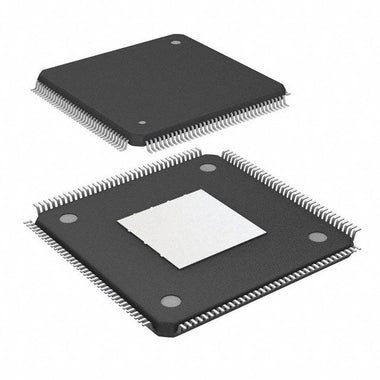
| package | 144-LQFP Exposed Pad |
| datasheet | 10M25SAE144C8G Intel |
| update time | 2025-08-01 |
Looking for 10M25SAE144C8G Inventory?
Check our real-time stock levels, pricing, and volume discounts for global distribution.
Check 10M25SAE144C8G Stock3. Architecture and Block Diagram
The architecture of the MAX 10 family is based on a lookup-table (LUT) and register structure, with a network of programmable interconnects. The 10M25SAE144C8G includes approximately 25,000 logic elements, on-chip user flash memory, and multiple blocks of M9K memory. It also features integrated ADCs and a temperature sensor, reducing the need for external monitoring components.
4. Video: Feature Breakdown
5. Equivalents, Cross-Reference, and Lifecycle
As of early 2026, the 10M25SAE144C8G is an active and widely available component. Cross-reference for this part may include other devices within the MAX 10 family with similar logic density and package types. Always verify pin compatibility and feature sets when considering replacements. For end-of-life information, refer to official Intel FPGA documentation.
6. Frequently Asked Questions (FAQ)
What is the primary application for the 10M25SAE144C8G?
It is commonly used for system management, I/O expansion, and as a bridge between different communication protocols in industrial and automotive systems.
Does the 10M25SAE144C8G require an external configuration device?
No, one of the key features of the MAX 10 family is the on-chip flash memory, which stores the FPGA configuration, enabling instant-on operation.
Alan Carter, Senior Hardware Engineer
Alan has over 15 years of experience in embedded systems design, specializing in ARM Cortex architectures, PCB routing for high-speed digital signals, and industrial IoT deployments. He frequently contributes technical teardowns and architecture comparisons.