Table of Contents
1. Overview of the 10M16SAU169I7G
The 10M16SAU169I7G is an FPGA from Intel (formerly Altera) belonging to the MAX 10 family. Built on a 55nm process technology, this device integrates non-volatile flash memory with programmable logic, eliminating the need for external configuration devices. The MAX 10 family is designed for cost-sensitive, low-power applications that require instant-on functionality, making it a popular choice in industrial control, communications, automotive, and consumer electronics.
As a single-chip, non-volatile FPGA, the 10M16SAU169I7G provides 16,000 logic elements (LEs), an integrated analog-to-digital converter (ADC), and dual configuration flash memory for fail-safe remote system updates. Its compact 169-UBGA package makes it ideal for space-constrained designs where high integration and reliability are paramount.
Whether you're designing embedded control systems, sensor interfaces, or protocol bridges, the 10M16SAU169I7G delivers a compelling balance of performance, integration, and cost efficiency. For more FPGA and programmable logic solutions, explore our FPGA product catalog.
2. Key Specifications & Parameters
| Parameter | Value |
|---|---|
| Part Number | 10M16SAU169I7G |
| Manufacturer | Intel (Altera) |
| Family | MAX 10 |
| Process Technology | 55 nm |
| Logic Elements (LEs) | 16,000 |
| Logic Array Blocks (LABs) | 1,000 |
| Embedded Memory (RAM) | 549 Kb (M9K blocks) |
| Phase-Locked Loops (PLLs) | 4 |
| Embedded Multipliers (18×18) | Up to 144 |
| User I/O Pins | 130 |
| Max LVDS Pairs | 22 |
| ADC | Yes (dual ADC capable) |
| Internal Flash | Dual configuration flash + User Flash Memory (UFM) |
| Package | 169-UBGA (11 × 11 mm) |
| Core Voltage | 1.2 V |
| I/O Voltage | 3.0 V – 3.3 V |
| Operating Temperature | −40 °C to +100 °C (Industrial grade) |
| Speed Grade | 7 (slowest timing) |
| External Memory Support | DDR2, DDR3, LPDDR2, SRAM |
| I/O Standards | LVTTL, LVCMOS, SSTL, HSTL, HSUL, LVDS, TMDS, PCI |
| Configuration | Internal (no external config device needed) |
| RoHS Compliant | Yes |
Need help selecting the right FPGA for your design? Visit our technical support page for expert assistance.
3. Block Diagram & Architecture
The MAX 10 FPGA architecture integrates several key functional blocks into a single device. The core fabric consists of Logic Array Blocks (LABs), each containing 16 Logic Elements with 4-input LUTs and dedicated registers. Surrounding the logic core are M9K embedded memory blocks, embedded 18×18 multipliers for DSP functions, and a flexible I/O ring supporting multiple voltage standards.
Key architectural highlights include:
- Dual Configuration Flash: Enables instant-on operation and fail-safe remote system upgrades
- Integrated ADC: Up to two analog-to-digital converters with up to 17 channels, supporting 12-bit resolution at up to 1 MSPS
- User Flash Memory (UFM): Non-volatile storage for application data, calibration values, or security keys
- 4 PLLs: Provide flexible clock management with frequency synthesis and phase shifting
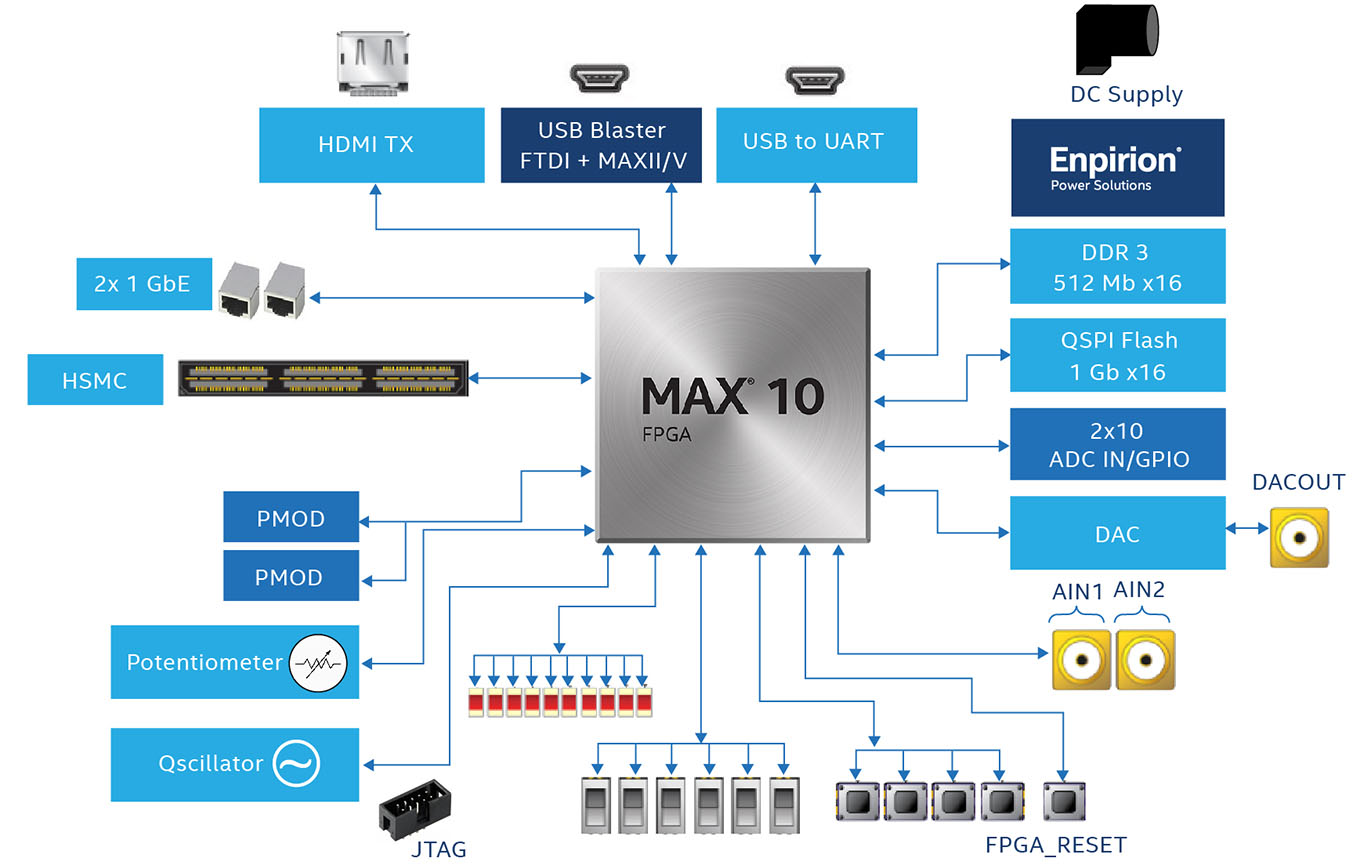
Figure 1: MAX 10 FPGA Development Kit system block diagram showing the integrated architecture and peripheral connectivity.
4. Package & Pinout Information
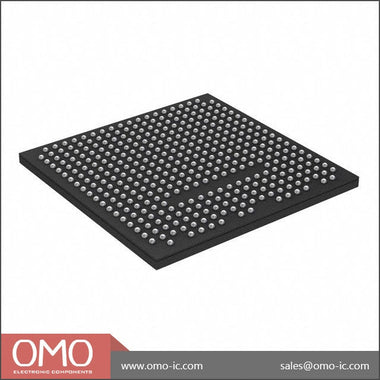
The 10M16SAU169I7G is housed in a 169-ball UBGA (Ultra-thin Ball Grid Array) package with an 11 × 11 mm body size. This compact form factor is ideal for portable and space-constrained applications. The U169 package provides 130 user I/O pins organized across multiple I/O banks, each independently configurable for different voltage standards.
Pin categories include:
- User I/O: 130 general-purpose I/O pins supporting 3.3V LVTTL/LVCMOS down to 1.0V LVCMOS
- Configuration Pins: JTAG interface (TCK, TMS, TDI, TDO), nCONFIG, nSTATUS, CONF_DONE
- Power Supply Pins: VCC (1.2V core), VCCIO (per-bank I/O voltage), VCCA (analog PLL supply)
- ADC Input Pins: Dedicated analog input channels for the integrated ADC

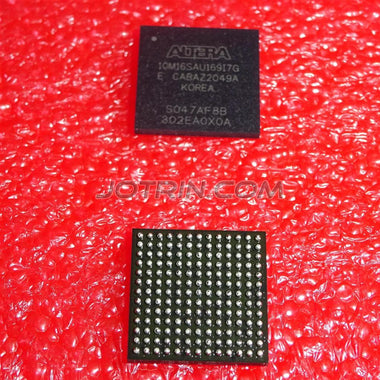
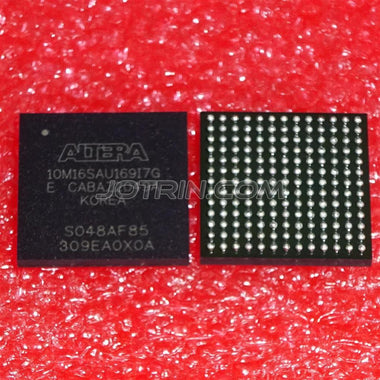
Figure 2: 10M16SAU169I7G in 169-UBGA package – compact BGA form factor for high-density PCB designs.
5. Application Circuits & Development Kits
The MAX 10 FPGA family is supported by robust development platforms from Intel/Altera and third-party vendors. These development kits provide a comprehensive environment for evaluating the 10M16SAU169I7G and prototyping end applications.
Typical Application Areas
- Industrial Automation: Motor control, sensor fusion, PLC coprocessor
- Communications: Protocol bridging (SPI/I2C/UART), data aggregation, baseband processing
- Automotive: ADAS preprocessing, instrument cluster control, CAN/LIN interfaces
- Consumer Electronics: Display controllers, audio processing, IoT edge devices
- Test & Measurement: Data acquisition with integrated ADC, signal conditioning
Development Ecosystem
Intel provides the Quartus Prime Lite Edition (free) for MAX 10 device development, including schematic entry, Verilog/VHDL synthesis, place-and-route, timing analysis, and on-chip debugging via Signal Tap Logic Analyzer.
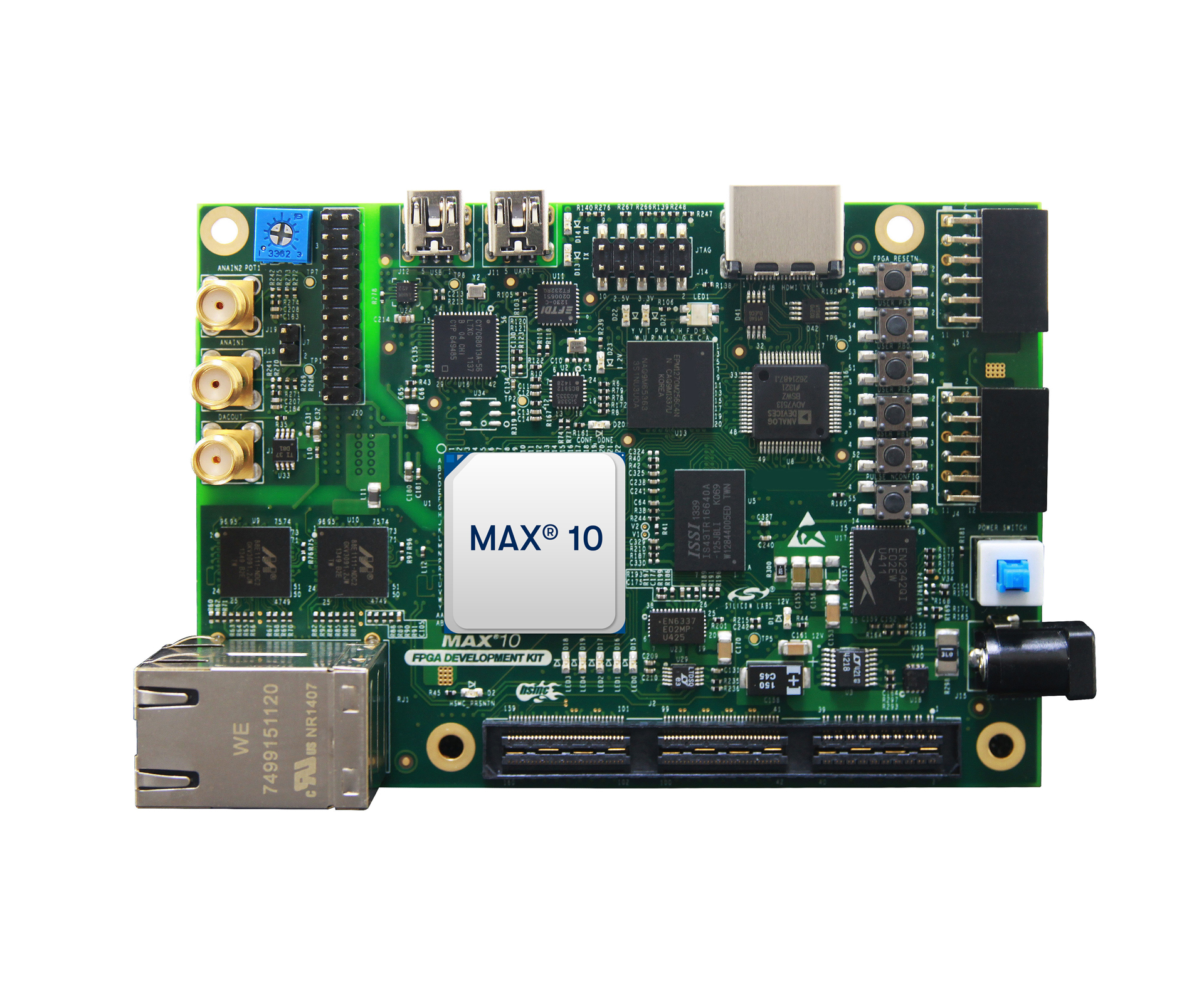
Figure 3: MAX 10 FPGA Development Kit – a feature-rich evaluation platform with Ethernet, HDMI, HSMC, and Arduino connectors for rapid prototyping.
Looking for MAX 10 development boards and accessories? Check our development board collection.
Video Tutorial: Getting Started with MAX 10 FPGA
6. Frequently Asked Questions (FAQ)
Q1: What is the 10M16SAU169I7G?
The 10M16SAU169I7G is a non-volatile FPGA from Intel's MAX 10 family. It features 16,000 logic elements, 549 Kb of embedded RAM, an integrated ADC, and dual configuration flash in a compact 169-UBGA package. It operates over the industrial temperature range of −40 °C to +100 °C.
Q2: Does the 10M16SAU169I7G require an external configuration memory?
No. The MAX 10 family features internal configuration flash memory, enabling instant-on operation without an external configuration PROM or flash device. This reduces BOM cost and PCB area while improving system reliability.
Q3: What is the difference between 10M16SAU169I7G and 10M16SAU169C8G?
Both devices share the same logic resources and package. The key differences are: the "I7" variant supports the industrial temperature range (−40 °C to +100 °C) with speed grade 7, while the "C8" variant is rated for commercial temperature (0 °C to +85 °C) with speed grade 8 (slower timing). Choose "I7" for harsh-environment applications.
Q4: What development tools are needed for the 10M16SAU169I7G?
Intel's Quartus Prime Lite Edition is the recommended free development tool. It supports Verilog, VHDL, and schematic design entry, along with synthesis, simulation, timing analysis, and on-chip debugging. A USB-Blaster programmer is required for JTAG configuration.
Q5: Can the integrated ADC in the MAX 10 replace an external ADC?
The MAX 10's built-in ADC offers 12-bit resolution at up to 1 MSPS with up to 17 input channels. For many sensor-interface and monitoring applications, this eliminates the need for an external ADC, reducing component count and cost. However, applications requiring higher resolution (>12-bit) or faster sampling rates may still need a dedicated external ADC.
Q6: What external memory interfaces does the 10M16SAU169I7G support?
The device supports DDR2, DDR3, LPDDR2, and SRAM external memory interfaces through its hard memory controller IP. This enables applications that need external data storage, frame buffers, or large lookup tables beyond the on-chip embedded memory capacity.