10M16SAU169I7G Datasheet, Specifications & Application Guide | Intel MAX 10 FPGA
The 10M16SAU169I7G is a high-performance FPGA from the Intel (Altera) MAX 10 family, delivering 16,000 logic elements in a compact 169-pin UBGA package. Built on 55nm process technology with integrated flash memory and a 12-bit ADC, this single-chip solution eliminates the need for external configuration devices, making it ideal for cost-sensitive embedded control, industrial IoT, and mixed-signal applications. In this comprehensive guide, we cover the 10M16SAU169I7G datasheet specifications, pinout, block diagram, application circuits, and design best practices.
Overview and Key Features
The 10M16SAU169I7G belongs to the Intel MAX 10 FPGA family, which is the industry's first single-chip, non-volatile FPGA. Unlike traditional FPGAs that require external flash memory for configuration, the MAX 10 integrates dual configuration flash memory on-die, enabling instant-on functionality with self-configuration in under 10 milliseconds at power-up.
Key features of the 10M16SAU169I7G include:
- 16,000 Logic Elements (LEs) organized in 1,000 Logic Array Blocks (LABs), each containing 16 LEs with 4-input LUTs
- Integrated 12-bit ADC with up to 1 MSPS sampling rate for analog-to-digital conversion without external components
- 549 Kb of M9K block RAM configurable as RAM, ROM, or FIFO buffers
- 46 embedded 18x18 multipliers for efficient DSP implementations
- Up to 4 PLLs for flexible clock management and synthesis
- User Flash Memory (UFM) for non-volatile data storage
- 130 user I/O pins with support for DDR3, LVDS, and various single-ended I/O standards
- Industrial temperature range (-40°C to +100°C) for harsh environment deployment
The "SAU" in the part number indicates a single analog supply device in the U169 (UBGA-169) package, while "I7G" denotes the industrial temperature grade. This device is programmed using the free Quartus Prime Lite Edition software from Intel.
Technical Specifications
| Parameter | Value |
|---|---|
| Manufacturer | Intel / Altera |
| Part Number | 10M16SAU169I7G |
| Family | MAX 10 (10M16) |
| Product Category | FPGA - Field Programmable Gate Array |
| Logic Elements | 16,000 |
| Logic Array Blocks (LABs) | 1,000 |
| Embedded Memory (M9K) | 549 Kb |
| Total RAM Bits | 562,176 |
| 18x18 Embedded Multipliers | 46 |
| PLLs | Up to 4 (package dependent) |
| User I/O Pins | 130 |
| ADC | 12-bit, up to 1 MSPS, single ADC |
| User Flash Memory (UFM) | 32 - 296 KB |
| Core Voltage | 1.2V |
| I/O Supply Voltage | 3.0V / 3.3V (2.85V - 3.465V) |
| Process Technology | 55nm |
| External Memory Interface | DDR3, DDR2, LPDDR2 |
| Configuration | Internal Flash (Instant-On, <10ms) |
| Operating Temperature | -40°C to +100°C (Industrial) |
| Package | UBGA-169 (11mm x 11mm, 0.8mm pitch) |
| Mounting | SMD / SMT |
| RoHS Compliant | Yes |
| Packaging | Tray |
Block Diagram and Architecture
The Intel MAX 10 10M16 FPGA architecture integrates programmable logic, embedded memory, DSP resources, clock management, analog-to-digital conversion, and flash configuration memory into a single device. The block diagram below illustrates the major functional blocks and their interconnections.
The FPGA core contains 1,000 LABs, each with 16 logic elements featuring 4-input look-up tables (LUTs) and programmable registers. The M9K memory blocks provide 549 Kb of on-chip SRAM that can be configured in various width/depth combinations. The 46 embedded 18x18 multipliers enable efficient DSP operations including FIR filters, FFTs, and matrix multiplication without consuming logic resources.
Pinout and Package Information
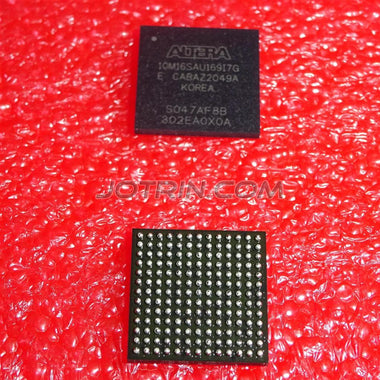
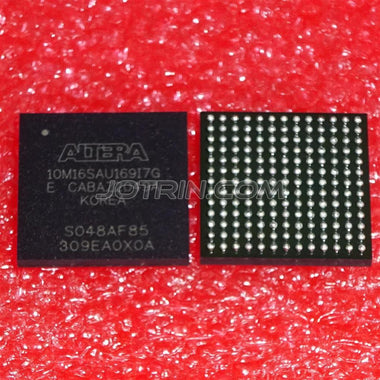
The 10M16SAU169I7G is housed in a 169-ball Ultra Fine-pitch Ball Grid Array (UBGA) package measuring 11mm x 11mm with a 0.8mm ball pitch. This compact footprint makes it suitable for space-constrained PCB designs. The device provides 130 user I/O pins organized across multiple I/O banks supporting 3.3V, 2.5V, 1.8V, and 1.5V I/O standards.
Pin categories in the UBGA-169 package include dedicated configuration pins (JTAG, nCONFIG, nSTATUS), power supply pins (VCC, VCCIO, VCCA, GND), clock input pins, analog input pins for the ADC, and general-purpose I/O pins. For complete pinout assignments, download the official pin-out file from Intel's device resource page.
Application Circuit and Design Guide
The 10M16SAU169I7G simplifies board-level design as a single-supply device with internal configuration flash. A typical application circuit requires only a 3.3V power supply with appropriate decoupling, a JTAG programming interface, and a clock oscillator. The diagram below shows a representative application circuit.
Power Supply Design Tips
- The single analog supply (SAU variant) requires 3.0V-3.3V for VCCA, VCC, and VCCIO
- Place 100nF ceramic decoupling capacitors on every power pin, as close to the BGA balls as possible
- Add bulk 10uF capacitors near the device for each power rail
- The internal 1.2V core voltage is generated by an on-chip regulator
- Place 1pF capacitors close to each analog input pin for best ADC performance
Getting Started with 10M16SAU169I7G
Watch this tutorial video to learn how to set up your development environment and program the MAX 10 FPGA using Quartus Prime Lite Edition:
Frequently Asked Questions
What is the 10M16SAU169I7G?
The 10M16SAU169I7G is a non-volatile FPGA from the Intel (Altera) MAX 10 family. It provides 16,000 logic elements, 549 Kb of embedded RAM, 46 embedded 18x18 multipliers, up to 4 PLLs, and an integrated 12-bit ADC, all in a 169-pin UBGA package with industrial temperature support (-40°C to +100°C).
Does the 10M16SAU169I7G require external configuration memory?
No. The MAX 10 family integrates dual configuration flash memory on-die. The device self-configures from its internal flash in under 10 milliseconds at power-up, eliminating the need for external SPI flash, EPROM, or configuration controllers. This reduces BOM cost and board space.
What software do I need to program the 10M16SAU169I7G?
You can use the free Quartus Prime Lite Edition from Intel (Altera). The MAX 10 family is fully supported in the Lite edition, so no paid license is required. Programming is done via JTAG using a USB-Blaster or USB-Blaster II cable. You can design in Verilog, VHDL, or use the Platform Designer (Qsys) schematic entry tool.
What is the maximum operating frequency of the 10M16SAU169I7G?
The maximum operating frequency depends on the design complexity and routing. The I7G speed grade (speed grade 7, industrial) offers balanced performance for most applications. Typical user designs achieve 150-300 MHz internal clock speeds depending on logic depth. The PLLs can generate clock frequencies from tens of MHz to over 400 MHz.
Can the 10M16SAU169I7G interface with DDR3 memory?
Yes. The 10M16 is one of the MAX 10 variants that supports external memory interfaces including DDR3, DDR2, and LPDDR2. This makes it suitable for applications requiring higher-bandwidth data storage beyond the on-chip 549 Kb of M9K block RAM.
What are the main applications for the 10M16SAU169I7G?
Common applications include industrial motor control, building automation, factory automation PLCs, sensor aggregation and processing hubs, protocol bridging (SPI/I2C/UART), automotive infotainment subsystems, medical device control systems, and IoT edge computing nodes. The integrated ADC is particularly useful for mixed-signal designs requiring direct analog sensor input without external ADC chips.
Looking for more FPGA and semiconductor components? Browse our full catalog at wwdparts.com or check out our guides on semiconductor technology for more design resources.