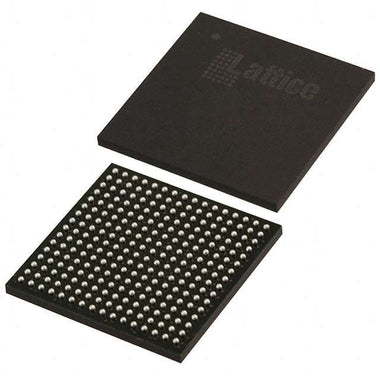
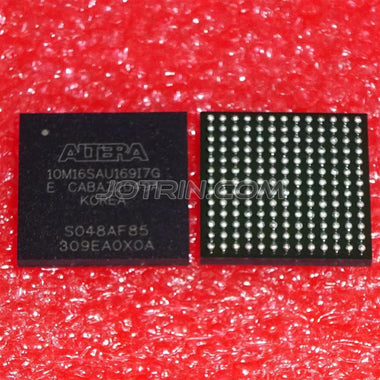
The 10M16SAU169I7G is a high-performance, non-volatile FPGA from the Intel (Altera) MAX 10 family. Built on 55nm flash process technology, this device integrates 16,000 logic elements, an analog-to-digital converter (ADC), and user flash memory into a compact UBGA-169 package. It is designed for industrial-grade applications operating from -40°C to +100°C, making it ideal for embedded control, motor drive, sensor interfaces, and IoT edge processing. This comprehensive guide covers the 10M16SAU169I7G datasheet specifications, pinout, block diagram, application circuits, and design tips.
Key Specifications & Parameters
The table below summarizes the critical electrical and functional parameters of the 10M16SAU169I7G. These values are extracted from the official Altera MAX 10 datasheet and distributor specifications.
| Parameter | Value |
|---|---|
| Part Number | 10M16SAU169I7G |
| Manufacturer | Intel (formerly Altera) |
| Device Family | MAX 10 (10M16) |
| Logic Elements (LEs) | 16,000 |
| Logic Array Blocks (LABs) | 1,000 |
| Embedded Memory (M9K) | 549 Kb (562,176 bits) |
| 18×18 Embedded Multipliers | 45 |
| PLLs | 4 |
| User Flash Memory (UFM) | Up to 736 Kb |
| Analog-to-Digital Converter | 1 × 12-bit SAR ADC (up to 1 MSPS) |
| Max User I/O Pins (U169) | 130 |
| LVDS Pairs | Up to 22 |
| Core Supply Voltage | 1.2 V |
| I/O Supply Voltage | 1.0 V – 3.3 V |
| I/O Standards Supported | LVTTL, LVCMOS, SSTL, HSTL, LVDS, LVPECL, PCI |
| External Memory Interfaces | DDR3, DDR2, LPDDR2, SRAM |
| Configuration | Internal flash (instant-on), dual boot |
| Speed Grade | 7 (Industrial) |
| Operating Temperature | -40°C to +100°C |
| Package | UBGA-169 (11 mm × 11 mm, 0.8 mm pitch) |
| Process Technology | 55 nm Flash |
| RoHS Compliant | Yes |
The MAX 10 family's single-chip, non-volatile architecture eliminates the need for external configuration memory, reducing board space and BOM cost. The integrated ADC is especially valuable for mixed-signal applications like sensor interface designs.
Block Diagram & Architecture
The following block diagram illustrates the internal architecture of the MAX 10 10M16 FPGA, showing the relationship between logic elements, embedded memory blocks, PLLs, the ADC module, and the I/O ring:
Key architectural highlights include:
- Instant-On Configuration: Internal flash stores the FPGA bitstream, enabling the device to configure itself at power-up without external flash memory.
- Dual Configuration Images: Supports two bitstream images for remote update with automatic fallback, critical for industrial FPGA deployments.
- Integrated 12-bit ADC: A successive-approximation ADC with up to 18 analog input channels, eliminating external ADC ICs in many designs.
- M9K Memory Blocks: Each block provides 9,216 bits of configurable RAM, supporting single-port, dual-port, ROM, and FIFO modes.
Pinout & Package Information
The 10M16SAU169I7G is housed in a UBGA-169 (Ultra-Thin Fine-Pitch BGA) package measuring 11 mm × 11 mm with 0.8 mm ball pitch. This compact form factor makes it suitable for space-constrained industrial and IoT applications.

The U169 package provides 130 user I/O pins organized across multiple I/O banks. Each bank can be independently configured with different I/O voltage standards. The pinout supports:
- 8 I/O Banks: Independently powered, supporting voltage levels from 1.0 V to 3.3 V per bank.
- LVDS Support: Up to 22 differential pairs for high-speed serial interfaces.
- DDR3 Memory Interface: Dedicated pins with DQS strobe support for external DDR3 SDRAM at up to 300 MHz.
- JTAG Interface: Standard 4-pin JTAG (TCK, TDI, TDO, TMS) for programming and debugging.
- ADC Input Pins: Dedicated analog input pins connected to the internal 12-bit ADC.
Typical Application Circuit
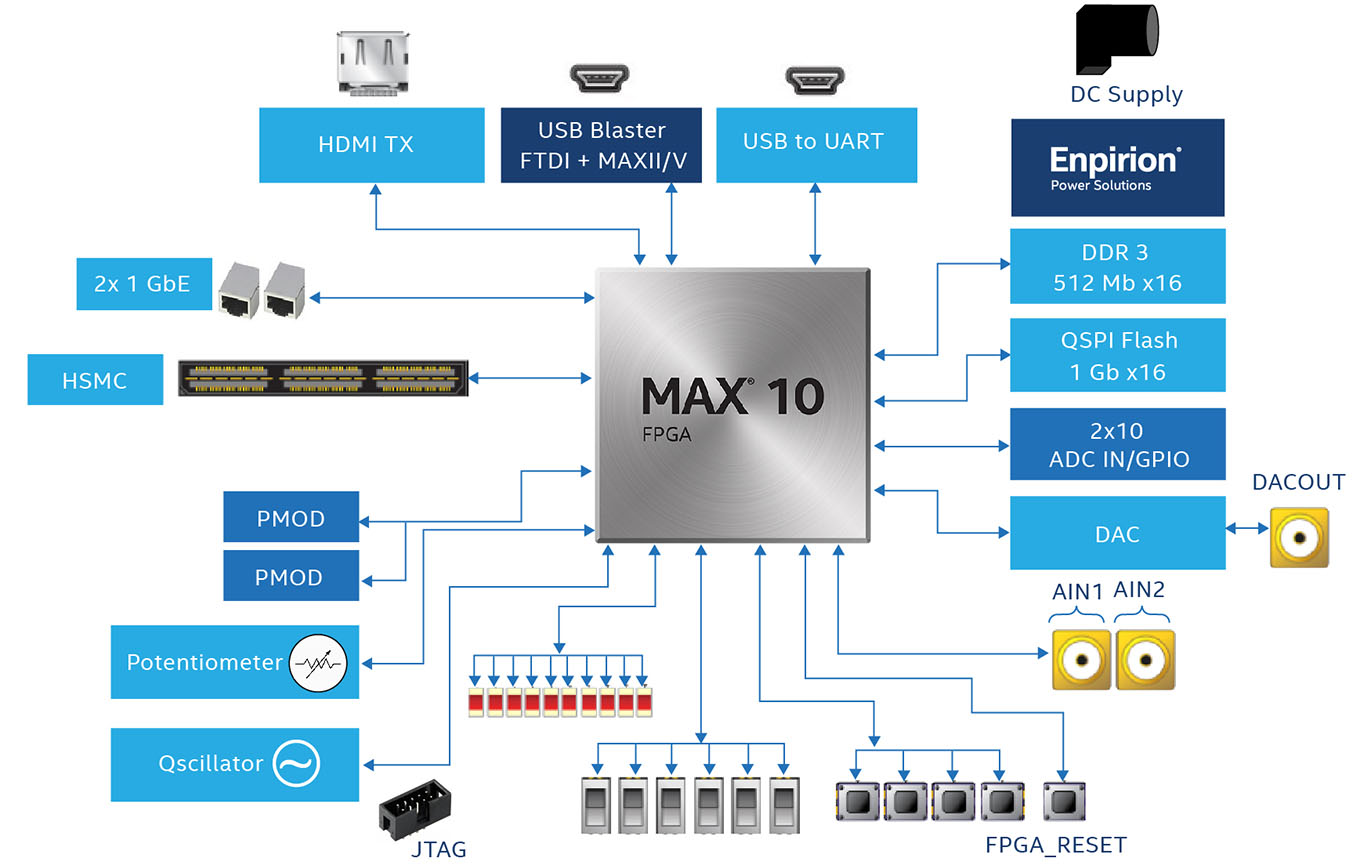
The MAX 10 FPGA Development Kit showcases a complete reference design around the 10M16 device. The image below shows the development board with peripheral interfaces that demonstrate typical application circuits:
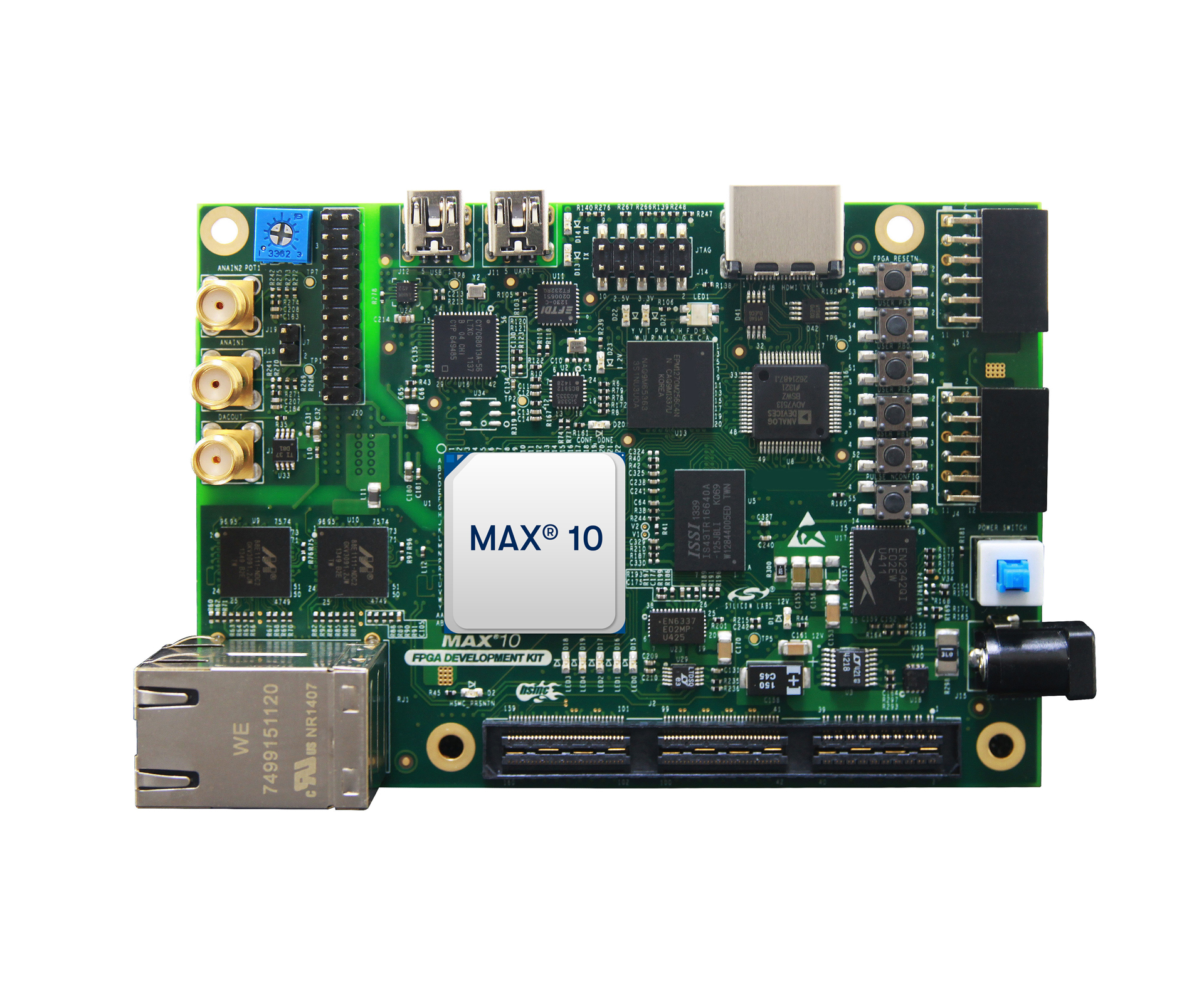
Common application circuits for the 10M16SAU169I7G include:
- Power Supply: 1.2 V core (VCC), 2.5 V PLL (VCCA), and 3.3 V I/O (VCCIO) rails with proper decoupling capacitors (100 nF ceramic per power pin, 10 µF bulk).
- Configuration: No external flash required — the device configures from internal flash. An optional JTAG header connects to the Intel USB Blaster II for programming.
- Clock Source: A 50 MHz oscillator feeds the PLL inputs, which generate internal clocks up to 450 MHz.
- DDR3 Interface: A 16-bit wide DDR3 SDRAM interface for high-bandwidth data buffering in embedded memory applications.
- Mixed-Signal: The integrated ADC samples analog signals through dedicated input pins, useful for temperature monitoring, voltage sensing, and basic data acquisition.
Design Guide & Development Tools
Developing with the 10M16SAU169I7G requires the Quartus Prime Lite Edition (free), which provides full support for the MAX 10 family including synthesis, place-and-route, timing analysis, and programming.
Getting Started Video
Watch this walkthrough of the Intel FPGA development workflow using Quartus Prime with a MAX 10 FPGA:
Development Workflow
- Install Quartus Prime Lite: Download from the Intel FPGA website. The Lite edition fully supports MAX 10 at no cost.
- Create a Project: Select the 10M16SAU169I7G as your target device. Assign pin locations using the Pin Planner.
- Write HDL: Use Verilog or VHDL. The MAX 10 supports SystemVerilog constructs in Quartus Prime.
- Simulate: Use ModelSim-Intel Edition (included) for RTL and gate-level simulation.
- Compile & Program: Generate a .pof file for internal flash programming via USB Blaster II or .sof for JTAG SRAM download.
- ADC Configuration: Use the Altera Modular ADC IP core in Platform Designer (Qsys) to set up sampling rate, channels, and sequencing.
Design Tips
- Use the dual-boot feature for fail-safe remote firmware updates — store factory and application images in separate flash sectors.
- The internal oscillator can clock the ADC without an external crystal for basic analog monitoring applications.
- Leverage Nios II soft processor IP for embedded processing tasks — the 10M16 has ample logic for a Nios II/e plus peripherals.
Frequently Asked Questions (FAQ)
What is the difference between 10M16SAU169I7G and 10M16SAU169C8G?
The primary differences are temperature range and speed grade. The 10M16SAU169I7G is an industrial-grade device (I = -40°C to +100°C, speed grade 7), while the 10M16SAU169C8G is a commercial-grade device (C = 0°C to +85°C, speed grade 8). The "7" speed grade is faster than "8" — lower numbers indicate better performance in Intel FPGA naming. Both share identical logic resources and pinouts.
Does the 10M16SAU169I7G require external configuration flash memory?
No. The MAX 10 family uses internal flash-based configuration, eliminating the need for external serial flash (like the EPCS series). The device stores its bitstream in on-chip flash and configures itself at power-up within milliseconds ("instant-on"). This also enables dual configuration image storage for remote update with automatic fallback.
What is the maximum clock frequency for the 10M16SAU169I7G?
The internal PLLs can generate clock frequencies up to 450 MHz. The achievable design frequency depends on your logic implementation and timing constraints. For the speed grade 7 variant, typical register-to-register performance in well-optimized designs can reach 250–300 MHz for simple logic paths. The DDR3 memory interface operates at up to 300 MHz (600 Mbps data rate).
How do I use the built-in ADC in the 10M16SAU169I7G?
The integrated 12-bit SAR ADC supports up to 1 MSPS sampling with up to 18 analog input channels. To use it, instantiate the Altera Modular ADC IP core in Platform Designer (Qsys) within Quartus Prime. Configure the sequencer for your desired channels, sampling rate, and averaging mode. The ADC provides digital output via an Avalon-MM slave interface that can be read by a Nios II processor or custom logic. The analog input range is 0 V to the VREFP reference voltage (typically 2.5 V or 3.3 V).
Can I run a Nios II processor on the 10M16SAU169I7G?
Yes. The 10M16 with 16,000 LEs can comfortably host a Nios II/e (economy) or Nios II/f (fast) soft processor core. A typical Nios II/e system with UART, timer, and GPIO uses approximately 600–800 LEs, leaving substantial resources for custom peripheral logic. You can store the software in on-chip M9K RAM or in the User Flash Memory (UFM) for non-volatile boot without external memory.
What are the recommended power supply decoupling practices for the 10M16SAU169I7G?
Follow Intel's Power Delivery Network (PDN) guidelines: place a 100 nF (0402) ceramic capacitor on every VCC, VCCA, and VCCIO power pin as close to the BGA pad as possible. Add 10 µF bulk capacitors per power rail (at least two per rail). Use a 4-layer or 6-layer PCB with dedicated power and ground planes. For the ADC analog supply (VREFP, ANAIN), use a separate filtered analog power supply with ferrite bead isolation from the digital supply to minimize noise coupling.