1. Overview of the 10M16SAU169I7G
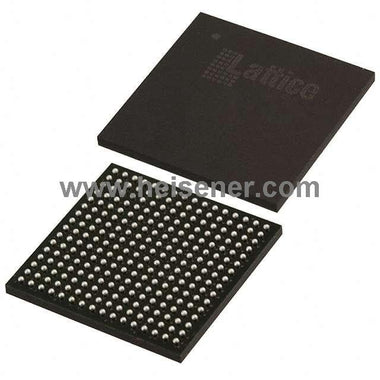
The 10M16SAU169I7G is a non-volatile FPGA from the Intel (Altera) MAX 10 family, built on a 55 nm flash process. It integrates 16,000 logic elements, embedded SRAM, a dual analog-to-digital converter (ADC), and user flash memory into a compact 169-ball UBGA package. Designed for industrial-grade applications, it operates across the extended temperature range of −40 °C to +100 °C, making it ideal for factory automation, motor drives, sensor hubs, and multi-function I/O consolidation.
Unlike SRAM-based FPGAs, the MAX 10 family stores its configuration in on-chip flash, enabling instant-on operation with no external configuration device. This simplifies the BOM and reduces board space—a significant advantage for cost-sensitive, high-reliability designs. The 10M16SAU169I7G also supports dual configuration images for safe remote field upgrades.
Looking for other industrial-grade FPGAs? Browse our selection of FPGA components at wwdparts.
2. Key Specifications & Electrical Parameters
| Parameter | Value |
|---|---|
| Part Number | 10M16SAU169I7G |
| Manufacturer | Intel / Altera |
| Family | MAX 10 (10M16) |
| Logic Elements (LEs) | 16,000 |
| Logic Array Blocks (LABs) | 1,000 |
| Embedded Memory (M9K Blocks) | 549 Kb (62 blocks) |
| User Flash Memory (UFM) | 128 Kb |
| 18 × 18 Embedded Multipliers | 45 |
| PLLs | 4 |
| Max User I/O Pins | 130 |
| Max LVDS Pairs | 22 |
| ADC Blocks | 1 dual ADC (up to 1 MSPS, 12-bit) |
| External Memory Interfaces | DDR3, DDR2, LPDDR2, SRAM |
| I/O Standards | 3.3 V / 2.5 V / 1.8 V / 1.5 V LVCMOS, LVTTL, SSTL, HSTL, HSUL, LVDS |
| Core Voltage | 1.2 V |
| I/O Supply Voltage | 1.0 V – 3.3 V |
| Process Technology | 55 nm flash |
| Package | UBGA-169 (11 mm × 11 mm, 0.8 mm pitch) |
| Operating Temperature | −40 °C to +100 °C (Industrial) |
| Speed Grade | 7 (lowest speed) |
| Configuration | Internal flash, dual boot image, instant-on |
| RoHS Compliant | Yes (lead-free, "G" suffix) |
Need help choosing between speed grades? Check our semiconductor blog for FPGA selection guides.
3. Block Diagram & Internal Architecture
The MAX 10 architecture centres on a sea of adaptive logic modules (ALMs), each containing a four-input look-up table and carry chain. Surrounding the logic fabric are M9K embedded memory blocks, DSP blocks with 18 × 18 multipliers, four PLLs, and a 12-bit dual SAR ADC. On-chip flash provides both configuration storage and user non-volatile memory.
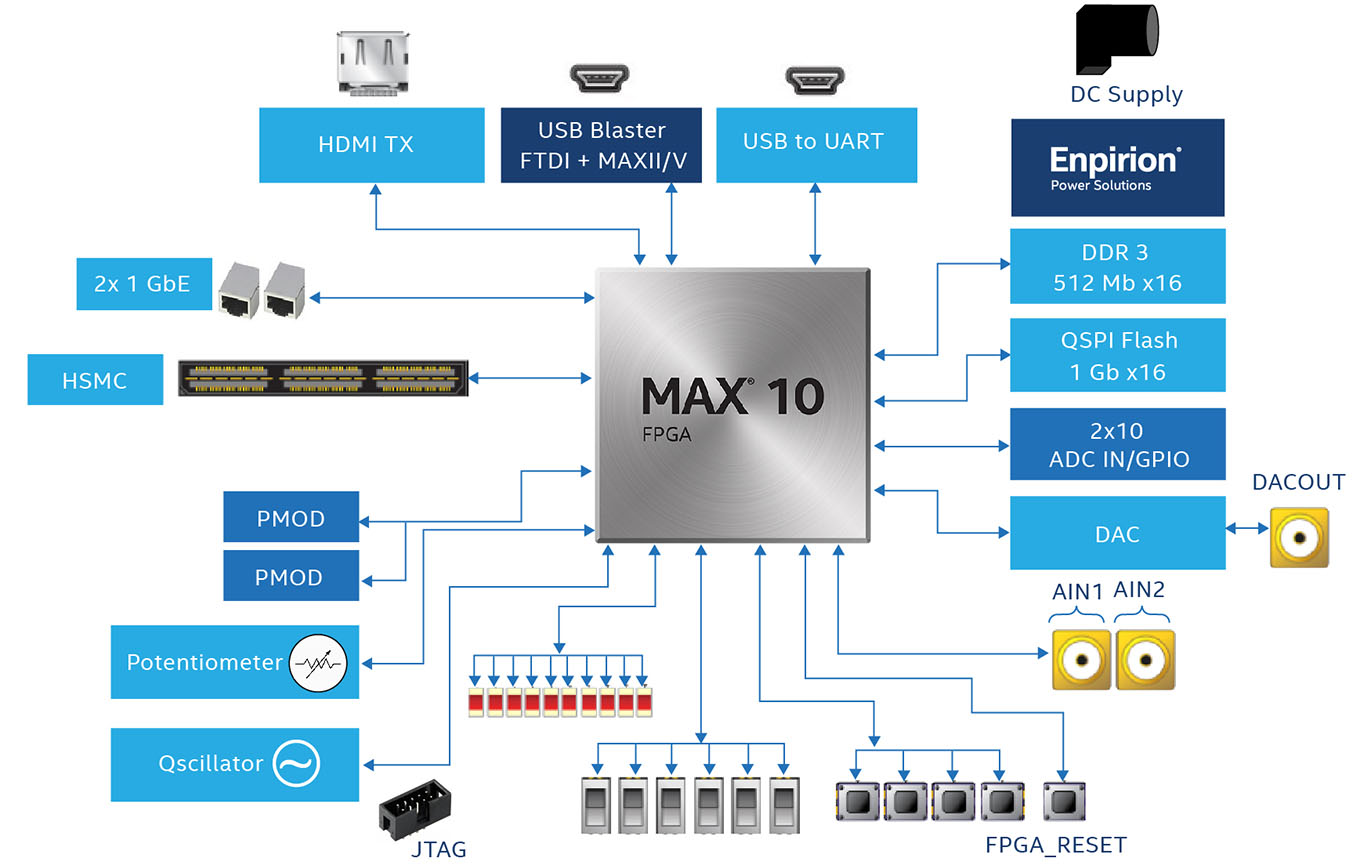
Figure 1 — MAX 10 FPGA development kit block diagram illustrating the interconnection of on-chip resources including the FPGA fabric, ADC, PLLs, and external interfaces.
4. Pinout, Package & Footprint
The 10M16SAU169I7G is housed in a 169-ball UBGA package measuring 11 × 11 mm with a 0.8 mm ball pitch. The compact form factor supports up to 130 user I/O pins distributed across multiple I/O banks, each independently configurable for different voltage standards. The package features a centre-ground thermal pad for improved thermal dissipation.
For PCB footprints and schematic symbols, visit wwdparts product catalog.
5. Application Circuit & Development Boards
The MAX 10 FPGA Development Kit provides a full-featured evaluation platform for the 10M16 device family. It includes dual Gigabit Ethernet, HDMI output, USB UART, HSMC expansion, and dual ADC SMA inputs—making it ideal for prototyping industrial control, motor drive, sensor fusion, and mixed-signal applications. Typical application circuits include power supply decoupling (1.2 V core, 2.5 V PLL, 3.3 V I/O), JTAG programming interface, and external DDR3 memory connection.
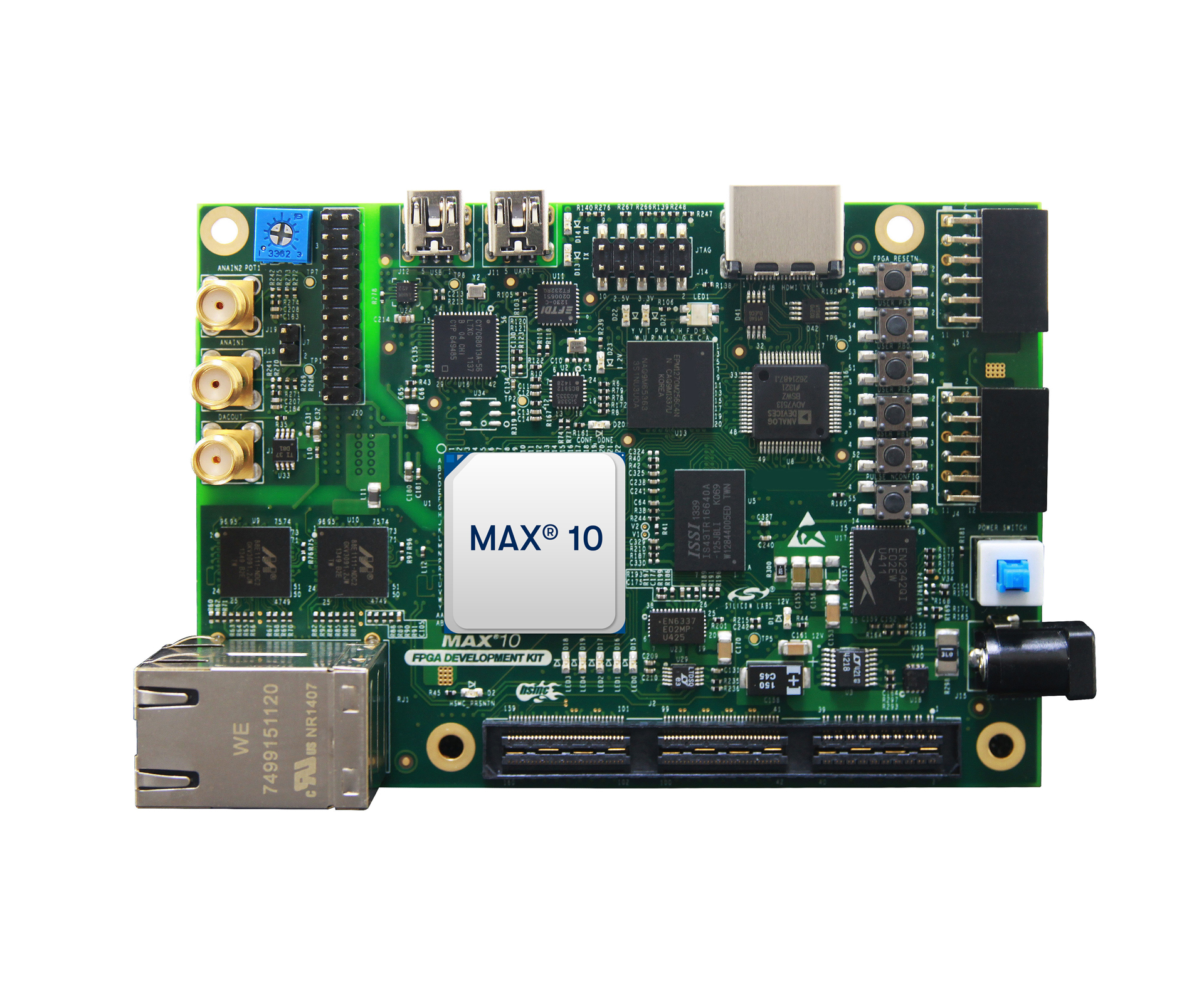
Figure 3 — MAX 10 FPGA Development Kit, a reference design platform for 10M16SAU169I7G-based applications. Image courtesy of Intel/Altera.
Video Tutorial: Getting Started with MAX 10 FPGA
6. FAQ – Frequently Asked Questions
Q1: What is the 10M16SAU169I7G?
The 10M16SAU169I7G is a non-volatile FPGA from Intel/Altera's MAX 10 family. It contains 16,000 logic elements, 549 Kb of embedded SRAM, a 12-bit dual ADC, and 128 Kb of user flash memory in a 169-ball UBGA package rated for industrial temperatures (−40 °C to +100 °C).
Q2: Does the 10M16SAU169I7G require an external configuration memory?
No. The MAX 10 family uses on-chip flash to store the FPGA configuration, providing instant-on operation without any external EEPROM or flash device. This reduces BOM cost and simplifies PCB layout.
Q3: What development tools are needed for the 10M16SAU169I7G?
You need Intel Quartus Prime Lite Edition (free) or Standard Edition. Both support the MAX 10 device family and include pin planning tools, the Platform Designer (Qsys) system integration tool, and the SignalTap II logic analyser.
Q4: What is the maximum operating frequency of the 10M16SAU169I7G?
As a speed-grade-7 device (the slowest grade in the MAX 10 family), typical register-to-register performance is around 200–300 MHz depending on design complexity and utilisation. Speed grade 6 and 8 variants offer higher performance if needed.
Q5: Can the on-chip ADC be used in production designs?
Yes. The integrated 12-bit SAR ADC supports up to 1 MSPS and includes a built-in temperature sensor plus up to 18 analog input channels (depending on the package). It is suitable for power monitoring, sensor conditioning, and system health monitoring.
Q6: What is the difference between 10M16SAU169I7G and 10M16SAU169C8G?
Both share the same silicon and package. The "I7" suffix denotes industrial temperature range (−40 °C to +100 °C) at speed grade 7, while "C8" denotes commercial temperature range (0 °C to +85 °C) at speed grade 8 (faster). Choose "I7" for harsh-environment applications and "C8" for cost-optimised commercial designs.