Overview of the 10M16SAU169I7G MAX 10 FPGA
The 10M16SAU169I7G is a non-volatile, low-power FPGA from the Intel (Altera) MAX 10 family. Built on a 55 nm process node, it delivers 16,000 logic elements (LEs) in a compact 169-ball UBGA package, making it an ideal choice for cost-sensitive embedded, industrial, and IoT applications that demand instant-on capability without external configuration memory.
The MAX 10 family is unique among FPGAs because it integrates dual on-chip configuration flash, an analog-to-digital converter (ADC), and user flash memory (UFM), eliminating the need for separate configuration and analog companion devices. The 10M16SAU169I7G variant carries an industrial temperature rating (−40 °C to +100 °C) and a speed grade of 7, suitable for designs where reliability across harsh thermal conditions is critical.
Key Specifications and Electrical Parameters
| Parameter | Value |
|---|---|
| Part Number | 10M16SAU169I7G |
| Manufacturer | Intel (Altera) |
| FPGA Family | MAX 10 |
| Logic Elements (LEs) | 16,000 |
| Logic Array Blocks (LABs) | 1,000 |
| Embedded Memory (M9K) | 549 Kb (562,176 bits) |
| User I/O Pins (U169) | 130 |
| PLLs | 4 |
| Embedded 18×18 Multipliers | 45 |
| Analog-to-Digital Converter | 1 × 12-bit SAR ADC (up to 18 channels) |
| User Flash Memory (UFM) | Up to 736 Kb |
| Internal Configuration Flash | Dual-boot capable |
| Max LVDS Pairs | 22 |
| External Memory Interface | DDR3, DDR2, LPDDR2, SRAM |
| Supply Voltage (VCCINT) | 1.2 V |
| I/O Voltage | 3.0 V / 3.3 V (also supports 1.2 V – 2.5 V banks) |
| Operating Temperature | −40 °C to +100 °C (Industrial) |
| Speed Grade | 7 (slowest timing) |
| Package | 169-ball UBGA (11 × 11 mm) |
| Process Technology | 55 nm |
| RoHS Compliant | Yes (Lead-free) |
Pinout, Package, and Block Diagram
The 10M16SAU169I7G uses a 169-ball UBGA package measuring 11 × 11 mm with a 0.8 mm ball pitch. The I/O banks are organized into eight banks (Bank 1A, 1B, 2, 3, 4, 5, 6, 7, 8) supporting a variety of single-ended and differential I/O standards including LVTTL, LVCMOS, SSTL, HSTL, and LVDS.
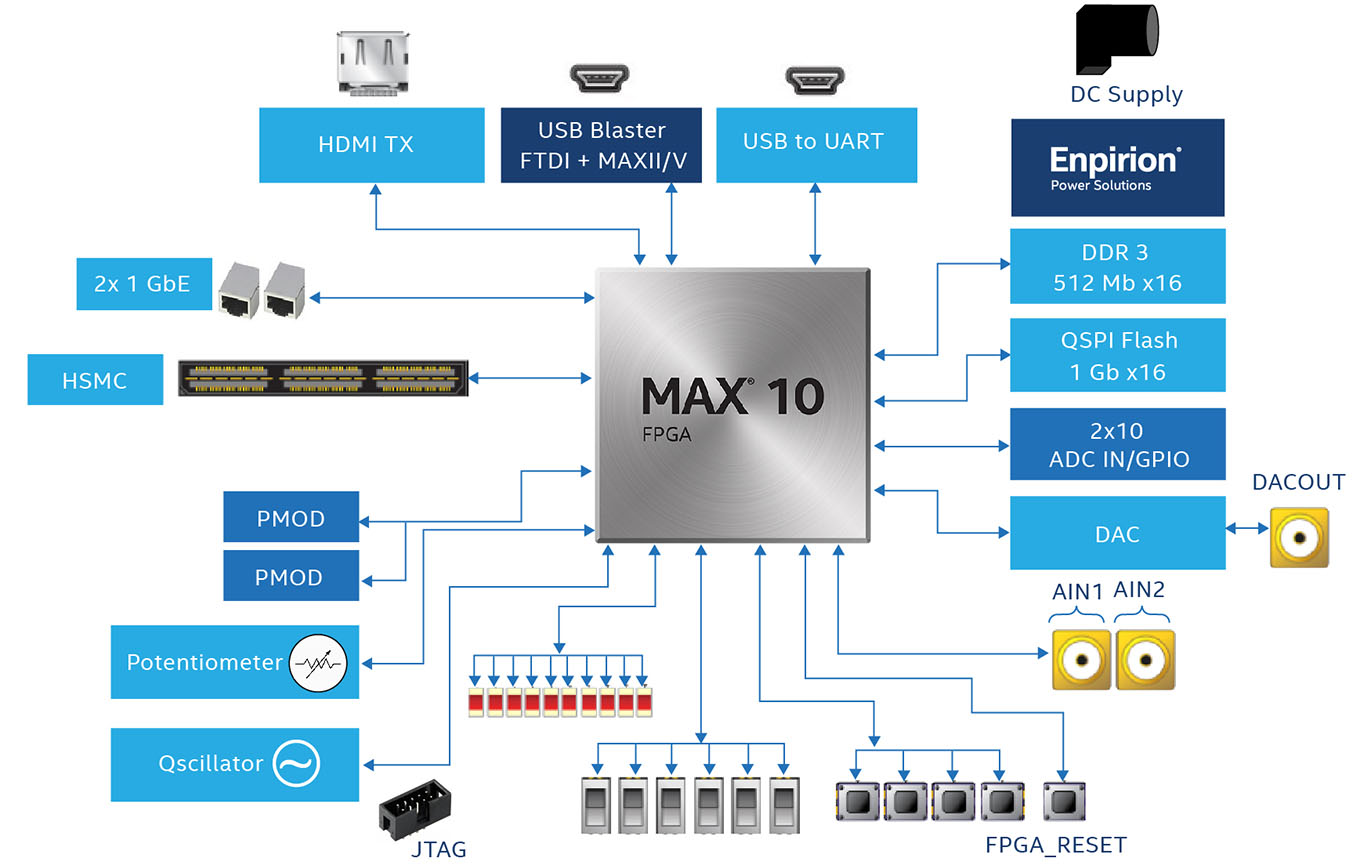
Figure 1 – MAX 10 FPGA system block diagram illustrating the integrated architecture including logic, ADC, and configuration flash.

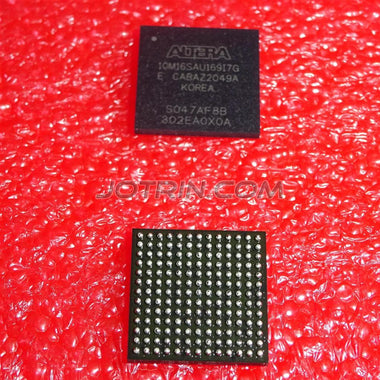
Figure 2 – 10M16SAU169I7G in 169-ball UBGA package.
Typical Applications and Design Considerations
The 10M16SAU169I7G is well-suited for a wide range of embedded and industrial applications:
- Industrial Automation: Motor control, PLC bridge logic, and sensor hub integration leveraging the built-in ADC.
- Communications Infrastructure: Protocol bridging, packet inspection co-processing, and SFP interface management.
- Board Management Controllers (BMC): Server and storage system health monitoring with instant-on boot.
- Consumer & IoT: Smart-home gateways, edge-AI pre-processing, and display pipeline management.
- Automotive ADAS: Camera interface bridging and sensor fusion pre-processing with industrial-grade temperature support.
For a typical application circuit, the MAX 10 FPGA Development Kit demonstrates a complete reference design with DDR3 memory, Gigabit Ethernet, HDMI, and dual ADC channels:
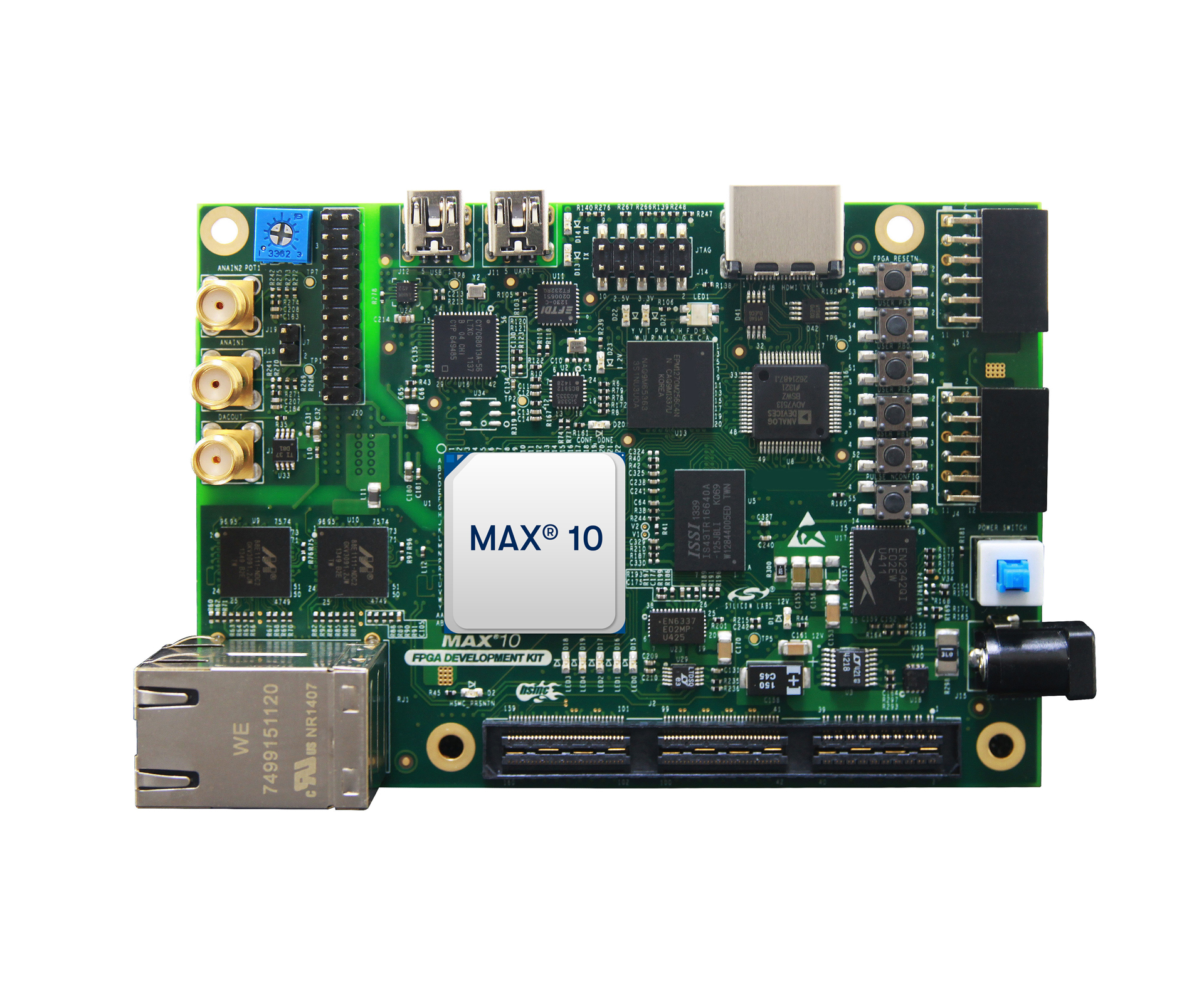
Figure 3 – MAX 10 FPGA Development Kit demonstrating a fully integrated reference application circuit.
Development Tools and Evaluation Kits
Intel provides a comprehensive ecosystem for MAX 10 FPGA development:
- Quartus Prime Lite Edition: Free-to-use design software supporting Verilog, VHDL, and schematic entry with built-in synthesis, place-and-route, timing analysis, and JTAG programmer.
- Nios II / Nios V Soft Processor: Embedded processor IP that can be instantiated inside the MAX 10 fabric for software-defined control applications.
- MAX 10 FPGA Development Kit: Full-featured evaluation board with 50K LE device, DDR3, Ethernet, HDMI, USB-UART, HSMC, and dual ADC SMA inputs.
- MAX 10 10M08 Evaluation Kit: Compact entry-level board with 10M08 device, ideal for power and control prototyping.
- Platform Designer (Qsys): System integration tool for connecting IP blocks, memory controllers, and peripherals.
Video Tutorial: Getting Started with MAX 10 FPGA
Frequently Asked Questions (FAQ)
1. What is the 10M16SAU169I7G?
The 10M16SAU169I7G is an Intel (Altera) MAX 10 non-volatile FPGA with 16,000 logic elements, an integrated 12-bit ADC, and dual configuration flash in a 169-ball UBGA package rated for industrial temperatures (−40 °C to +100 °C).
2. Does the 10M16SAU169I7G require external configuration memory?
No. The MAX 10 family features on-chip dual configuration flash that stores the FPGA bitstream internally, enabling instant-on operation and eliminating the need for external EEPROM or serial flash devices.
3. What design software is needed to program the 10M16SAU169I7G?
Intel Quartus Prime Lite Edition (free) fully supports the MAX 10 family. It provides HDL synthesis, place-and-route, timing analysis, and JTAG-based device programming. ModelSim Intel Edition can be used for simulation.
4. What is the difference between the SA and SC variants of MAX 10?
The "SA" variant (single-supply analog) includes an integrated ADC and supports single-supply 3.3 V operation, while the "SC" variant (single-supply compact) lacks the ADC but may offer slightly different I/O features. Both share the same logic capacity and package.
5. Can the 10M16SAU169I7G interface with DDR3 memory?
Yes. The MAX 10 device supports hard memory controller interfaces for DDR3, DDR2, and LPDDR2, allowing direct connection to external SDRAM for data buffering and processing applications.
6. What is the operating temperature range of the 10M16SAU169I7G?
The "I" suffix denotes the industrial temperature grade, operating from −40 °C to +100 °C (TJ). This makes it suitable for factory automation, outdoor equipment, and automotive-adjacent applications where extended temperature resilience is needed.
Looking for more semiconductor components? Explore our other product guides: