LFE5U-45F-8BG381C Design-In Guide: Why Choose It and How to Use It
Hardware engineers frequently face the challenge of integrating high-bandwidth interfaces like Gigabit Ethernet, PCI Express, or high-resolution video into systems with strict cost, power, and size constraints. Often, the choice is between a low-cost microcontroller that lacks the necessary I/O speed and processing power, or a high-end, power-hungry FPGA that blows the budget. The Lattice LFE5U-45F-8BG381C ECP5 series FPGA is engineered to solve this exact problem, providing a balanced architecture of logic, DSP resources, and high-speed SerDes transceivers in a cost-effective package. This guide provides a senior engineering perspective on why this specific part is a compelling choice and how to integrate it successfully into your next design.

Table of Contents
The Design Challenge LFE5U-45F-8BG381C Solves
In modern embedded systems, data is moving faster than ever. The challenge is no longer just processing data, but moving it efficiently between chips, boards, and systems. This is the "connectivity gap" where many designs falter. Consider a typical industrial camera system: it needs to capture high-resolution images from a sensor (via MIPI CSI-2 or LVDS), perform real-time image processing like scaling or color space conversion, and then transmit the video stream over Gigabit Ethernet. A standard microcontroller can't handle the raw bandwidth of the sensor interface or the real-time processing demands. A high-end FPGA can, but its cost and power consumption are often prohibitive for a mass-market industrial product.
The LFE5U-45F-8BG381C directly addresses this mid-market need. It's a "bridge" and "co-processor" specialist. The core value proposition lies in its combination of three key elements:
- High-Speed SerDes: With four 5G SerDes channels, this FPGA can natively implement interfaces like PCI Express Gen 2, Gigabit Ethernet (SGMII/1000BASE-X), JESD204B, and DisplayPort. This eliminates the need for external PHY chips, reducing board space, BOM cost, and system complexity. For example, you can directly connect an SFP optical module to the FPGA for fiber optic communication.
- Sufficient Logic and DSP Resources: With 44K Look-Up Tables (LUTs) and 194 DSP slices (18x18 multipliers), it has enough horsepower for significant signal and video processing. This is ideal for tasks like FFTs, digital filtering, motor control algorithms, or implementing a video scaling pipeline. It allows you to offload these intensive, parallel tasks from a host processor, or in many cases, eliminate the host processor entirely.
- Low Power and Cost Optimization: The ECP5 family was designed from the ground up for low static and dynamic power consumption. The LFE5U-45F-8BG381C, with its 1.1V core voltage and standard speed grade ('8'), is optimized for cost-sensitive applications that don't require the absolute highest Fmax. This makes it viable for deployment in thermally constrained enclosures without active cooling, a common requirement in industrial and automotive environments.
By integrating these capabilities, the LFE5U-45F-8BG381C allows a designer to create a single-chip solution for complex interfacing and processing tasks that would otherwise require a more expensive FPGA or a messy multi-chip architecture. It's the go-to choice for adding smart, high-speed connectivity to an existing system or building a compact, powerful data processing hub from scratch.
Key Specifications at a Glance
The following specifications are derived from the official Lattice ECP5 Family Data Sheet (DS1044). These are the critical parameters for a design-in decision.
| Parameter | Value | Why It Matters |
|---|---|---|
| Logic Cells (LUTs) | 44K | Defines the fundamental logic capacity for implementing control logic, state machines, and general-purpose functions. 44K is a substantial amount for complex bridging and co-processing. |
| SerDes Channels | 4 channels, up to 5 Gbps | The primary feature for high-speed connectivity. Enables native implementation of PCIe, GbE, JESD204B, etc., without external PHYs, reducing cost and complexity. |
| DSP Slices | 194 | Hardware blocks for efficient multiplication and accumulation. Critical for any signal processing application like digital filters, FFTs, or video processing algorithms. |
| Embedded Block RAM (EBR) | 1944 kbits | On-chip memory for data buffering, FIFOs, and implementing soft processors. Essential for handling data bursts in high-speed interfaces. |
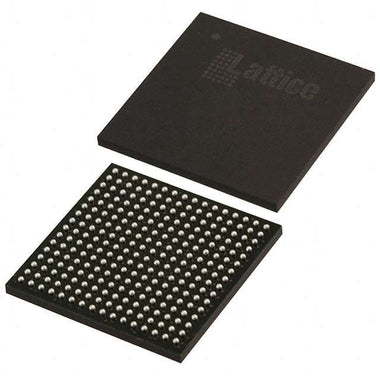
| Package | 381-ball caBGA (17x17 mm, 0.8mm pitch) | Determines the PCB footprint and routing complexity. This package offers a good balance of I/O count and board density, suitable for standard PCB manufacturing processes. |
| Maximum User I/O | 205 | The number of general-purpose I/O pins available for connecting to other components like ADCs, DACs, memory, and microcontrollers. |
| Core Voltage (VCC) | 1.1V | The main power supply for the FPGA fabric. A low core voltage is key to achieving low dynamic and static power consumption. |
| Temperature Grade | Commercial (0°C to 85°C Junction) | Specifies the operational junction temperature range. The 'C' suffix indicates it's intended for controlled environments, not extreme automotive or military applications. |
LFE5U-45F-8BG381C vs Alternatives: Head-to-Head
Choosing an FPGA is about finding the right trade-offs. Here's how the LFE5U-45F-8BG381C stacks up against two common alternatives in its class.
| Feature | Lattice LFE5U-45F-8BG381C | Xilinx Artix-7 (e.g., XC7A50T) | Intel Cyclone V SE |
|---|---|---|---|
| Architecture Focus | Low-power connectivity and co-processing | Performance-per-watt, general purpose | SoC with integrated ARM processor |
| SerDes Speed | Up to 5.0 Gbps | Up to 6.6 Gbps (GTP) | Up to 5.0 Gbps |
| Hard Processor | No | No | Yes (Dual-core ARM Cortex-A9) |
| Power Consumption | Generally lower static and dynamic power | Competitive, but often higher for similar utilization | Higher due to the Hard Processor System (HPS) |
| IP Ecosystem | Good, with strong support for bridging/video IP | Very extensive, mature IP library | Extensive, with strong support for HPS peripherals |
| Toolchain | Lattice Diamond (free license available) | Xilinx Vivado (free WebPACK edition available) | Intel Quartus Prime (free Lite edition available) |
When to choose the LFE5U-45F-8BG381C:
You should select the Lattice ECP5 part when your primary design drivers are cost, power, and high-speed I/O bridging. It excels in applications where you need to connect Point A to Point B with some processing in between, and do so within a tight power budget. For example, converting a MIPI camera feed to a DisplayPort output, or aggregating multiple sensor data streams into a single Gigabit Ethernet link. The absence of a hard processor is a feature, not a bug, in this context; it simplifies the design and reduces power if you don't need a full-blown operating system. While the Artix-7 might offer slightly higher SerDes speeds, the ECP5 often wins on total solution cost and power efficiency, which are critical for volume production.
Conversely, if your application is heavily software-driven and requires an OS like Linux, the Intel Cyclone V SE with its integrated ARM core is a more natural fit. If you need the absolute highest performance or access to a very specific IP core only available from Xilinx, the Artix-7 is a strong contender. The LFE5U-45F-8BG381C carves out its niche as the pragmatic, efficient choice for the vast number of connectivity-centric designs.
Recommended Application Circuit
A successful LFE5U-45F-8BG381C integration hinges on a robust support circuit, particularly for power and configuration. Here are the key areas to focus on:
Power Delivery Network (PDN): The ECP5 requires several voltage rails. A typical power scheme includes:
- VCC (1.1V): The core voltage. This is the highest current rail and requires a capable DC-DC converter. It is extremely sensitive to noise and voltage droop. A multi-phase buck converter is often overkill, but a high-quality single-phase converter with a tight feedback loop is essential. Follow the datasheet's decoupling recommendations precisely, using a mix of bulk capacitance (e.g., 10-47uF) and high-frequency ceramic capacitors (0.1uF, 0.01uF) placed as close as possible to the BGA balls.
- VCCAUX (2.5V or 3.3V): Powers auxiliary internal logic, including JTAG and configuration circuits. This rail has lower current requirements but still needs careful decoupling.
- VCCIO (1.2V to 3.3V): There are multiple I/O banks, and each has its own VCCIO rail. This is a key feature, allowing the FPGA to interface directly with logic at different voltage levels (e.g., a 1.8V sensor and a 3.3V microcontroller) without external level shifters. Each VCCIO rail must be decoupled near its respective I/O bank.
- SerDes Power: The SerDes transceivers have their own analog and digital supplies (e.g., VCCA_PLL, VCCJ) that are highly sensitive to noise. It is common practice to power these from a dedicated low-noise LDO, fed from a cleaner main rail, and to use ferrite beads to isolate them from digital noise.
Configuration: The FPGA loads its configuration from an external non-volatile memory upon power-up. The most common and cost-effective method is using an external SPI flash memory. A 16Mbit or 32Mbit flash is typically sufficient for the LFE5U-45F's bitstream. The key connections are the standard SPI signals (CS, SCLK, MOSI, MISO) between the FPGA and the flash chip. The FPGA's `PROGRAMN` pin should be controllable by a reset circuit or host processor to initiate reconfiguration if needed. The `DONE` pin signals that the FPGA has successfully configured.
Clocking: A stable, low-jitter clock source is non-negotiable, especially for the SerDes. A 100MHz or 125MHz differential oscillator is a common choice as a reference clock for the SerDes PLLs. General-purpose logic can be clocked from a separate, less expensive single-ended oscillator. For more complex designs, a clock generator IC can provide all necessary frequencies from a single crystal.
For a comprehensive look at compatible peripherals and support ICs, you can Browse ECP5 Series and related components on our site.
PCB Layout and Thermal Design Tips
The 381-ball, 0.8mm pitch BGA package requires careful PCB layout. Mistakes here can lead to signal integrity issues or thermal failure.
BGA Fanout and Routing: With a 0.8mm pitch, a "dog-bone" fanout strategy is typically used, where traces are routed from the BGA pads to vias placed just outside the pad array. This is generally achievable with standard 4 or 6-layer PCB processes. For the high-speed SerDes differential pairs, route them symmetrically with controlled 100-ohm differential impedance. Keep them as short as possible, avoid sharp turns, and minimize the use of vias. Ensure a continuous ground reference plane beneath these traces to maintain impedance control.
Power Plane and Decoupling: A multi-layer PCB is mandatory. Use solid ground and power planes for the 1.1V VCC rail to provide a low-impedance path. Place all decoupling capacitors on the same side of the board as the FPGA if possible, or directly underneath on the opposite side, with vias connecting directly to the BGA pads and power/ground planes. The goal is to minimize the loop inductance between the capacitor and the FPGA power pin.
Thermal Management: The LFE5U-45F-8BG381C is a low-power device, but thermal management cannot be ignored, especially if the DSP and SerDes blocks are heavily utilized. The caBGA package has a central ground pad array that also functions as the primary thermal path. It is critical to place an array of thermal vias in these pads, connecting them directly to a large ground plane. This plane acts as a heat spreader. In a fanless enclosure, this ground plane might be sufficient. For higher-power designs (approaching 2-3W), you may need to conduct heat to the chassis or add a small, flat-bottomed heatsink to the top of the FPGA. Always perform a thermal simulation using power estimates from the Lattice Diamond software to verify your junction temperature will remain below the 85°C maximum for this commercial-grade part.
Where to Buy LFE5U-45F-8BG381C
The LFE5U-45F-8BG381C is a popular member of the Lattice ECP5 family, valued for its blend of features and cost-effectiveness. As a result, it is generally well-supported by major distributors. For production volumes, these components are typically supplied in JEDEC trays or on tape and reel for automated pick-and-place assembly lines. For prototyping and small-batch runs, they can often be purchased as individual units.
Market conditions can affect availability and lead times, so it is always prudent for procurement professionals and design engineers to plan ahead. Engaging with a reliable distributor early in the design cycle can help secure inventory and mitigate supply chain risks. At WWDParts, we provide up-to-date stock information and competitive pricing to support your project from prototype to production. You can Check LFE5U-45F-8BG381C Inventory & Pricing on our platform to get the latest availability data for your project planning.
Video Demonstration
Frequently Asked Questions (LFE5U-45F-8BG381C FAQ)
What's the main difference between the LFE5U-45F and a Xilinx Artix-7 device?
The primary difference lies in their design philosophy. The Lattice LFE5U-45F is optimized for low power consumption and cost-effective, high-speed connectivity. It excels as a bridge or co-processor. The Xilinx Artix-7, while also very capable, is often positioned for higher performance-per-watt and has a more extensive, mature IP library. For designs where total solution cost and low power are the absolute top priorities, the ECP5 is often the more compelling choice.
Do I need a heatsink for the LFE5U-45F-8BG381C?
It depends entirely on your application's power dissipation and the system's thermal environment. For many low-utilization bridging applications, a well-designed PCB with thermal vias under the FPGA connected to a large ground plane is sufficient. However, if you are using the SerDes channels at high speed and running the DSP blocks near maximum capacity, the power can exceed 2W. In such cases, especially in a fanless enclosure with elevated ambient temperatures, a heatsink may be necessary to keep the junction temperature below the 85°C commercial limit.
What configuration memory should I use with this FPGA?
The most common and recommended method is to use an external SPI (Serial Peripheral Interface) flash memory. The LFE5U-45F supports x1, x2, and x4 SPI modes for faster configuration times. A 32Mbit SPI flash is a safe and inexpensive choice that provides ample space for the configuration bitstream and potential future updates. Ensure the chosen flash memory is supported by the Lattice Diamond programming tools.
Can the LFE5U-45F implement a PCI Express interface?
Yes, absolutely. The SerDes transceivers in the LFE5U-45F are capable of supporting PCI Express (PCIe) Gen 1 (2.5 GT/s) and Gen 2 (5.0 GT/s) data rates. Lattice provides soft IP cores for implementing PCIe endpoint and root port functionalities. This makes the LFE5U-45F an excellent choice for creating custom PCIe cards or for adding a PCIe interface to an embedded system.
What are the key power rails I need to design for?
You must provide several distinct power rails. The most critical are VCC (1.1V) for the FPGA core logic, VCCAUX (typically 2.5V or 3.3V) for auxiliary functions, and one or more VCCIO rails (1.2V to 3.3V) to power the I/O banks. Additionally, the SerDes transceivers require their own clean analog supplies, such as VCCA_PLL and VCCJ, which should be isolated from digital noise using ferrite beads and supplied by low-noise LDOs.