AT7456E Functional Block Diagram — SPI Interface, Sync Separator, Character Generator, Video MUX, and EEPROM Storage (Source: DFRobot / ZHONGKEWEI Datasheet)
The AT7456E is a single-channel monochrome on-screen display (OSD) generator IC manufactured by ZHONGKEWEI. Designed as a pin-compatible and register-compatible replacement for the Maxim MAX7456, the AT7456E integrates a sync separator, video timing generator, OSD insertion multiplexer, and nonvolatile EEPROM character memory into a compact TSSOP-28 EP package. Operating from a 3.0 V to 5.5 V supply and supporting both NTSC (13×30) and PAL (16×30) video standards via SPI control, this chip enables real-time text and graphics overlay onto composite video signals—making it the industry-standard OSD solution for FPV drone flight controllers, security camera displays, and industrial video monitoring systems.
Table of Contents
1. Overview and Core Features
The AT7456E belongs to the OSD generator category of analog video ICs, purpose-built to overlay alphanumeric characters and simple graphics onto a live composite video feed. Originally introduced by Maxim Integrated as the MAX7456, the AT7456E from ZHONGKEWEI serves as a cost-effective, fully compatible alternative that has become the dominant OSD chip in the FPV (First-Person View) drone ecosystem. Every major analog FPV flight controller—from Betaflight to ArduPilot—relies on the AT7456E for telemetry overlay including battery voltage, GPS coordinates, flight mode, RSSI, and altitude data displayed directly in the pilot’s video feed.
Key features of the AT7456E include 256 user-programmable characters stored in on-chip EEPROM, automatic NTSC/PAL detection, integrated sync separator eliminating the need for an external LM1881, and a high-speed SPI interface supporting clock rates up to 10 MHz. The chip provides both video input clamping and a buffered video output driver, reducing external component count and simplifying PCB layout. With a typical current consumption under 50 mA and a wide 3.0–5.5 V operating range, the AT7456E integrates seamlessly into battery-powered systems without additional voltage regulation.

AT7456E / MAX7456 Pin Configuration — TSSOP-28 EP Package (Source: Maxim Integrated / ZHONGKEWEI Datasheet)
2. Specifications and Parameter Table
| Parameter | Value |
|---|---|
| Manufacturer | ZHONGKEWEI |
| Device Type | Single-Channel Monochrome OSD Generator with EEPROM |
| Compatible With | Maxim MAX7456 (pin & register compatible) |
| Video Standards | NTSC (13×30 character grid) / PAL (16×30 character grid) |
| Character Memory | 256 user-programmable characters in EEPROM (12×18 pixels each) |
| Display Memory | 480 bytes (16×30) display RAM |
| Digital Interface | SPI (up to 10 MHz clock) |
| Supply Voltage (VDD) | 3.0 V to 5.5 V (single supply) |
| Supply Voltage (VDDIO) | 1.65 V to 3.6 V (digital I/O) |
| Integrated Sync Separator | Yes (no external LM1881 required) |
| Video Input Impedance | 75 Ω (internal termination) |
| Video Output Driver | Buffered, 75 Ω back-terminated |
| OSD Insertion | Multiplexed (white/black character with adjustable brightness) |
| Crystal Frequency | 27 MHz external crystal |
| Package | TSSOP-28 EP (exposed pad) |
| Pin Count | 28 |
| Operating Temperature | −40°C to +85°C |
| RoHS Compliance | RoHS Compliant |
Looking for AT7456E Inventory?
Check our real-time stock levels, pricing, and volume discounts for global distribution.
Check AT7456E Stock3. Architecture, Pinout, and Application Circuit
Internally, the AT7456E processes incoming composite video through an input clamp and sync separator, which extracts horizontal and vertical synchronization signals to lock the OSD timing to the video source. The character generator reads display RAM contents and maps each character code to the corresponding 12×18 pixel glyph stored in nonvolatile EEPROM. The OSD insertion MUX then blends the generated character pixels onto the video signal at programmable brightness levels (white and black pixel intensity are independently adjustable through SPI registers), before the buffered output driver delivers the composite signal to the downstream video transmitter or monitor.
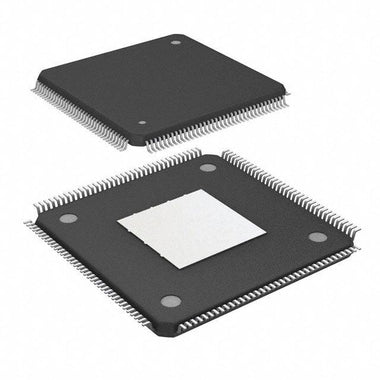
The TSSOP-28 EP package provides dedicated pins for VIN (composite video input), VOUT (buffered video output), HSYNC/VSYNC outputs, SPI interface signals (SDIN, SDOUT, SCLK, CS), and a RESET input. The exposed pad serves as both a thermal pad and analog ground connection, which should be soldered to a ground plane for optimal noise performance. For the typical application circuit, the video input requires a 75 Ω termination resistor and a 0.1 µF AC-coupling capacitor. Each power supply pin should be bypassed with 0.1 µF and 10 µF capacitors placed as close to the pins as possible, and a 27 MHz crystal with 18 pF load capacitors connects to the CLKIN pin.

AT7456E Typical Application Circuit — SPI Connection to MCU with Video Input/Output and Crystal Oscillator (Source: DFRobot DFR0515 Wiki)
4. Video: OSD Setup Tutorial
This video demonstrates how to configure the on-screen display (OSD) in Betaflight for analog FPV systems. The AT7456E chip on the flight controller overlays telemetry data—battery voltage, GPS position, flight mode, and RSSI—directly onto the pilot’s video feed. Topics include enabling OSD in Betaflight Configurator, selecting and positioning display elements, and configuring warnings and alarms for safe flight operations.
5. Equivalents, Cross-Reference, and Lifecycle
The AT7456E is currently in Active production by ZHONGKEWEI and is widely available through distributors including LCSC (part number C82351) and JLCPCB. As a drop-in replacement for the discontinued Maxim MAX7456, the AT7456E has become the de facto standard OSD chip in the drone and embedded video industries. When evaluating alternatives or planning for design flexibility, engineers should consider:
- MAX7456 (Analog Devices / Maxim Integrated) — The original OSD generator IC. While discontinued by Maxim (now Analog Devices), remaining stock may still be available. The AT7456E is fully pin-compatible and register-compatible, making migration seamless with no PCB or firmware changes required.
- AT7456 (ZHONGKEWEI) — An earlier variant from the same manufacturer without the “E” suffix. Some minor register differences may exist; verify datasheet compatibility for your specific firmware version.
- MAX7456ESA+T — The original Maxim part in SOIC-28 package variant. If your legacy design specifically requires the Maxim silicon, check availability and pricing at WWDParts.
- STM32F405RGT6 — Modern flight controllers increasingly pair the AT7456E with this popular ARM Cortex-M4 MCU for Betaflight and iNav firmware. A common companion component in FPV electronics BOM.
For designs transitioning to digital FPV systems (DJI O3, HDZero, Walksnail), the AT7456E is not required as OSD rendering moves to the digital link. However, analog FPV remains dominant in racing and budget builds, ensuring continued demand for the AT7456E. Check AT7456E Inventory & Pricing at WWDParts for current stock and lead times.
6. Frequently Asked Questions (FAQ)
Q1: What is the AT7456E, and what is it used for?
The AT7456E is a single-channel monochrome on-screen display (OSD) generator IC manufactured by ZHONGKEWEI. It overlays text and simple graphics onto a composite video signal (NTSC or PAL) via an SPI interface. The chip is most commonly used in FPV drone flight controllers to display real-time telemetry data—such as battery voltage, altitude, GPS position, and signal strength—directly on the pilot’s video feed. It is also deployed in security camera systems, industrial video monitors, and legacy AV equipment.
Q2: Is the AT7456E a direct replacement for the MAX7456?
Yes. The AT7456E is fully pin-compatible and register-compatible with the Maxim MAX7456. It uses the same TSSOP-28 EP package, identical pin assignments, and the same SPI register map. Existing firmware written for the MAX7456 (including Betaflight, iNav, and ArduPilot OSD drivers) works with the AT7456E without modification. The AT7456E is often preferred because it remains in active production while the original MAX7456 has been discontinued by Analog Devices.
Q3: What supply voltage does the AT7456E require?
The AT7456E operates from a single 3.0 V to 5.5 V power supply on the VDD pin, with a separate VDDIO pin accepting 1.65 V to 3.6 V for digital I/O level compatibility. Most FPV flight controllers supply 3.3 V to both VDD and VDDIO from the onboard regulator. Each supply pin should be bypassed with 0.1 µF and 10 µF decoupling capacitors placed close to the package for stable operation.
Q4: How many characters can the AT7456E display, and can I customize them?
The AT7456E stores 256 user-programmable characters in its on-chip EEPROM, with each character occupying a 12×18 pixel cell. In NTSC mode, the display grid is 13 rows by 30 columns (390 positions), and in PAL mode it expands to 16 rows by 30 columns (480 positions). Custom character fonts can be uploaded via SPI using tools like the Betaflight OSD font uploader or the MAX7456 Character Designer utility. Firmware like Betaflight includes pre-built font sets with flight telemetry icons, directional arrows, and battery indicators.
Q5: Why is my OSD not displaying on the video feed?
Common troubleshooting steps include: (1) verify that OSD is enabled in your firmware configurator (Betaflight > Configuration > OSD toggle); (2) ensure the video signal path is correct—camera video-out connects to the flight controller’s video-in pad, and the flight controller’s video-out connects to the VTX; (3) check that the 27 MHz crystal is properly soldered and oscillating; (4) confirm the AT7456E CS (chip select) pin is correctly connected to the MCU’s designated SPI CS output; (5) inspect solder joints on the TSSOP-28 package, as cold joints on fine-pitch pins are a common cause of OSD failure.
Q6: Where can I buy the AT7456E, and what is its current availability?
The AT7456E is widely available from electronics distributors including LCSC (part number C82351), JLCPCB, and through global distributors. At WWDParts, you can check real-time stock levels, compare pricing across suppliers, and request volume quotes. Given the chip’s active production status and widespread use in the drone industry, supply is generally stable with typical lead times of 2–4 weeks for bulk orders.