XC7K70T FPGA: Complete Technical Guide and Applications
The XC7K70T FPGA represents a pivotal breakthrough in programmable logic design, offering engineers an exceptional balance of high-performance processing and stringent power efficiency within the acclaimed AMD Xilinx Kintex-7 family. For designers tasked with building next-generation electronic components, this sophisticated device delivers exceptional parallel processing capabilities while significantly reducing overall system costs and thermal footprint. By integrating state-of-the-art transceiver technology and highly adaptable logic blocks, the XC7K70T FPGA empowers hardware developers to conquer complex bandwidth challenges across telecommunications, industrial automation, and advanced aerospace architectures.
Overview
Positioned meticulously as an entry-to-mid-range powerhouse within the broader Kintex-7 portfolio, the XC7K70T effectively bridges the historical gap between low-cost, low-density alternatives and ultra-premium programmable logic families. It specifically solves the persistent engineering problem of achieving maximum data throughput—operating at internal maximum clock frequencies of up to 1098 MHz—without exceeding the strict power and thermal budgets dictated by compact embedded system designs. Built on an optimized 28nm High-Performance Low-Power (HPL) semiconductor process, the chip eliminates the need for complex multi-chip network solutions, giving engineers a singular, integrated platform for both rapid prototyping and seamless, cost-effective volume production.
Key Specifications
- Logic Elements/LUTs: 65,600 Logic Cells, translating to 41,000 highly adaptable 6-input Look-Up Tables (LUTs).
- DSP Slices: 240 advanced DSP48E1 slices, optimized for symmetric filtering and complex mathematical algorithms.
- Block RAM: 4.86 Mb of total fast-access memory capacity, intelligently distributed across 135 dual-port 36 Kb blocks.
- Maximum I/O Pins: Up to 300 user-configurable internal standard inputs and outputs (I/Os) for massive parallel data streams.
- Speed Grade: Available in -3 (highest absolute performance), -2, -1 (standard optimal balance), and -2L (optimized for ultra-low power consumption).
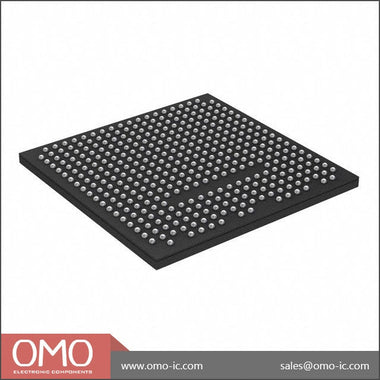
- Package Options: High-density surface-mount technology including 484-pin FBGA (23x23mm) and 676-pin PBGA/FBGA (27x27mm) packages.
- Core Voltage: 1.0V nominal supply voltage (0.97V minimum to 1.03V maximum margin), with dedicated 0.9V options for specialized low-power applications.
Key Features
- Multi-Gigabit Serial Transceivers: The architecture includes powerful GTX transceivers capable of functioning at staggering line speeds of up to 12.5 Gbps per channel. This massive serial bandwidth facilitates seamless interfacing with critical high-speed protocols such as PCI Express (PCIe) Gen2, 10 Gigabit Ethernet (10GbE), CPRI, and OBSAI, rendering it a foundational element for next-generation telecommunications networking gear.
- High-Performance DSP48E1 Architecture: The strategic inclusion of 240 tightly integrated DSP48E1 slices allows the device to execute highly complex mathematical algorithms and real-time digital signal processing with unprecedented precision. Every discrete slice features a 25 x 18 multiplier, a 25-bit pre-adder, and a robust 48-bit accumulator, drastically minimizing standard logic element usage when calculating the heavy workloads encountered in radar array processing and medical imaging hardware.
- Advanced Memory Integration and High-Speed Interfacing: Moving beyond its generous internal 4.86 Mb Block RAM footprint, the component provides native hardware-level support for high-bandwidth external memory interfaces, fully supporting rapid DDR3 memory implementations at speeds up to 1866 Mbps. These specialized integrated memory controllers dramatically lower standard read/write execution latency, ensuring that data-intensive applications such as deep packet inspection remain free of data processing bottlenecks.
- Robust Configuration and Seamless Boot Flexibility: Design engineers are granted immense architectural flexibility in determining exactly how logic gates are populated upon system initialization, utilizing comprehensive support for Master/Slave Serial Peripheral Interface (SPI), Byte Peripheral Interface (BPI), and standard boundary-scan JTAG configurations. The device fundamentally supports advanced multi-boot capabilities, securely allowing embedded systems to remotely store, verify, and switch between different configuration bitstreams on the fly.
- Military-Grade Intellectual Property Security: Protecting valuable proprietary design IP and actively preventing reverse-engineering attempts is effortlessly achieved through the device's deeply integrated AES-256 bitstream encryption and SHA-256 digital authentication protocols. These highly secure safeguards rigorously ensure that proprietary corporate designs remain completely impenetrable against unauthorized device cloning, hardware tampering, or sophisticated cyber-espionage.
- Exceptional 28nm Power Efficiency Innovations: Manufactured on the industry-leading 28nm High-Performance Low-Power (HPL) semiconductor fabrication process, the internal logic fabric employs advanced architectural techniques, including intelligent clock gating, to minimize dynamic power dissipation. By dynamically shutting down internal clock networks routed to inactive regions of the silicon die, the component realizes a holistic power footprint that is up to 50% lower than comparable previous-generation FPGA alternatives.
Industrial Applications
The highly adaptable internal architecture and vast array of customizable I/O options allow this programmable logic device to natively excel across a multitude of rigorous, highly specialized, and continuously evolving industrial sectors.
Communications and Networking
By incorporating high-speed GTX transceivers and an immensely flexible logic array, this device thrives in telecommunications environments by enabling incredibly efficient packet processing, dynamic line-rate data inspection, and seamless protocol bridging across both legacy and modern network backbones. Systems engineers frequently leverage its massive parallel processing capabilities to design robust edge network routers, advanced baseband processing units for cellular communication towers, and optical transport network interfaces. Furthermore, its ability to sustain rapid internal clock speeds ensures that high-bandwidth voice and data communication streams remain entirely bottleneck-free.
Industrial Control and Automation
In the rapidly expanding realm of industrial control and precision automation, the deterministic, ultra-low-latency processing capabilities of this programmable logic device make it the absolute ultimate solution for complex multi-axis motor control, tightly synchronized assembly line robotics, and high-speed machine vision systems deployed on the factory floor. The integrated array of DSP slices effortlessly handles the complex real-time mathematical computations required for predictive maintenance machine learning algorithms and multi-point sensor fusion. Additionally, its highly resilient, fault-tolerant architecture steadfastly guarantees the strict real-time timing constraints demanded by closed-loop industrial networking protocols.
Defense and Aerospace
Global aerospace and defense contractors consistently rely heavily on this robust, highly secure silicon architecture for vital, mission-critical applications such as advanced phased-array radar signal processing, highly secure military software-defined radio (SDR) communications, and heavily encrypted satellite telemetry data links. The profoundly vital inclusion of military-grade bitstream encryption effectively safeguards highly sensitive proprietary algorithms and classified communication protocols against aggressive physical tampering. Furthermore, due to its availability in heavily specialized extended temperature grades, the component successfully performs flawlessly in the harsh environmental conditions typically encountered in high-altitude aviation.
Development Tools and Getting Started
Designing, comprehensively simulating, and successfully deploying complex configuration bitstreams for this logic device is accomplished primarily through the powerful AMD Xilinx Vivado Design Suite, which presently represents the unquestioned industry gold standard for modern programmable logic development environments. While engineers working with alternative silicon ecosystems might utilize Intel's Quartus Prime or Lattice's Diamond software, those targeting the Kintex-7 family rely heavily on Vivado’s ultra-modern, visually intuitive IP-centric design flow. This sophisticated toolchain drastically accelerates time-to-market by utilizing advanced High-Level Synthesis (HLS) capabilities, allowing hardware engineers to write complex algorithms in C or C++ and compile them into optimized HDL without manually authoring thousands of lines of low-level Verilog code.
For multifaceted engineering teams actively looking to aggressively accelerate their initial physical prototyping phases, intelligently leveraging official evaluation boards—such as the highly regarded KC705 Kintex-7 FPGA Evaluation Kit—is an incredibly wise and cost-effective starting point. These comprehensive hardware platforms come fully populated with the necessary stable power delivery networks, high-speed external memory modules, and vastly varied I/O physical connectors (such as high-density FMC slots and Gigabit Ethernet ports) required to thoroughly test the customized logic fabric in real-world conditions immediately. Additionally, developers gain entirely unfettered access to an expansive library of pre-verified Intellectual Property (IP) cores, covering everything from fundamental AXI bus interconnects to complex DSP compiler blocks.
When actively embarking on a completely new custom printed circuit board (PCB) layout designed to house this sophisticated chip, dedicated design teams must pay incredibly close attention to vital hardware design flow steps, such as achieving strict digital timing closure, ensuring proper power distribution network (PDN) decoupling, and implementing diligent thermal management solutions. The exceptionally high toggle rates strictly demand meticulously routed, impedance-matched PCB traces to preserve critical signal integrity, especially when routing the highly sensitive 12.5 Gbps GTX transceiver communication lines. Utilizing Vivado's deeply integrated power estimator during early logic synthesis allows systems engineers to accurately predict worst-case operational heat dissipation, comprehensively ensuring that the physical hardware remains definitively stable.

Where to Buy XC7K70T
Sourcing XC7K70T FPGA components reliably requires a trusted distributor with verified inventory. WWDParts specializes in the complete Kintex-7 series — including all speed grades and package variants of the XC7K70T. We offer competitive pricing, authenticity guarantees, and fast global shipping to support your production schedules. Browse XC7K70T inventory at wwdparts.com for real-time stock and pricing.
Conclusion
To comprehensively summarize, the XC7K70T FPGA remains an exceptionally powerful, functionally versatile, and highly adaptable programmable silicon solution, granting seasoned design engineers the absolute perfect synthesis of logic array density, high-speed transceiver performance, and steadfast energy efficiency. Whether your engineering team is actively prototyping a cutting-edge aerospace communication module, developing sophisticated medical imaging hardware, or scaling up production for industrial networking edge devices, successfully securing authentic components is absolutely vital. Trust the dedicated industry component experts to securely fuel your ongoing digital innovation, and visit wwdparts.com to confidently source your specialized programmable logic components and accelerate your hardware deployment today.

Alan Carter
Senior Hardware Engineer & Component Specialist
Alan has over 15 years of expertise in embedded systems design, FPGA architecture, and global semiconductor supply chains. He specializes in component cross-referencing, lifecycle management, and helping OEMs navigate supply shortages.